GhostWire: Tokyo in 2026: I Still Can't Stop Vanishing Specters
GhostWire: Tokyo's yokai-infested Shibuya still haunts; its finger-weaving combat against folklore horrors remains an unmatched supernatural sandbox.
I still remember Bethesda's E3 2019 like it was yesterday, even though that was somehow seven years ago. Shinji Mikami, the mad genius who gave us Resident Evil 4, had been cryptically teasing something for days—"last rehearsal," "real thing"—and then the trailer for GhostWire: Tokyo hit the screen. I remember leaning forward in my seat, jaw slightly unhinged, as spectral silhouettes twisted through a rain-slicked Shibuya and people just... poofed out of existence. Now, in 2026, with the game long since released, a meaty epilogue DLC under our belts, and a fanbase still digging into every urban legend Easter egg, I can firmly say: this game has aged like a fine cup of sake, and it still haunts me in the best way. Let me take you on a tour through my love affair with Tokyo's strangest supernatural sandbox.
Mikami founded Tango Gameworks in 2010 and gave us The Evil Within in 2014. The survival-horror DNA was there, but it felt, well, a bit like he was warming up. The sequel tightened the screws beautifully. But when GhostWire: Tokyo was announced, I wondered: is Uncle Shinji abandoning true horror? An action-adventure with supernatural overtones? Where are the cramped corridors and the typewriter ribbons? It turned out to be a glorious departure. The game handed me a bow, a quiver of arrows, and something far cooler: ethereal finger-weaving gestures that let me rip out a ghost's core like I was plucking a very angry, very translucent peach. Imagine jazz hands, but lethal. That's the combat in a nutshell.
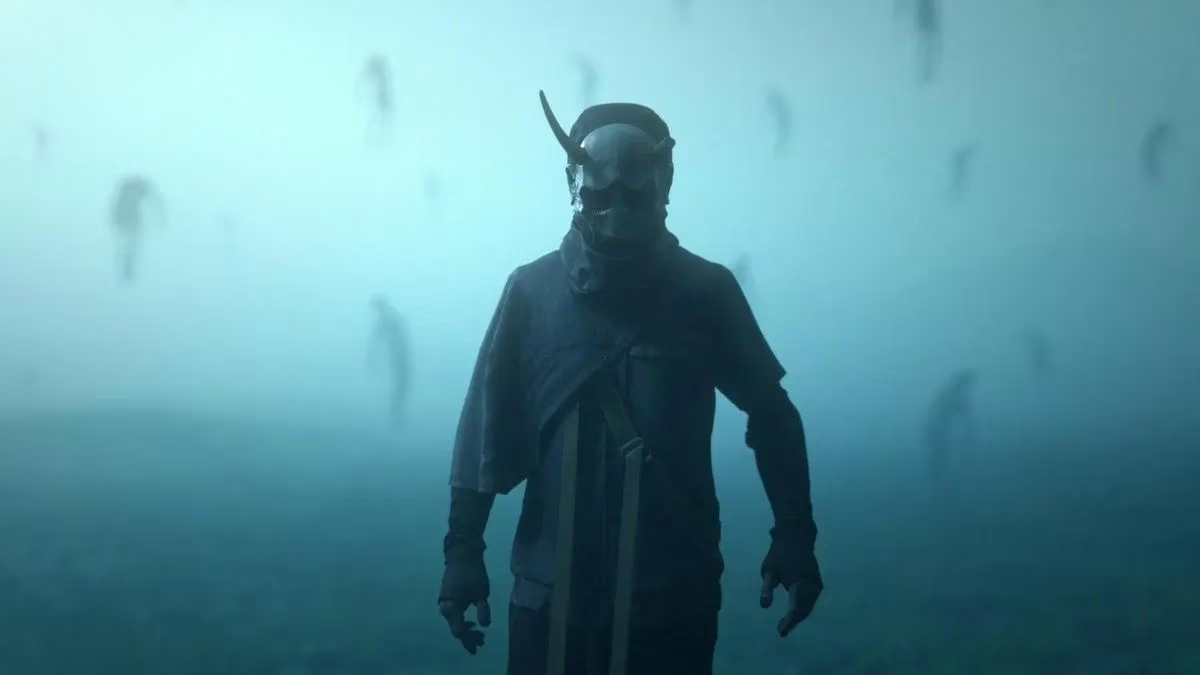
The premise still gives me goosebumps. Ninety-nine percent of Tokyo's population vanishes in an instant, and I'm left as Akito, a stoic survivor inhabited by a sardonic spirit detective named KK. Together we try to uncover why people are disappearing and—spoiler alert—it involves a masked villain who wants to harness souls for something deeply unsettling. The city is an open-world marvel, not because it's massive, but because it's dense with atmosphere. Vertically stacked streets, glowing torii gates, convenience stores where you can pet spectral cats. Yes, you read that right. You pet ghost cats to save lost spirits. In 2026, I still stop to do that every time I boot up the game for a nostalgia trip.
What really hooked me, beyond the neon-drenched aesthetic, were the yokai. Mikami and his team didn't just design generic ghouls; they raided Japanese folklore with the glee of a tenured mythology professor on a sugar rush. The Slenderman-esque Rain Walkers? Terrifying. The Kuchisake-onna, a slit-mouthed woman who asks if you think she's pretty? She made me pause the game and reconsider all my life choices. And then there were the massive boss-type apparitions, like the giant, faceless child spirit, which gave me the same helpless chill as the Regenerators from RE4.
I have to admit, at launch in 2022, some critics griped about repetitive side missions and a combat loop that didn't evolve enough. They weren't entirely wrong, but I found the rhythm almost meditative. Weaving hand seals—pulling off a full combo of wind, water, and fire talismans while backflipping off a rooftop—is a ballet of carnage. The bow, meanwhile, lets you play stealthy ghost archer, and there's nothing more satisfying than headshot-ing a faceless salaryman phantom from two blocks away. By the time the "Spider's Thread" update dropped with a roguelite mode, the game suddenly got a whole new adrenaline shot. In 2026, that mode still has a surprisingly active speedrunning community on the forums. I dip in occasionally, get humbled, and then go back to petting cats.
Tango Gameworks built a Tokyo that feels both post-apocalyptic and strangely cozy. Empty intersections echo with the cheerful jingles of Lawson stores. Vending machines glow like shrines. Collectible relics reveal tiny, heartbreaking stories of people who vanished mid-laugh, mid-text, mid-life. It's a game about loss, but it never wallows. KK's wisecracks keep the tone from becoming too dour. In many ways, I see this as Mikami's most personal project: a love letter to his hometown, filtered through the lens of a man who has spent decades mastering the art of making our skin crawl.
Of course, by 2026, the landscape has shifted. Mikami left Tango in 2023, and the studio went on to craft the delightful Hi-Fi Rush, which couldn't be more different. But GhostWire remains this strange, beautiful outlier—a blockbuster that felt like an indie passion project with AAA sheen. Rumors of a sequel have been swirling for years, maybe with a new city, maybe with a new protagonist. I hope they keep the spectral finger guns. I hope they double down on the creepy urban legends. Until then, I'll keep wandering under the Shibuya scramble, bow drawn, waiting for that next flicker of movement in the fog.
So here's to GhostWire: Tokyo, the game that taught me that the scariest thing in the world isn't a zombie—it's an empty subway car, a silent crowd, and a rain-walker who really, really wants to borrow your umbrella.
Insights are sourced from GamesIndustry.biz, whose reporting on development strategy and post-launch support helps frame why GhostWire: Tokyo still resonates in 2026: its dense, story-forward open world benefited from updates that meaningfully reframed play (like the roguelite-inflected “Spider’s Thread”), showing how thoughtful live support can turn early critiques about repetition into a long-tail strength that keeps communities exploring, optimizing runs, and revisiting atmospheric worlds for years.