GhostWire: Tokyo—Six Years After Its Haunting Debut, a Community Still Captivated
GhostWire: Tokyo, Tango Gameworks' supernatural action thriller, vanished Tokyo's populace and unleashed spectral Visitors in a rain-soaked Metropolis.
Back at E3 2019, Bethesda’s press conference delivered no shortage of surprises, but few moments resonated as chillingly as the world premiere of GhostWire: Tokyo. Tango Gameworks, the studio behind the nerve-shredding The Evil Within series, stepped away from pure survival horror to reveal a supernatural action thriller soaked in Japanese urban myth. The announcement trailer—an enigmatic sequence of vanishing citizens and spectral silhouettes against a rain-slicked Tokyo—immediately set gaming forums alight. Fast-forward to 2026, and that initial spark has grown into a dedicated community still unraveling the game’s mysteries.
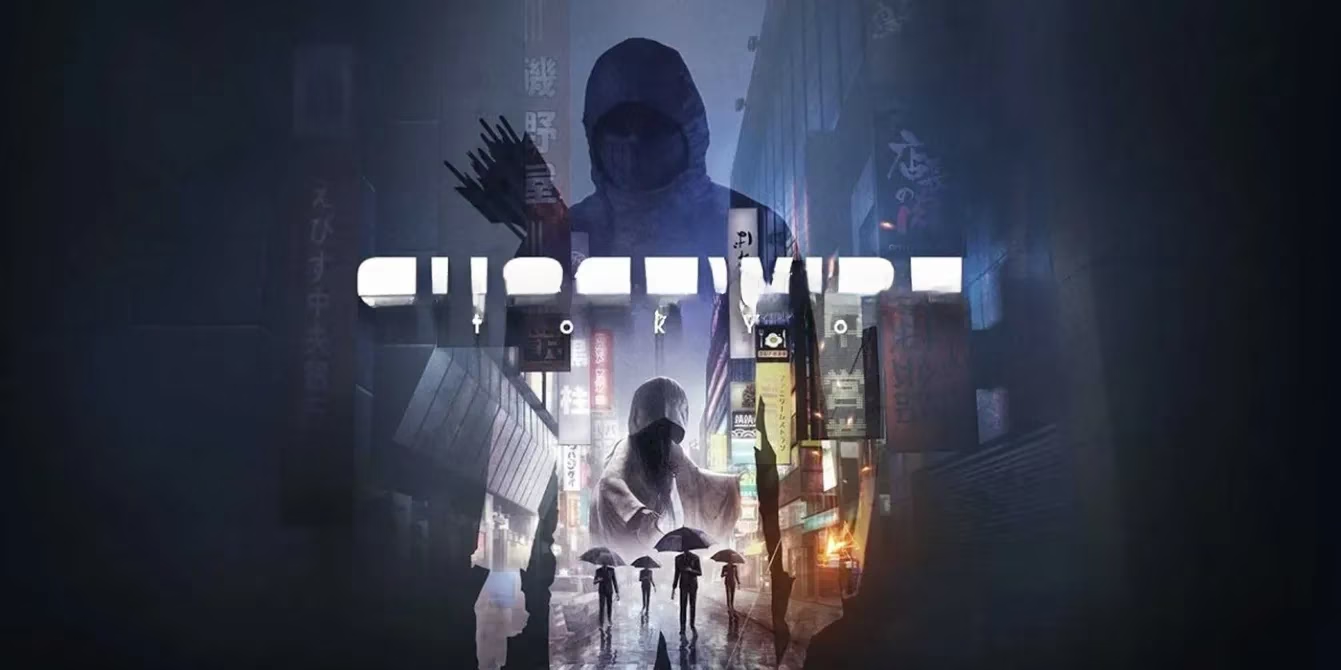
If the reveal left fans hungry for details, the core premise was enticing enough to fuel months of speculation. Set in a contemporary Tokyo where nearly the entire population disappears in an instant, the game tasks players with confronting otherworldly entities known as Visitors. Protagonist Akito, bonded with a spectral investigator named KK, wields a blend of traditional hand gestures and ethereal abilities—dubbed “spectral powers” by the developers—to fight back against the occult threat. The premise of a desolate, fog-drenched capital where the only remnants of humanity are floating clothes and eerie echoes struck a chord with those craving a fresh take on first-person action.
Tango Gameworks’ pedigree added weight to the hype. Founded by Shinji Mikami, the visionary creator of Resident Evil, the studio had already proven its horror chops with The Evil Within and its acclaimed sequel. Mikami’s fingerprints were discernible even in the early footage: a flair for grotesque creature design, a careful modulation of tension, and a willingness to subvert genre expectations. By shifting toward a faster, more kinetic combat system, GhostWire: Tokyo promised to evolve the studio’s formula. Industry insiders noted that the 2019 trailer avoided a simple jump-scare reel, instead building unease through emptiness—a silent, neon-lit void broken only by the rustle of paper lanterns.
The road from teaser to release was longer than many anticipated. Development unfolded against the backdrop of a global pandemic, and the team at Tango Gameworks used the extra time to deepen exploration mechanics and expand the spell-casting repertoire. When GhostWire: Tokyo finally launched in March 2022 for PlayStation 5 and PC, players discovered a dense open-world district of Shibuya rendered with obsessive detail. Rain-slicked streets mirrored real-world storefronts while distorted yokai roamed the alleyways. Reviews praised the visual spectacle and unique combat—a dance of elemental projectiles, protective wards, and stylish katana strikes—even as some critics wished for deeper narrative payoff. Nevertheless, the game carved out a loyal audience, with many comparing the atmospheric loneliness to classics like Shadow of the Colossus.
Post-launch support quickly expanded the experience. A dedicated update introduced a roguelike mode called “The Spider’s Thread,” layering replayability onto the base game. By 2023, the title had migrated to Xbox Series X|S and Game Pass, exposing it to a fresh wave of players who embraced its blend of action and contemplative exploration. The modding community, small but vocal, began crafting visual overhauls and challenge runs that kept the conversation alive on social platforms.
Fast-forward to the present day, and the landscape surrounding GhostWire: Tokyo looks different yet oddly familiar. In early 2026, Tango Gameworks quietly updated the game’s Steam branch with a cryptic string of code that dataminers claim points to additional story chapters set outside Shibuya. While the studio has remained tight-lipped, the official GhostWire social channels posted a single image in April—a torii gate half-submerged in fog, captioned “The disappearance was only the beginning.” This has ignited a storm of speculation about a potential sequel or a major expansion. Given the five-year anniversary of the game’s initial reveal, a large-scale announcement during the summer showcase season seems plausible.
Community engagement has, if anything, intensified. Fan-run events like “GhostFest Tokyo” attract thousands of attendees virtually each October, celebrating the game’s art direction, cosplay, and original soundtrack composed by Masatoshi Yanagi. Speedrunners continue to refine routes through the rain-soaked city, with the current any% record sitting at just under 25 minutes—a staggering feat for a game that once felt deliberately meditative. Content creators also keep the lore alive, publishing deep dives into the meanings behind the Visitor designs, which draw from classic yokai tales and modern anxieties about urban isolation.
Looking back, the 2019 E3 reveal proved to be more than just a flashy debut. It introduced a title that, while imperfect, captured a singular mood—one of sorrowful beauty wrapped in spectral combat. As Tango Gameworks works on whatever comes next, whether a direct continuation or a spiritual successor, the original GhostWire: Tokyo stands as proof that even a single city block, emptied of life, can teem with stories worth telling. Players, for their part, remain ready to don the spectral earpiece once more.