GhostWire: Tokyo – Six Years Later, Its Supernatural Pulse Still Echoes
GhostWire: Tokyo’s horror-action spectacle pits spectral gestures against eerie yokai in a Tokyo frozen mid-vanishing.
When Shinji Mikami unveiled his latest brainchild at E3 2019, the gaming world was instantly hypnotized. Now, in 2026, GhostWire: Tokyo has long since carved its place in the horror-action canon, but the neon-drenched alleys and spectral whispers of its alternate Tokyo still cling to the imagination like the scent of incense after a thunderstorm. The game’s journey—from a mysterious PlayStation 5 exclusive to a cult classic that defied easy labels—is a testament to how a bold vision can turn a vanishing city into an unforgettable playground.
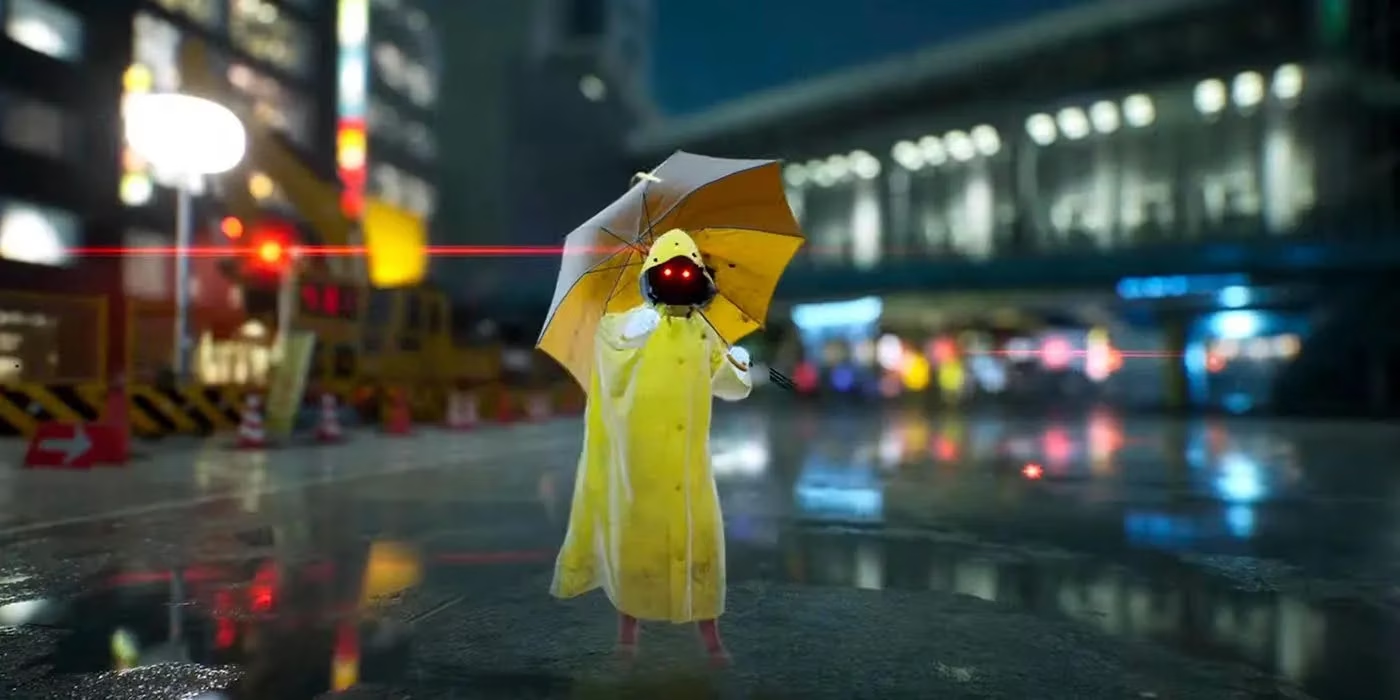
From the very first cryptic teaser, GhostWire: Tokyo promised something different. Set in a version of Japan’s capital where 99% of the population has vanished in an instant, players step into the shoes of a lone survivor who wields "spectral abilities"—a hand choreography that weaves elemental powers directly from the spirit realm. Combat unfolds like a calligrapher’s duel at 3 a.m., where kanji become both bullet and barrier, and every gesture feels less like a button press and more like a séance directed by a techno-shaman. The original 2021 launch on PS5, followed later by its arrival on Xbox Series X|S and PC, introduced players to a rogues’ gallery of urban yokai: faceless businessmen who drift through Shibuya like living negative space, headless schoolgirls who giggle in decaying arcades, and the impossibly tall Slenderman-esque figures that epitomize the game’s quiet dread.
The visual language of GhostWire: Tokyo remains its strongest weapon. The city itself is a character frozen mid-breath—umbrellas lie abandoned on crosswalks, trains idle with doors agape, and entire skyscrapers flicker between solid reality and an eerie spectral overlay as if the whole metropolis is a photograph slowly being developed in a darkroom of ghosts. Visceral contrasts define the atmosphere: the sterile hum of a Famichiki sign next to a splatter of otherworldly blue fire, the juxtaposition of futuristic skyline with ancient torii gates that swallow light. This friction, where hyper-modernity scrapes against centuries-old folklore, gives the game the texture of a forgotten dream retrieved from a corrupted memory card.
The road to release, however, was not entirely smooth. In 2019, charismatic creative director Ikumi Nakamura became a fan favorite overnight with her infectious energy during Bethesda’s E3 showcase, but her departure later that year left a creative vacuum. Industry rumors at the time suggested it could derail the project, but Mikami’s Tango Gameworks steadied the ship, steering GhostWire away from pure horror toward a more open-world, action-adventure rhythm. This shift polarized early viewers: some praised the new combat-focused trailer as “disturbing and awesome,” while others lamented that it looked too “indie” or too reminiscent of Skyrim’s spell-slinging in first-person. The truth landed somewhere in the middle—GhostWire: Tokyo is a nontraditional horror game that patiently builds tension not through jump scares, but through the slow-motion dread of walking through a city where you are both the hunter and the haunted.
By 2026, the game has aged like a well-preserved time capsule from the early PS5 era. The post-launch updates, including the “Spider’s Thread” roguelike mode added in 2023, expanded the combat sandbox with new talismans and co-operative challenges, breathing fresh life into the desolate streets. Modding communities on PC have taken the city’s framework and twisted it further—adding weather systems that make rain freeze midair, or populating the emptiness with friendly ghosts that wave from windows. A quiet but devoted community now hosts annual “Ghostwire midnight walks,” where players livestream their explorations without HUD, treating the game as a piece of ambient theater.
The sequel chatter, once floated by developers who speculated about "different cities," has matured into confident whispers. While Tango Gameworks has not officially confirmed GhostWire: Kyoto or GhostWire: New York, job listings as recent as 2025 hint at a next-gen sequel that might build on the original’s mythos with a more intricate karma system. If GhostWire: Tokyo taught us anything, it’s that a city is never truly empty—it just waits for someone to listen to its echoes.