GhostWire: Tokyo’s Journey: From E3 2020 Tease to a Haunting Masterpiece
Pete Hines’ 2020 tease of a parallel between GhostWire: Tokyo and DOOM Eternal turned out to be their shared aggressive mobility and rhythmic combat.
It’s hard to believe that one of the most talked-about snippets of gaming news back in early 2020 came from a podcast conversation. Gamers were still waiting to see what Tango Gameworks had been cooking up ever since the studio, led by the legendary Shinji Mikami and directed by the charismatic Ikumi Nakamura, first teased GhostWire: Tokyo at Bethesda’s E3 showcase the year before. The silence since that reveal had been deafening. Was the project in trouble? Was it being reworked? Enter Pete Hines, Bethesda’s Senior Vice President of Global Marketing and Communications at the time, who dropped a few key nuggets during an episode of Kinda Funny’s We Have Cool Friends. He promised the game would appear at E3 2020, and he even hinted at some bizarre connective tissue with DOOM Eternal, of all things. Looking back from 2026, those promises turned out to be a lot more than just PR fluff.
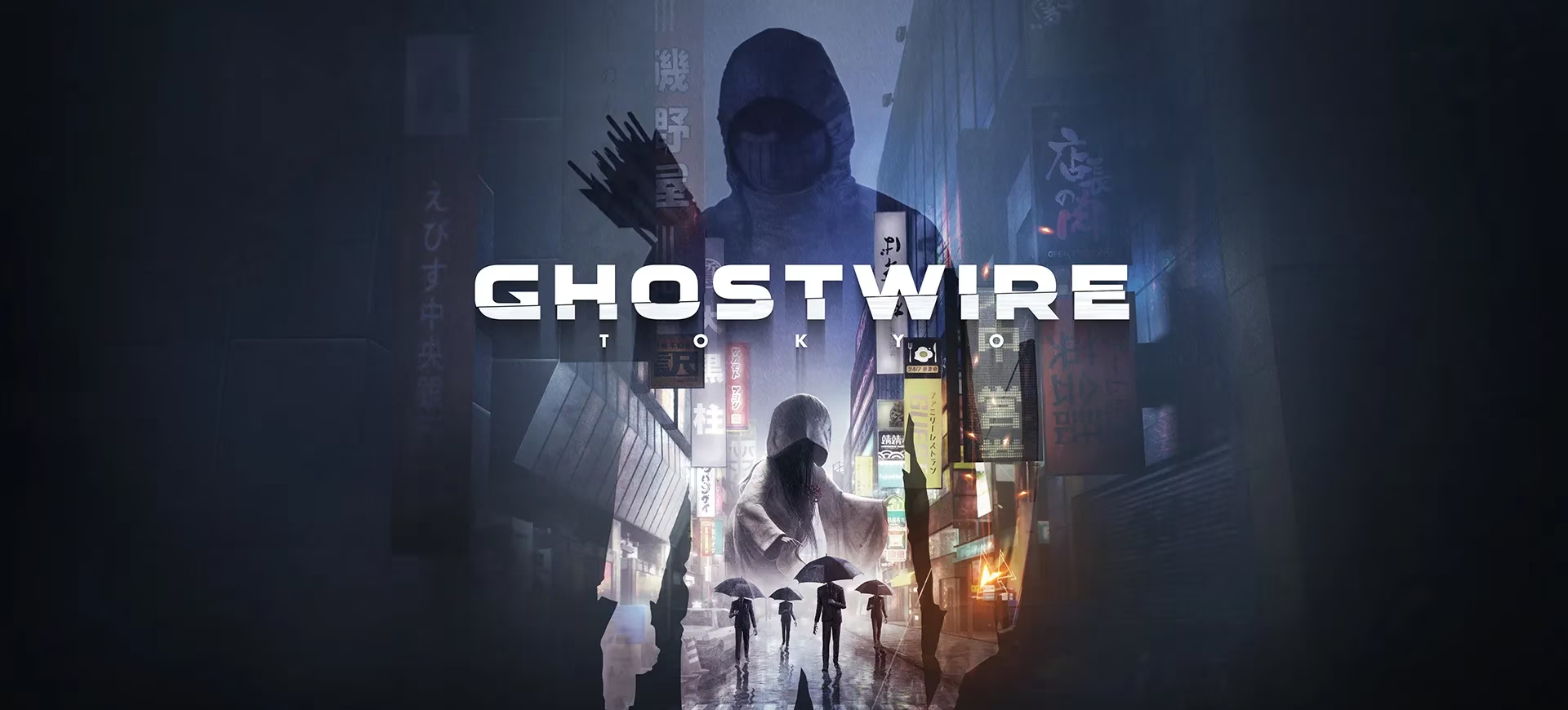
Hines didn’t just confirm an E3 appearance; he also insisted there was a fascinating parallel between GhostWire: Tokyo and DOOM Eternal, saying he would explain once the game was shown. “I won’t say anything now, but it does have an interesting parallel to DOOM Eternal that I’ll talk to you about once we show GhostWire,” he teased. At the time, that remark sparked a frenzy of speculation. Did it mean the games share a universe? Could there be Rip and Tear energy in the middle of a neon-lit, rain-slicked Tokyo? The internet’s theories ranged from the plausible to the outright ludicrous. But anyone who played both titles eventually noticed the connection: it was all about aggressive mobility and a rhythmic dance of combat. Where the Doom Slayer moved forward relentlessly to crush demons with brute force, Akito in GhostWire: Tokyo used ethereal hand gestures to weave through spectral threats, constantly repositioning while unleashing elemental powers. It was a mirror image—two approaches to the same first-person adrenaline pump, one with bullets and rage, the other with finger-snap incantations and spiritual cleansing.
That E3 2020 event arrived in a summer still unsettled by a global pandemic, and it was a digital-only showcase that nonetheless delivered an extended gameplay deep dive for GhostWire: Tokyo. The presentation revealed a stunningly atmospheric Tokyo where nearly all citizens had vanished, leaving behind only their clothes and a malevolent fog. The city was overrun by folkloric creatures like the Kuchisake-onna and headless schoolgirls, and players would step into the shoes of Akito, a young man fused with a spectral detective named KK. From that moment, the game’s identity became clear: part open-world investigation, part supernatural brawler, with a strong focus on vertical exploration using a grappling hook-like ability. The combat, as Hines had hinted, felt strangely familiar yet entirely original. Instead of a shotgun, you’d weave hand seals to conjure wind blades, water streams, and fireballs, all while dodging enemy attacks with a fluid, almost dance-like tempo. Anyone who had spent hours in DOOM Eternal’s arenas could feel that same “zone” where movement and attack become one seamless flow.
Fast forward to March 2022, and GhostWire: Tokyo finally landed on PlayStation 5 and PC, with an Xbox release following after the timed exclusivity window. Critics praised its captivating art direction and the sheer eeriness of an empty Shibuya, but opinions were split on the repetitive side activities and lack of a deep narrative payoff. However, by 2026, the game has earned a cult status. The post-launch updates, including the massive “Spider’s Thread” roguelike mode and new story chapters, expanded the experience in ways that addressed many early criticisms. Fans continue to debate whether the game could have been a true masterpiece if it had launched with that extra content. Was it too ahead of its time? Perhaps. Its blend of atmospheric horror and action-focused gameplay was never going to please pure horror fans or adrenaline junkies exclusively, but that’s precisely why it stands out in Tango Gameworks’ catalog.
And what about that promise from Pete Hines? True to his word, after the game’s full reveal, he elaborated in subsequent interviews that the parallel was indeed about the “combat loop philosophy.” Both games reject hiding behind cover. They push the player forward, reward constant movement, and build encounters around a cycle of weakening enemies and then delivering a satisfying finisher. In DOOM Eternal, it was a glory kill. In GhostWire: Tokyo, tearing out a visitor’s core after exposing it with charged attacks had the exact same cathartic punch. Hines had spotted the shared DNA long before anyone else could.
In 2026, GhostWire: Tokyo stands as a curious case study in how Bethesda’s marketing machine could generate long-lasting intrigue. Sure, E3 as we knew it is now a memory, but the conversations it sparked continue to enrich how we interpret Tango Gameworks’ efforts. Should we have paid more attention to Hines’ cryptic remarks? Definitely. Could any of us have predicted that a game about cleansing spirits with hand gestures would sit comfortably alongside the most visceral shooter of the decade? Probably not. But that’s exactly the sort of delightful surprise that keeps gamers glued to every podcast hint and teaser trailer. In the end, the spectral streets of Tokyo left behind a legacy far more tangible than the fog that once consumed them.