How Star Wars Outlaws Chose Heart Over Algorithms to Build Its Universe
Star Wars: Outlaws features handcrafted planets inspired by Assassin's Creed: Odyssey zones, prioritizing quality over procedurally generated worlds.
When Bethesda’s Starfield promised over a thousand planets to explore in 2023, a lot of eyebrows shot up. The sheer scale sounded almost too good to be true—and for many players, the initial thrill was quickly dampened by the (\textit{wait-wasn’t-this-cave-identical-to-the-last-three}) feeling of procedural generation. So when Massive Entertainment stepped up to the plate with Star Wars: Outlaws, fans held their breath. Would this be another galaxy of copy-paste rocks? Thank the maker, no. Instead, the team behind Outlaws decided to build their worlds the old-fashioned way: with blood, sweat, and a whole lot of handcrafted love. 🌌
Way back in 2023, creative director Julian Gerighty sat down with Edge Magazine and let everyone in on a little secret that felt like a rebel victory against the growing trend of AI-driven landscapes. “It’s a crude analogy,” he admitted, “but the size of one planet might be [equivalent to] two of the zones in Assassin’s Creed: Odyssey.” Now, if you’ve ever roamed the hills of Attika or got lost in the sprawling streets of Athens, you’d know that’s no small potato. Gerighty clarified: “It could be two to three zones. But it’s not this sort of epic ‘the whole of England recreated’ approach.” Talk about a breath of fresh Tatooine air.
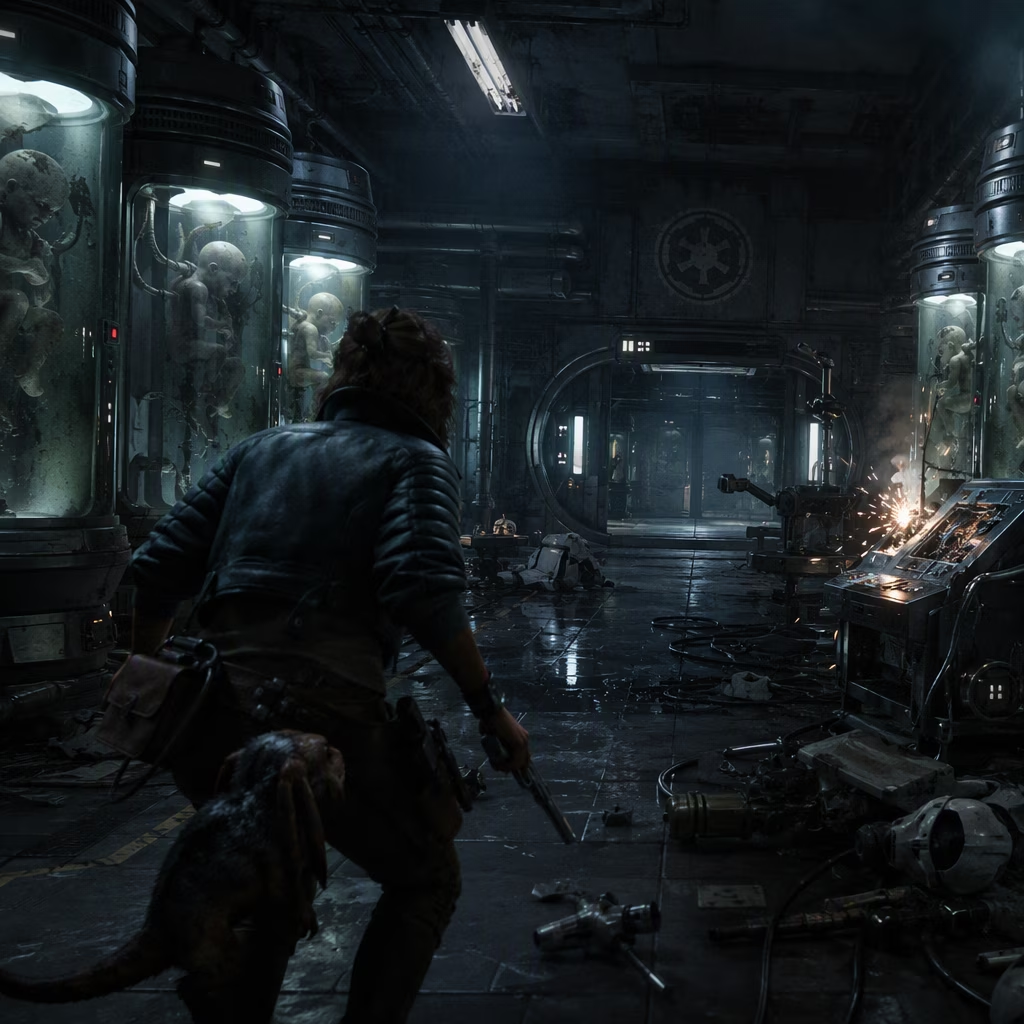
This vision translates into a galaxy that doesn’t overwhelm you with empty miles. Star Wars: Outlaws takes place in that tantalizing timeline between The Empire Strikes Back and Return of the Jedi—a period where the underworld thrived and scoundrels like Kay Vess could actually carve out a name for themselves. Kay isn’t some Jedi with destiny on her shoulders; she’s a sharp-witted outlaw chasing one big score that could set her up for life. And she never travels alone. Her constant companion is Nix, an axolotl-like alien critter that fans latched onto faster than a Kowakian monkey-lizard on a shiny object. 🦎
But back to those planets. Massive’s idea wasn’t just about dodging the Starfield template; it was about respecting the player’s time. Imagine walking into a bar on a forest moon and actually recognizing the bartender from three systems ago because the devs (\textit{purposely}) wove a side story through multiple locations. Handcrafted zones in Assassin’s Creed: Odyssey were packed with secrets, hidden tombs, and quests that felt organic rather than spat out by a number cruncher. If one planet in Outlaws truly offers two to three of those dense zones, then each landing could offer 20 to 30 hours of meaty exploration without a single “radiant quest” feeling tacked on.
Here’s the kicker, though. Gerighty never specified exactly how many planets would dot the map, and even now, in 2026, the community still debates whether the final count was a modest five or a generous dozen. What we got, however, was a clear message: quality over quantity. The streets of Canto Bight, the dusty outposts on Toshara—every settlement feels like a miniature diorama where the devs painstakingly placed each moisture vaporator and cantina table. No two alleys look the same. No random outpost leaves you thinking you’ve walked through a time loop.
Comparing Outlaws to Starfield isn’t simply a matter of slamming one for the other. Bethesda’s cosmos had its own magic, especially in the handcrafted hubs like New Atlantis, and the sheer scale meant someone with a love of deep-space isolation could find bliss on a barren moon nobody else ever visited. But for a story-driven adventure set in the Star Wars universe—a place that lives and breathes through its characters, its lived-in sci-fi aesthetic—handcrafted density was the right call. Massive dodged the (\textit{wide-as-an-ocean-deep-as-a-puddle}) pitfall so many open worlds stumble into.
And let’s be honest, nobody wanted to land on Coruscant only to discover it was just a landing pad and a procedurally scattered crate. The reaction from players in 2024 and 2025 proved the formula worked: forums lit up with screenshots of unique graffiti, alien cuisine stalls that told small visual stories, and dynamic events that genuinely surprised veterans. The game’s map mirrors the philosophy that “manageable” can still be epic. As Gerighty put it, no one was trying to recreate an entire country; they were constructing a lived-in neighborhood where every corner mattered.
So, as we look back from 2026, Star Wars: Outlaws stands as a testament to the power of saying “no.” No to endless terrain vomited out by a machine. No to planets that feel like wallpaper patterns. Yes to a galaxy that, while smaller on paper, feels infinitely larger in your memory. After all, in a universe full of possibilities, it’s the hand-placed details that make you want to shout “I have a good feeling about this!” And really, isn’t that what a Star Wars experience should do? 🚀