How Star Wars Outlaws' Hand-Crafted Planets and 70s Vibe Redefined Open-World Freedom
Star Wars Outlaws opts for hand-crafted open worlds over procedural generation, with planets akin to two to three Assassin's Creed Odyssey zones.
Back in the summer of 2023, when Ubisoft and Massive Entertainment first pulled back the curtain on Star Wars Outlaws, it felt like a dream finally taking shape. By the time the game landed in 2024, that dream had become a sprawling, galaxy-hopping reality that players are still sinking their teeth into here in 2026. What made the reveal so exciting wasn’t just the promise of another open-world title—it was the way the team talked about building those worlds. Not with cold, random algorithms, but with the warm, meticulous hands of artists who treat each rock and cantina like it's a love letter to the original trilogy.
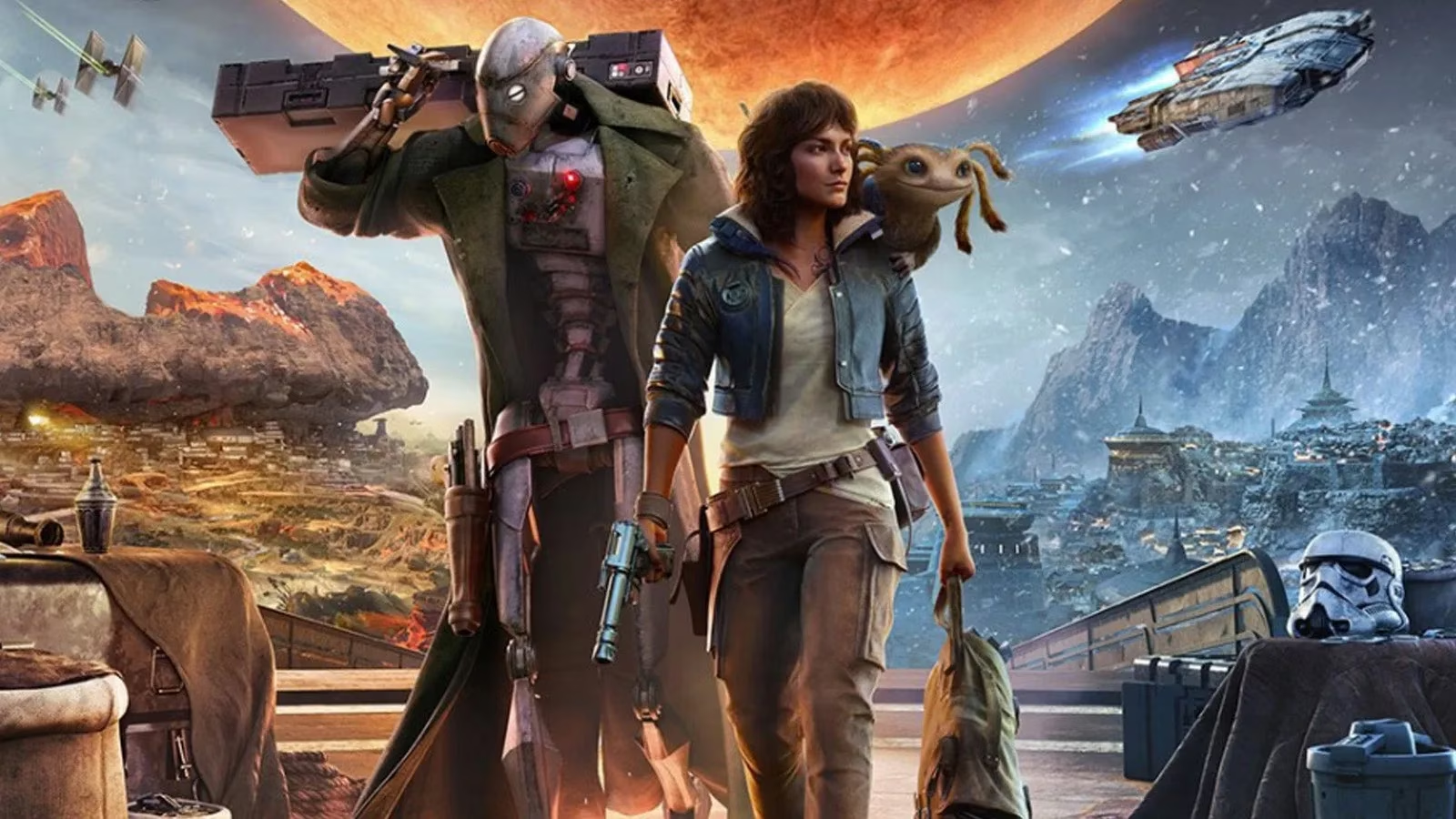
Creative director Julian Gerighty gave an interview at the time that still echoes through community discussions. He dropped a comparison that helped everyone visualize the scale: one planet in Outlaws is roughly the size of two, maybe three, of the zones found in Assassin's Creed Odyssey. That’s a far cry from the continent-sized maps some feared or the entire-planet simulations others expected. “It’s a crude analogy,” Gerighty admitted, “but it's not, you know, this sort of epic ‘the whole of England recreated’ approach.” There’s something wonderfully honest in that. Instead of trying to serve up an entire globe that would inevitably feel shallow, Massive chose to craft bespoke slices—manageable, intimate, and absolutely devoid of procedural generation hand-waving.
You can almost hear the planets themselves breathing. Toshara’s windswept savannahs, Kijimi’s frozen alleyways, and Akiva’s lush jungles all feel like they have a stubborn personality that refuses to be cloned. Heck, a droid merchant on Tatooine won't just sell you the same generic junk you’d find on another world; his wares reflect the desperation of that particular dustball. That’s the hand-crafted difference. The team didn’t just plop down assets; they sculpted a lived-in feeling, where the geometry of a canyon or the scuff marks on a landing pad tell a story. And because no planet is procedurally bloated, you’re never stuck riding a blurrg across empty nothingness for ten minutes just to reach the next interesting bit. Every corner has a reason to exist.
Naturally, the conversation in 2023 kept looping back to another big space RPG that was on the horizon—Starfield—which proudly leaned into its 1000-plus procedurally generated planets. Gerighty was quick to clarify Outlaws’ own stance: “We haven't procedurally generated an entire planet.” The air quotes practically wrote themselves. This wasn’t a dig at other games; it was a statement of intent. Each world here is a handcrafted diorama you can practically hold in your palm. And, oh boy, does it show when you’re sneaking through an Imperial garrison and noticing that every ventilation shaft, every officer’s desk clutter, was placed by someone who stayed up late thinking about 1970s sci-fi set design.
Speaking of the Empire, space itself isn't just a glorified loading screen. When you blast off in the Trailblazer, you enter a bubble of near-orbit freedom around each planet or moon. You can swerve through asteroid fields, get pulled out of hyperspace by Imperial patrols, and engage in dogfights that feel tense and clunky in that charmingly analog Star Wars way. But—and this is the kicker—you can’t just skim over jungles and dive into canyons freely. You pick a landing zone from orbit and transition down. It’s a deliberate constraint that keeps the surface-level environments dense and purposeful, rather than an endless, half-baked terrain.
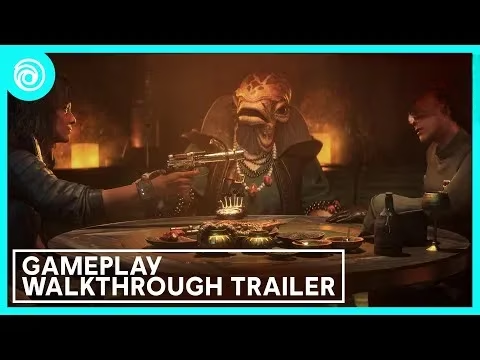
The open-world philosophy extends far beyond geography. During that Ubisoft Forward demo, Kay Vess approached an Imperial officer with a choice: slide some credits under the table or find a ventilation shaft and a dark corner for a more permanent negotiation. That moment became a microcosm of the entire experience. “We're really focusing on what ‘open world’ means to the player, which is full freedom of approach,” Gerighty said. And the thing is, the game actually trusts you to get creative. Maybe you’ll cause a distraction with Nix, your merqaal companion, to pickpocket a keycard. Maybe you’ll climb three stories of crumbling architecture and snipe the entire patrol from the rafters. Or maybe you’ll just waltz in with your reputation so high that the officer waves you through with a nervous chuckle.
What ties all this freedom together is an overwhelming commitment to a specific cinematic mood. Gerighty spoke about recreating the lenses of the original 1970s films—vignetting, film grain, lens breathing, that subtle curvature of a thicker lens, and those tiny flares that catch the corner of a screen. It’s the kind of detail that sneaks up on you. One moment you’re admiring a binary sunset, and the next you realize your eyes are watering not from emotion but from the soft, analog glow that makes everything feel tangible. Massive, a studio known for the crisp urban realism of The Division, ended up crafting the most tactile Star Wars experience since the original trilogy wrapped up. They put film grain on your blaster fire, for crying out loud. That’s the sort of obsession that turns a great game into an enduring love letter.
So here in 2026, with a couple of years of dust settled on the sabacc tables, Star Wars Outlaws still stands as a testament to the power of saying “no.” No to infinite procedural sprawl. No to seamless but empty surface-to-space transitions. Yes to planets that feel more like curated museum exhibits—except you can shoot the exhibits and steal their speeders. Yes to freedom that isn’t just about where you go, but how you choose to exist in a galaxy that remembers the 1970s as fondly as it does the Force itself.
| Feature | Outlaws Approach | Typical Open-World Trend |
|---|---|---|
| Planet Creation | Hand-crafted, bespoke zones | Procedural generation for scale |
| Map Size per Planet | 2–3 Assassin's Creed Odyssey zones | Entire continents or more |
| Space Exploration | Free-flight in near-orbit; defined landing points | Full atmospheric flight |
| Visual Style | 1970s lenses, film grain, lens breathing | Hyper-realistic or clean CGI |
| Player Freedom | Multi-approach (bribe, stealth, combat, reputation) | Often combat-heavy “stealth optional” |
In the end, what Massive Entertainment and Ubisoft delivered wasn’t just the first-ever truly open-world Star Wars game. They gave us a dusty, scuffed, and deeply personal obi-wan of a game—one that understands that the best adventures don’t happen on entire planets, but in the meticulously crafted shadows of them.