How Star Wars Outlaws Let Me Betray Jabba and Explore a New Alien Savannah Moon
Experience the scoundrel fantasy in Star Wars Outlaws’ open-world Toshara and Tatooine, where speeder rides and double-crosses thrive.
I still remember sliding into the worn leather of my captain’s chair in 2024, booting up Star Wars Outlaws for the first time. Back then, the marketing promises felt almost too good to be true: a truly open-world scoundrel fantasy where you could work for Jabba the Hutt—or stab him in the back. Fast-forward to today, 2026, and I’ve spent hundreds of hours living that life as Kay Vess. The game’s version of Toshara and Tatooine aren’t just map icons; they’re living, breathing places with secrets I’m still uncovering.
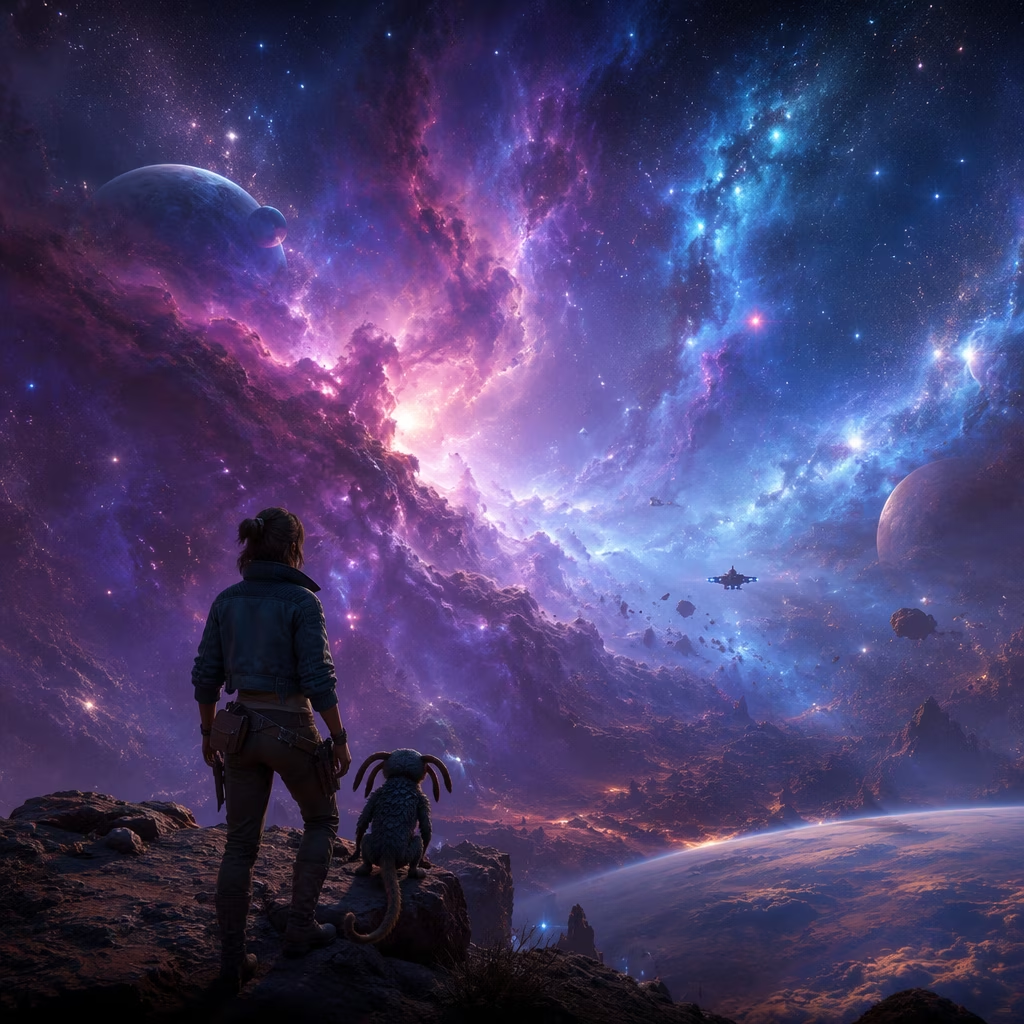
Let’s talk about Toshara first. When Massive Entertainment described it as “inspired by the eastern African savannah,” I’ll be honest: I tilted my head. But the moment my customizable speeder hit those wide, open plains, I got it. The grass ripples in the virtual wind, acacia-like trees dot the horizon, and the sun beats down with a warmth you can almost feel. And then you look up. Looming over everything is a mountain—so colossal it scrapes the clouds—carved into amberine. That’s the crystalline substance they mentioned in old Comic-Con panels. The mountain isn’t just rock; it’s a city, a glimmering hive of scoundrels and merchants literally sculpted from reflective orange crystal. I still remember my first approach, the way the setting sun made the entire city blaze like a signal fire on the rim. It perfectly nailed Lucasfilm’s 80/20 rule: 80% African savannah I could recognize, 20% pure Star Wars alien wonder. The team even visited Tanzania to get the biome right—and it shows in every dust devil and salt flat.
What I didn’t expect was how the environment feeds the gameplay. Toshara is tailor-made for Kay’s speeder. You’ll spend hours ripping across flats, catching air off rocky outcroppings, and discovering hidden smugglers’ caches beneath overhangs of that same amberine. Wind turbines connect the plains to the city, flinging your bike into breathtaking vertical ascents. One moment you’re doing a low-flying canyon run, the next you’re chasing a bounty down a crystalline boulevard. 👌
And then there’s Tatooine. Yes, we’ve all been to Tatooine before—in films, shows, countless games. But Massive’s approach, built on that concept of “virtual tourism,” gave me something I’ve craved since I was a kid: a real sense of scale. The journey from a lonely moisture farm to the cantina in Mos Eisley isn’t a loading screen. It’s a ride on the actual map, dunes stretching forever under twin suns. I parked my speeder outside Chalmun’s Cantina and just sat there, absorbing the grime. Inside, every nook and cranny felt faithful, thanks to access to Lucasfilm’s archives. I found a booth in the back where you can overhear job offers—or set up a double-cross.
Speaking of double-crosses: Jabba’s palace is where the scoundrel fantasy truly peaks. Early on, I ran courier jobs for the Hutt, building rep, gaining access deeper into his court. The detail is staggering—chains hanging from slave quarters, the stench of hookah smoke, Rancor roars vibrating through your controller. But the real thrill came when I decided to betray him. I’ll spare you the spoilers, but the mission involved falsifying a spice shipment, planting evidence on a rival syndicate, and a chaotic shootout in the droid workshop. The consequences were immediate: a bounty on my head, Jawas suddenly hostile, and a Hutt Cartel enforcer tracking me across systems. The fact that the game let me make that choice—and then live with the fallout—cemented Outlaws as something special.
It’s easy to look back in 2026 and see the game industry’s trend toward reactive open worlds, but Star Wars Outlaws was one of the first to truly trust the player. Whether I was racing across Toshara’s plains with a stolen Imperial shuttle on my tail, or kneeling before Jabba’s dais deciding his fate, I felt like my Kay Vess mattered. The locations aren’t just beautiful—they’re narrative engines. And two years on, I’m still finding new ways to betray the galaxy’s biggest crime lords. 😈