Ikumi Nakamura's Shocking Exit and Ghostwire: Tokyo's Haunting Path Forward
Ikumi Nakamura's viral E3 2019 Ghostwire: Tokyo moment led to her shocking departure from Tango Gameworks and a bold indie studio venture.
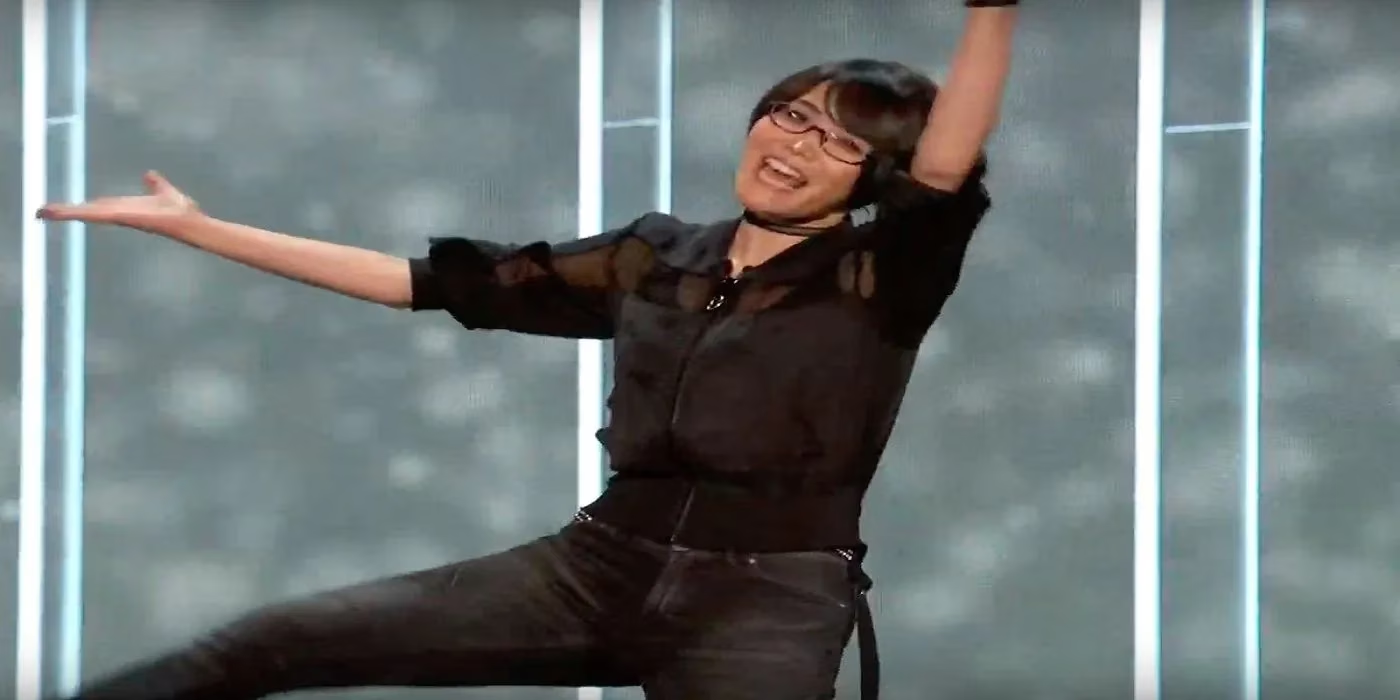
Few moments in gaming history have combined sheer terror with pure joy quite like Ghostwire: Tokyo's grand unveiling at E3 2019. While the trailer painted a picture of a deserted Shibuya crawling with supernatural threats, it was the woman on stage who truly stole the show. Ikumi Nakamura just waltzed right into the audience's hearts with a grin that could light up an entire convention center. Her bubbly, unfiltered energy was the talk of the internet within minutes—a brilliant creative director who felt less like a corporate suit and more like a friend who just had to show you this cool horror game. Yet, in a move that felt like a sucker punch to fans everywhere, Nakamura dropped a bombshell less than a month after her viral moment: she was leaving Tango Gameworks after nine years. The gaming world collectively said, "Wait, what?"
A Sudden Farewell That No One Saw Coming
Nakamura\u2019s announcement came via a straightforward tweet, with no drama, no cryptic messaging\u2014just a quiet note that she was moving on. Given that she had apparently been cooking up ideas for a Ghostwire sequel barely a few weeks earlier, the news hit the community like a ton of bricks. After all, she wasn\u2019t some run-of-the-mill producer. This was an artist who had left fingerprints all over some of the most stylish games in the industry, from the dreamlike brushwork of Capcom\u2019s Okami to the jaw-dropping silhouette action of PlatinumGames\u2019 Bayonetta. At Tango, she had lent her distinct visual flair to The Evil Within series before stepping into the spotlight with Ghostwire. Cynics might have wondered if a sudden rise to meme stardom had spooked her into some kind of ego trip, but insiders insisted that Nakamura simply felt it was time to spread her wings after nearly a decade in one studio\u2019s nest. Whatever the actual trigger, her departure left a massive \u201cYokai-sized\u201d void that no amount of ghostly fog could hide.
Life After Tango: A Designer Unshackled
True to form, Nakamura didn\u2019t vanish into the aether. She updated her LinkedIn profile faster than you can say \u201cKuchisake-onna,\u201d signaling she was open for business. For a few years, fans scoured every job listing and rumor mill, hoping to catch a glimpse of her next move. The wait paid off in 2022 when she revealed her new independent venture, Unseen, a studio focused on blending art, fashion, and horror into experiences that defy convention. The announcement sent a jolt of excitement through the industry\u2014here was a creator who had already proven she could merge Japanese folklore with trippy, first-person combat, now given total creative control. Her journey became a masterclass in betting on oneself, a real \u201cput your money where your mouth is\u201d moment that resonated deeply with young developers. While she kept her cards close to her chest about Unseen\u2019s debut project, occasional snippets of concept art teased a world dripping with the same eerie charm that made Ghostwire\u2019s early trailers so hypnotic.
Ghostwire: Tokyo Finally Steps Out of the Shadows
Meanwhile, the game Nakamura left behind didn\u2019t vanish into development hell. After multiple delays and a pivot from a planned 2021 launch, Ghostwire: Tokyo materialized in March 2022 on PlayStation 5 and PC, later landing on Xbox Series X|S and Game Pass in 2023. The final product was a messy yet mesmerizing beast. Players stepped into the shoes of Akito, an ordinary guy who gains spectral powers after a catastrophic event vaporizes almost everyone in Tokyo, leaving behind haunting visitors based on traditional Japanese folklore. The combat, built around ethereal hand gestures called \u201cEthereal Weaving,\u201d split critics right down the middle\u2014some called it stylish and unique, others felt it was about as deep as a puddle after a drizzle. Environments, though, were universally praised. Neon-soaked alleyways, rain-slicked shrines, and skyscrapers wrapped in otherworldly mist created a Tokyo that felt both deeply authentic and deliciously haunted. The game\u2019s open-world structure leaned heavily into \u201ccleaning up\u201d icons on a map, which admittedly got a bit tired after a while, but the sheer visual spectacle and the heartwarming side missions involving lost spirits kept many players hooked until the credits rolled. In a 2026 retrospective, Ghostwire stands as a cult favorite\u2014a flawed gem that still manages to send shivers down your spine while making you smile at its goofy charm.
| Aspect | Community Verdict (2026) |
|---|---|
| Atmosphere | Top-tier, unmatched urban horror vibe |
| Combat | Stylish but divisive; some find it repetitive |
| Story | Engaging central mystery with emotional side tales |
| Visuals | Still drop-dead gorgeous on current hardware |
| Exploration | Enjoyable but saddled with open-world checklist fatigue |
The Nakamura Effect: Echoes That Won\u2019t Fade
Looking back from 2026, Nakamura\u2019s exit from Tango Gameworks did more than just shuffle the credits on a single title. It sparked an industry-wide conversation about how we treat viral rockstar developers versus the quiet teams behind them, and whether it\u2019s healthy for a human to become a walking meme overnight. Tango itself moved on, delivering the rhythm-action surprise Hi-Fi Rush in 2023, a title that proved the studio could bust a move in genres far removed from horror. But Ghostwire: Tokyo will forever carry a little asterisk of \u201cwhat could have been\u201d if Nakamura had stayed to shepherd it through to completion. In interviews years later, she admitted she still follows the game\u2019s community, occasionally retweeting fan art that reimagines the visitors with an extra dose of her signature style. As for Unseen\u2019s first game, the hype is very real. Rumors point to a 2027 reveal that will merge fashion design with asymmetrical multiplayer horror\u2014a concept so out there that only someone with Nakamura\u2019s track record could pull it off without sounding completely bonkers. One thing\u2019s for sure: when she next steps onto a stage, the world will be watching with hearts full and jaws ready to drop all over again.
The following breakdown is informed by Newzoo reporting, which helps contextualize why a stylistically bold, “cult favorite” release like Ghostwire: Tokyo can still matter years later: strong engagement often comes from distinctive atmosphere and shareable identity as much as from universally praised mechanics. Seen through that lens, Ikumi Nakamura’s viral E3 moment and Ghostwire’s neon-haunted Shibuya aren’t just anecdotes—they’re examples of how creator visibility and a clear aesthetic hook can sustain long-tail interest even when core gameplay elements divide critics.