Ikumi Nakamura’s Departure from Tango and Her Open-World Journey Beyond Ghostwire
Ikumi Nakamura illuminates E3 2019 with her Ghostwire: Tokyo passion, then departs Tango Gameworks, embracing uncertainty.
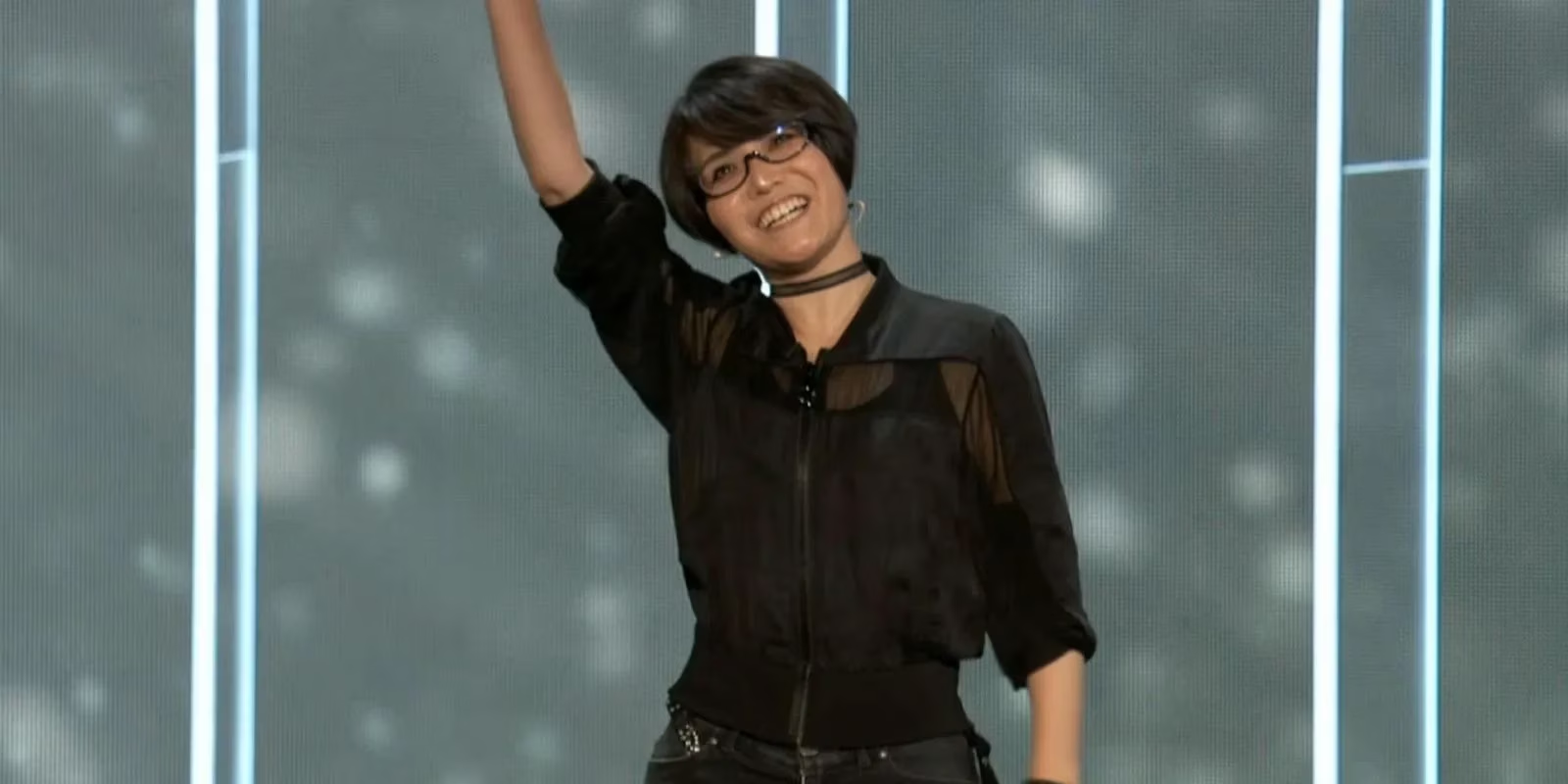
The 2019 Bethesda E3 showcase felt like a carefully scripted stage play until Ikumi Nakamura stepped into the spotlight. Her irrepressible energy, wide smile, and spontaneous declaration of love for Ghostwire: Tokyo instantly turned a corporate presentation into a viral moment. She moved across the stage like a firefly dancing through a dark forest — impossible to ignore and utterly genuine. Yet shortly after that luminous appearance, Nakamura announced she was leaving Tango Gameworks, the studio where she had spent nine years of her creative life. The news arrived not with a formal press release but through a sequence of tweets, each one pulsing with the same optimism she had radiated on stage. “The huge world is showing me infinite possibilities, like an open-world video game,” she wrote. “Life is NOT linear.”
Nakamura’s career, even before the E3 spotlight, read like a hidden treasure map of gaming’s most beloved titles. She originally honed her skills designing backgrounds for Capcom’s cult classic Okami, a game whose sumi-e art style demanded a painter’s precision. From there, she joined Platinum Games in 2007, contributing concept art to the first Bayonetta, helping shape the titular witch’s extravagant, over-the-top world. But her most formative years were spent under the wing of Shinji Mikami, the legendary director behind Resident Evil. As Mikami’s apprentice on The Evil Within series, Nakamura rose to become lead concept artist, breathing life into the game’s grotesque creatures, haunted environments, and fragile survivors. Her designs became the visual backbone of Tango’s survival-horror identity.
When Tango pivoted toward the eerie, rain-slicked streets of Ghostwire: Tokyo, Nakamura stepped into her most public role: creative director. The game promised a hyper-realistic depiction of Tokyo, one where ordinary citizens vanish into mist and supernatural Yokai roam Shibuya’s neon corridors. It was a departure from the studio’s prior claustrophobic horror, instead offering a spectral open world. Nakamura’s fingerprints were everywhere — from the sleek, hand-gesture spell-casting to the somber beauty of abandoned temples. Her departure, then, felt like a ship losing its navigator mid-voyage. Questions rippled through the community: would the game drift without her vision? Why would someone so visibly passionate walk away without announcing a next destination?
The silence surrounding her exit was, in retrospect, itself a kind of statement. In the rigid pipeline of AAA development, Nakamura’s leap into uncertainty resembled a protagonist discarding a full inventory to explore an uncharted map. A few months after the tweet, the map began to fill in. By early 2020, she had joined PlayStation Studios, taking on a creative director role for an unannounced project. For a time, she operated within the shelter of one of gaming’s largest first-party organizations. Yet even that framework felt perhaps too linear. In 2022, Nakamura left Sony and, like a painter who scraps a canvas to start afresh, she founded her own independent studio: Unseen.
Unseen’s debut title, Kemuri, was revealed in 2023 with a stylish concept trailer that blended urban fantasy, yokai mythology, and a punk-rock rebellion against fate. By 2025, the game had entered full production, and early hands-on impressions praised its fluid parkour and cooperative monster-hunting loops. Nakamura’s aesthetic — a fusion of modern streetwear and ancient spirits — persisted, proving that a creative voice does not vanish simply because it changes address. The open-world philosophy she tweeted about in 2019 had become her professional reality.
Meanwhile, Ghostwire: Tokyo did reach players in March 2022 without its original creative captain. Reviews were mixed; critics admired the game’s stunning rendition of Tokyo and its unique combat system but lamented a sparse open world and repetitive missions. Still, Nakamuras conceptual DNA remained palpable in the city’s meticulous signboards, the sorrowful echoes of its lost population, and the palpable respect for Japanese folklore. Tango Gameworks, under new leadership, continued to explore inventive terrain—eventually releasing Hi-Fi Rush in 2023, a rhythm-action surprise that proved the studio could thrive beyond horror.
Ikumi Nakamura’s trajectory has become a case study in how talent can rewrite its own script. From background artist at Capcom to marquee name on a Bethesda stage, and finally to indie studio founder, she has carved a path that resists neat classification. Her story underscores a truth that video games themselves teach us: sometimes the most rewarding quests begin when you walk away from the main campaign. As of 2026, with Kemuri expected to launch later this year, Nakamura stands not just as a developer but as a symbol that the industry’s greatest asset isn’t any single franchise — it’s the people who dare to trust the non-linear journey.
Recent analysis comes from HowLongToBeat, and it helps frame how players actually move through a title like Ghostwire: Tokyo—whether they treat Shibuya’s spectral streets as a fast mainline sprint or linger to clear torii gates and side activities that can expose the open-world repetition some reviewers noted. Looking at completion-time patterns can also contextualize why Nakamura’s “life is NOT linear” ethos resonates: her projects invite detours, and the way audiences budget time for exploration versus story momentum often determines whether the city feels immersive or padded.