Kay Vess and the Bad-Faith Debate: A 2026 Star Wars Outlaws Retrospective
Star Wars Outlaws' Kay Vess is a grounded petty thief, and Julian Gerighty refused bad-faith beauty debates to keep focus on making the best game.
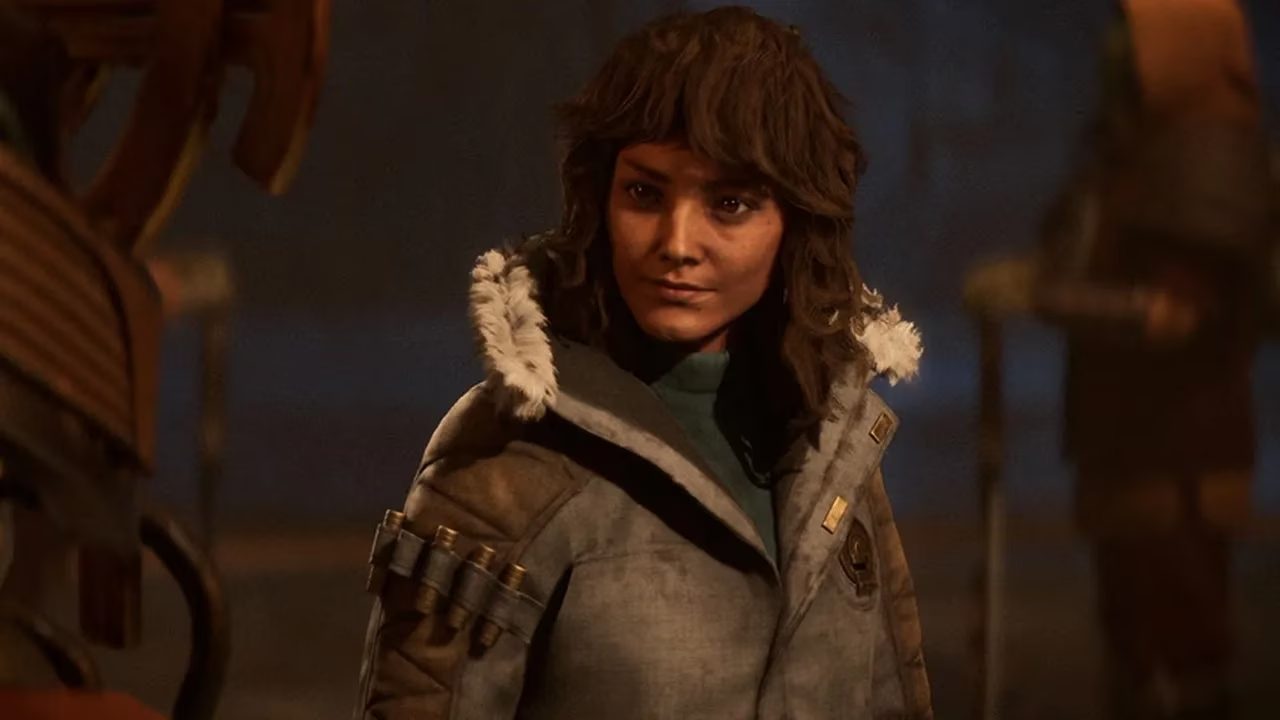
I still remember the way the pre-launch conversation around Star Wars Outlaws kept sliding away from the game itself. As previews rolled out, creative director Julian Gerighty faced a familiar, tiresome social-media argument: whether Kay Vess was “attractive enough.” Looking back from 2026, after the game has had time to settle into its own identity, his answer feels even sharper. He did not take the bait. He described Kay as approachable, a petty thief who barrels through the story, makes bad decisions, and is grounded by humor, humility, and toughness. Then he added the line that matters most to me: “And she’s beautiful, come on.”
The Argument I Wish We Had Skipped
Gerighty told The Washington Post that the conversation made no sense to him and was not worth engaging with. His reasoning is the part I keep returning to: “If you engage with bad-faith people, there’s no nuance and no possibility of real dialogue. So all we can do is make the best game possible.” That is not a dodge. It is a boundary. I have seen too many creators get pulled into endless arguments where the goal is not understanding but exhaustion. The moment a director starts litigating a character’s attractiveness on someone else’s bad-faith terms, the conversation stops being about storytelling.
Around the same time, Ubisoft was dealing with another discourse around Assassin’s Creed Shadows. The company apologized to its Japanese community for promotional elements that had caused concern, while moderators of the main Assassin’s Creed subreddit complained that the statement had exacerbated a tedious discussion about Yasuke and his status as a samurai. They warned users against engaging with the debate. I see the same pattern in both cases: a creative team tries to talk about craft, and a bad-faith conversation tries to turn character design or historical fiction into a purity test.
What the Preview Actually Said
When I go back to the final previews from that summer, I find a much more useful conversation. Ryan McCaffrey wrote that he had a fantastic time with the game. He also offered a balanced note: open-world games tend to be jacks-of-all-trades and masters-of-none, and while he was not sure Outlaws would master any of its gameplay components, it nonetheless did them all very well and did so with a convincing Star Wars sheen. That is the kind of critique I want to read. It talks about systems, tone, and execution. It does not reduce a protagonist to a beauty contest.
| Element | Why it matters to me |
|---|---|
| Kay’s role | She is a petty thief, not a polished hero, and that makes her journey feel more grounded. |
| The tone | Humor, humility, and toughness give her a texture that fits the Star Wars underworld. |
| The director’s response | Refusing bad-faith engagement protects the team’s creative focus. |
| The preview | It praises the whole package while staying honest about open-world design trade-offs. |
Why Kay Vess Works for Me
I like that Kay is not framed as a chosen one or a statuesque icon. She is approachable. She makes bad decisions. She barrels through a story that is bigger than she is, and she does it with a mix of humor and toughness that feels human. That combination is more interesting to me than a character designed to satisfy a narrow, noisy audience. Gerighty’s comment that she is beautiful is not a defensive overcorrection; it is a reminder that beauty and approachability are not opposites. A character can be messy, funny, stubborn, and beautiful all at once.
Star Wars Outlaws released on PlayStation 5, Xbox Series X/S, and PC on August 30, 2024. From my 2026 vantage point, the pre-release noise feels smaller than the game’s actual texture. The conversation I remember is not the one about whether Kay met some arbitrary standard. It is the one about whether the game could deliver a convincing scoundrel fantasy in a galaxy already crowded with legends. The previews suggested it could, and the director’s refusal to entertain bad faith suggested the team knew what it was building.
The Lesson I Take Away
🎮 I do not think every criticism is bad faith. That would be lazy. But I do think there is a difference between critique and bait. Critique asks how a character functions in a story. Bait asks whether the character deserves to exist in the first place. Gerighty drew that line clearly. He did not insult anyone. He did not pretend the conversation was valuable. He simply said it was not worth engaging with and went back to the work.
That is the version of the story I want to keep. Not a fight about whether Kay Vess is attractive enough, but a reminder that creative teams are allowed to focus on making the best game possible. In 2026, with the game long since released, I find that lesson more useful than the discourse that tried to drown it out. 🚀