My Heart Stopped When Darth Vader Walked Into That Office in Star Wars Outlaws
Star Wars Outlaws offers a gripping, underworld-driven story and open world gameplay, immersing players in Kay Vess’s perilous journey.
It’s 2026, and I still can’t shake the cold chill that ran down my spine when the doors slid open and that mechanical breath filled the room. I’d been a scoundrel for dozens of hours by then, sneaking through cantinas, double-crossing syndicates, and stealing ships across the Outer Rim. Kay Vess’s story felt personal, a gritty underworld tale far from the Jedi and the Empire’s grand battles. But in a single moment, all that changed. The Sith Lord himself stepped into the light, and suddenly my blaster felt like a toy.
Star Wars Outlaws hooked me from the start with its promise of a different perspective. I wasn’t a hero with a destiny. I was Kay, a small-time thief on the run from Zerek Besh after a heist went sideways. The game dropped me into a sprawling open world where every choice had consequences, and every contact could be a trap. I spent my early hours learning the rhythms of the criminal underworld, doing jobs for the Pykes, charming Crimson Dawn, and trying to keep my head low. The war between the Rebellion and the Empire felt distant, like background noise on a cantina news feed. That was the brilliance of the setup—it made me forget who really ran the galaxy.
Everything shifted when I dug deeper into Sliro’s secrets. The man I’d been fleeing, the mastermind of Zerek Besh, wasn’t just some crime lord. Late one night, after pulling off a data heist on Kijimi, I uncovered the truth: Sliro was Director Barsha of the Imperial Security Bureau. Zerek Besh was a front. The ISB had been puppeteering the syndicates, using them to gather intel on dissidents and Imperial rivals alike. My heart pounded as I read the files. I wasn’t just a thief with a bounty; I’d stumbled into the Empire’s dirty laundry. The stakes had never been higher.
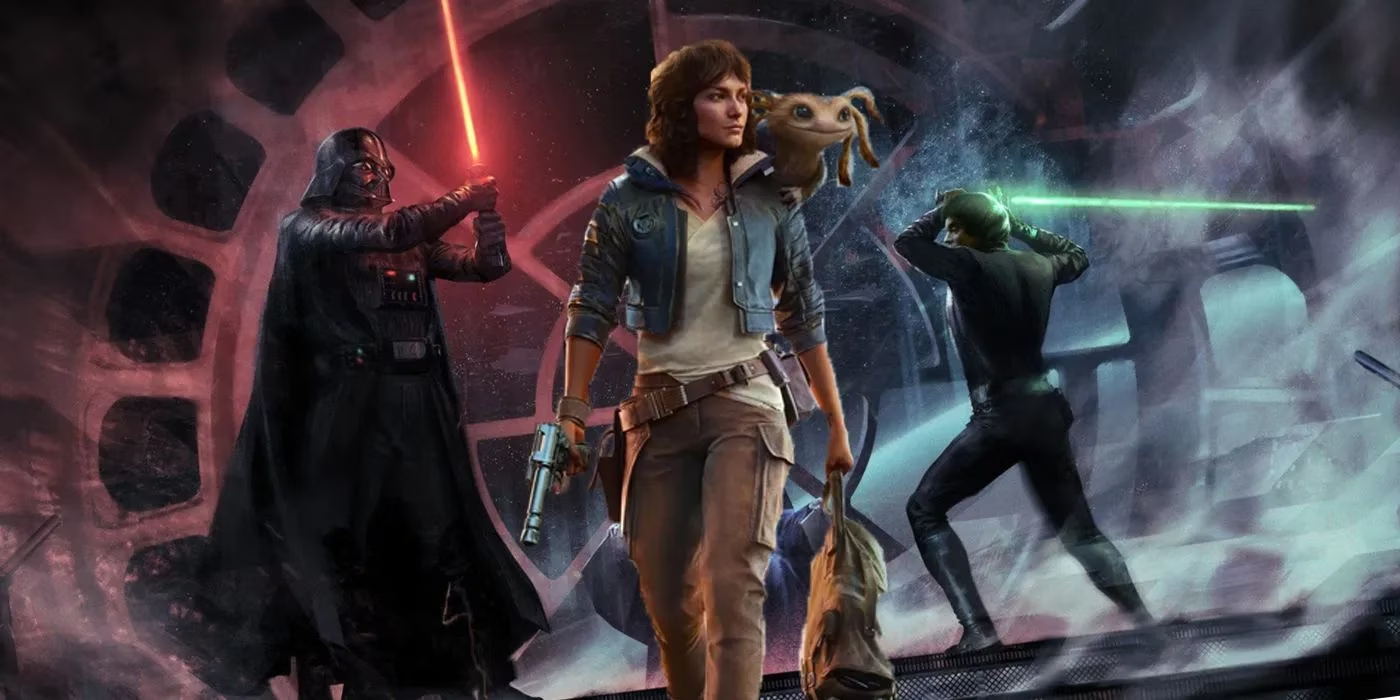
The real shock came during a cutscene in Sliro’s opulent office on Canto Bight. The bounty hunter Vail had just finished a holocall, and the atmosphere was thick with tension. Then I heard it: the rhythmic, unmistakable breathing. The camera panned, and towering in the doorway stood Darth Vader. I froze. I wasn’t playing a Jedi; I had no lightsaber, no Force powers. I was just a scoundrel with a lucky charm and a stolen speeder. Vader’s presence filled the screen, and the game made sure I felt utterly insignificant. He walked past the terrified guards, his cape billowing, and confronted Sliro with a fury I’d only ever experienced in the movies.
What unfolded was a masterclass in terror. Vader called Sliro’s entire operation a “failure” because Zerek Besh hadn’t captured a single Rebel. Sliro, foolishly arrogant, dared to talk back, boasting about the ISB’s intelligence network and even insulting the Imperial military. I remember leaning closer to the screen, whispering “Don’t.” The air crackled. Vader’s fist clenched, and with a flick of his wrist, the glass of Sliro’s display cabinet shattered. Every shard hovered, needle-sharp, aimed directly at the Director. My hands were sweating on the controller. I wasn’t controlling Kay in that moment; I was a helpless spectator watching cosmic power remind a mortal how small he was. Vader’s ultimatum was simple: find Rebels, or else. The scene ended, and I had to pause the game to process what I’d just witnessed.
That first encounter was just the appetizer. Much later, after the big heist on Sliro’s mansion, the story took another twist. The score we’d risked everything for wasn’t beskar ingots—it was a codex containing blackmail on the highest-ranking Imperial officers. Jaylen, our crew leader and Sliro’s estranged brother, had his own agenda. He revealed his plan to sell the codex to the Empire in exchange for Zerek Besh and his brother’s head. I sat there, mouth agape, as a hologram flickered to life and Vader’s armored silhouette appeared before the crew. The Dark Lord’s voice, cold and final, accepted the deal and dismissed Sliro with words that sent a chill through me: “You have outlived your usefulness to the Emperor.” In that moment, I wasn’t just watching a villain’s downfall; I was seeing the ruthlessness of the Empire laid bare, and I knew I’d been playing on borrowed time.
What made Vader’s appearances so effective was that the developers understood exactly what they were doing. This isn’t Jedi: Fallen Order or Survivor. Kay can’t parry a lightsaber or push back with the Force. She ducks, rolls, and shoots. A boss fight against Vader would have been over in seconds, a humiliating, instantly fatal encounter. Instead, by weaving him into the narrative as an overwhelming force that interacts with the antagonists, the game preserved his menace without breaking immersion. It reminded me of the lesson I learned from Jedi: Survivor back in 2024, where the clash between Vader’s mystical power and the ISB’s military bureaucracy was hinted at. Here, that friction became a central spectacle.
Looking back from 2026, with the game now available on the Nintendo Switch 2 and still thriving on PC and consoles, this moment remains a high point of interactive storytelling. It’s a testament to how Star Wars Outlaws respects the source material while forging its own path. I’d spent so long as Kay, a small fish in a big, dirty pond, that I forgot the galaxy’s ultimate predator could swim by at any time. And when he did, I didn’t need a health bar or a quick-time event to feel his weight. I just needed that breath, that shattered glass, and the absolute certainty that I could never, ever win against him.