My Journey from a Wooden Spaceship to Star Wars Outlaws
Discover the incredible journey of portraying Kay Vess in Star Wars Outlaws, a thrilling full-circle moment from early roles to leading a major galactic adventure. This compelling narrative highlights the transformative power of motion capture acting.
As I sit here in this motion capture studio, the familiar scent of wood and electronics in the air, I can't help but reflect on the incredible journey that brought me to this moment. The year is 2026, and I'm portraying Kay Vess, the fearless protagonist of Star Wars Outlaws. But my path to piloting the Trailblazer through the galaxy's most dangerous corners began long before this, in a much smaller wooden spaceship. That first experience, where my dreams of working in video games became a tangible reality, feels like a lifetime ago yet remains vivid in my memory. The progression from my initial role to now leading a major Star Wars title represents not just career growth, but a deeply personal full-circle moment that continues to shape my artistic identity.
The First Flight: Starlink and a Wooden Ship
My introduction to this world was as Calisto Chase Da Silva in Ubisoft's Starlink: Battle for Atlas. I remember vividly walking into that first in-person callback. The studio had built a literal wooden spaceship for me to sit in during the motion capture session. 🚀 I was a racer-turned-pilot with a bionic arm and leg—a character born from tragedy but reborn for space. Sitting in that crude wooden frame, pretending to navigate the stars, I felt an electric connection to the craft. It was my first baby in this industry, my proof that real actors could bring these digital worlds to life. At the time, I had no idea how foundational that experience would be.
Coming Full Circle with Kay Vess
Years later, I found myself once again in a motion capture studio, once again at the helm of a wooden spaceship prop. Only this time, it was for something monumental: Star Wars Outlaws. The parallels were impossible to ignore. From Calisto to Kay Vess, from a rookie space pilot to the lead of a galactic adventure—the progression felt both surreal and beautifully inevitable.
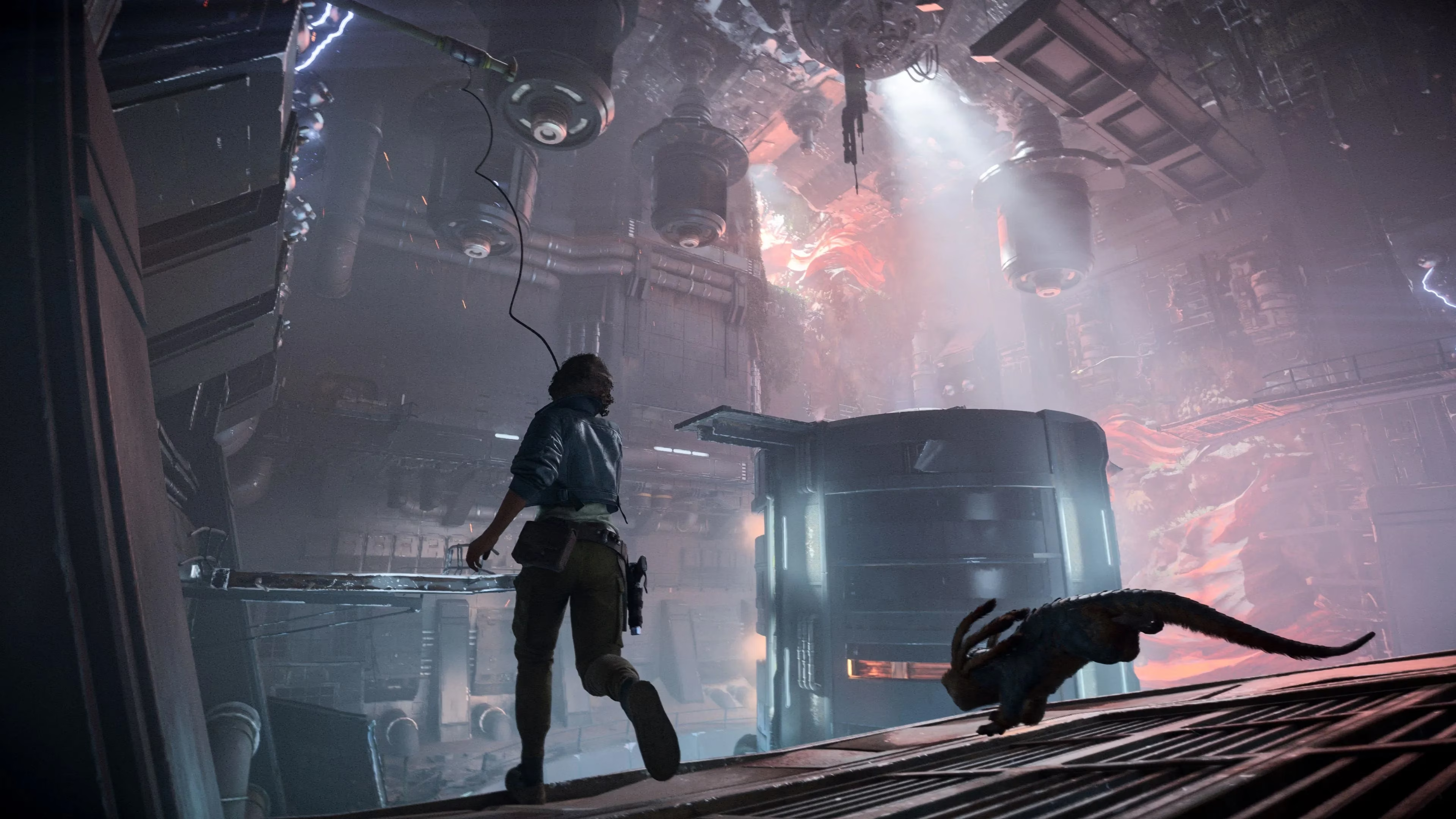
Playing Kay is more than just another role; it's the culmination of a dream I've nurtured since my theater school days in Montreal. Back then, I got to wear the motion capture suits for the first time, doing mock scenes and realizing a whole side of the acting industry I never knew existed. I thought video game characters were purely animated creations. Discovering that performers like me could inhabit them was a revelation that set my career on its current trajectory.
The Art of Motion Capture: A Unique Discipline
Working in video games, especially through motion capture, has profoundly shaped me as an actor. It demands a level of physical precision and control that screen acting often doesn't. Every subtle shift of weight, every micro-expression, every gesture of the hand must be intentional because it will be captured and translated directly into the animation.
Here's how motion capture acting differs from and enhances other forms of performance for me:
| Aspect | Motion Capture Performance | Traditional Screen Acting |
|---|---|---|
| Physicality | Entire body performance is captured; movement is data. | Often framed from waist up; focus on face. |
| Environment | Performed in a volume with markers, often with minimal props. | Performed on a detailed, physical set. |
| Result | Becomes the foundation for a digital character's animation. | Is the final performance seen on screen. |
| Preparation | Requires understanding how movement translates to a digital model. | Focuses on emotional truth within a realistic setting. |
This discipline has made me a more mindful and technically skilled performer overall. It taught me that acting isn't just about delivering lines; it's about embodying a character with your whole physical being, even when that character will one day be a collection of pixels and polygons.
A Dream Forged Early
I'll be fully transparent: video games and motion capture were my first love, even before film and television. While many actors stumble into games later in their careers, for me, it was always the goal. That early exposure in Montreal lit a fire. I saw the potential to tell stories in an interactive, immersive medium where the audience doesn't just watch but participates. Roles in Far Cry 6 and Avatar: Frontiers of Pandora were incredible stepping stones, each teaching me something new about scale, narrative, and character. But Kay Vess... she is the milestone.
Looking to the Future
Where does one go after piloting the Trailblazer in the Star Wars universe? It's a question I ponder sometimes. The industry is full of inspiring trajectories, like Maggie Robertson's stunning journey from Lady Dimitrescu to Orin the Red in Baldur's Gate 3. High-profile roles can open unexpected doors. Perhaps my next adventure will involve an even bigger wooden spaceship, or perhaps a completely different kind of challenge. What I know for certain is that my foundation is solid. I've grown from that actress in a wooden prop to one who helps build believable, lived-in worlds.
My journey is a testament to following a niche passion. I entered an industry segment many of my peers overlooked, and it has given me everything. As for Kay Vess, she represents hope, resilience, and the thrill of the unknown—qualities I've tried to channel from my own story into hers. Every time I step into the volume, I carry with me the memory of that first wooden ship and the wide-eyed actress who sat in it, dreaming of the stars. Now, I'm not just dreaming of them; I'm flying through them, and I can't wait to see where the solar winds take me next. ✨