My Unexpected Hope for Star Wars Outlaws: A World Without Skill Trees and Numbies
Star Wars Outlaws revolutionizes RPG progression by replacing skill trees with an immersive expert system, offering meaningful character growth.
Look, I'll just say it straight: I absolutely despise skill trees. There, I've admitted it. It's 2026, and I thought my gaming days of staring at branching lines of tiny percentage boosts and pointless combos were a permanent fixture, like a slightly annoying but necessary piece of furniture. I hate it when a game, after I've mindlessly mashed buttons through another horde of enemies, rewards me with a "skill point" that lets me magically know how to perform a spinning backflip slash. What does that even represent? Did my character have a sudden epiphany mid-battle? It's all just meaningless numbies—those little dopamine-triggering numbers that make us feel like we're progressing when we're really just ticking boxes. Most modern RPGs are built on this shaky foundation, so I've learned to suffer through them, watching my partner light up at every +2% critical hit chance in games where you can max out everything anyway, rendering the whole "build" concept utterly pointless. It's pure power fantasy, stripped of any sense of earned growth or narrative logic. I've been craving something different, something with what the fancy critics call "ludonarrative harmony"—where how my character gets better actually makes sense within the story being told.
The Great Ubisoft Surprise: Throwing Out the Rulebook
Now, here's the plot twist I never saw coming. Star Wars Outlaws, of all games, seems to be the one answering my desperate, skill-tree-hating prayers. Let's be real: when you hear "Ubisoft game," a very specific, slightly exhausting image comes to mind. You picture a map absolutely littered with icons, towers you must scale to reveal more icons, gear with escalating numbers, and quest logs longer than a Wookiee's arm. It's a formula, and it works, but it rarely surprises. Yet, everything we've learned about Outlaws feels like a deliberate, point-by-point refutation of that very formula. No towers to climb. Smaller, hand-crafted, dense planets instead of vast, empty procedurally generated landscapes. A map that isn't pre-filled with chores, but one you have to actually explore to discover its secrets. And now, the crown jewel for me: no experience points, no leveling up, and absolutely zero traditional skill trees.
Progression That Actually Means Something: The Expert System
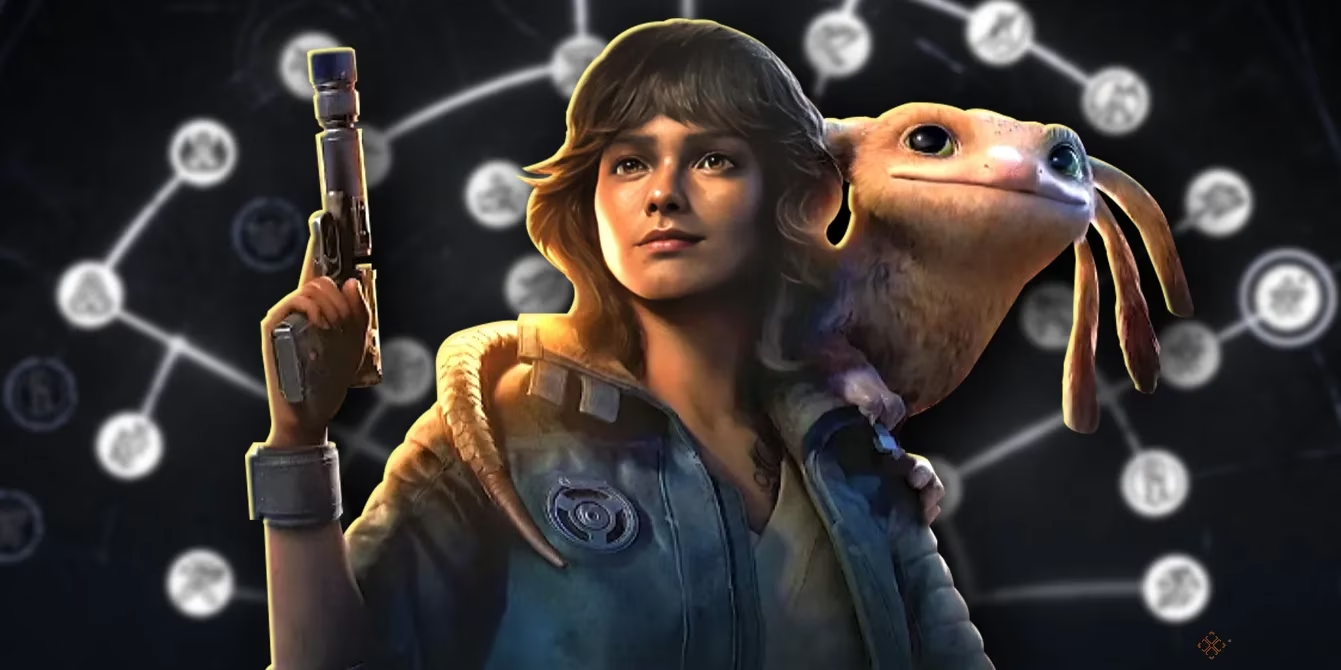
So, how in the galaxy does your character, the scoundrel Kay Vess, get better? This is where Outlaws has genuinely piqued my interest. The game is implementing what they call an "expert system." If you want to upgrade your gear, your ship, or learn a new ability, you can't just bank XP until a lightbulb appears over Kay's head. You have to go out into the world, find the right person with the knowledge, and earn it from them. These aren't just menu icons; they're described as "full-on characters" with their own personalities, locations, and requirements.
Let's break down how this might work, based on the example they've given:
-
Discover the Intel: You might be hanging in a grimy cantina, ears open, and overhear a rumor about a legendary Jawa tinkerer.
-
Embark on the Quest: This expert won't help you for free. They need something. Maybe it's a rare component, like a tooth from a dead Sarlacc pit creature (a brilliantly Star Wars macguffin).
-
Earn the Upgrade: Only after you've completed their specific, often dangerous, task will they trade their knowledge or craftsmanship for your upgrade.
This isn't a transaction; it's a "journey of discovery." You're not just accumulating points, you're accumulating stories and relationships. Suddenly, that new blaster modification isn't just a +5% damage stat—it's a reminder of that terrifying trip into the Dune Sea and the strange, deal-making Jawa you met there. The progression is woven directly into the worldbuilding and the narrative. Sure, this system could potentially become a grind if the quests are repetitive, but even a flawed version of this feels infinitely more meaningful and immersive than another tree filled with incremental stat boosts.
Cautious Optimism from a Chronic Skeptic
Alright, let me pump the brakes on my own excitement for a second. I've been hurt before. My history with certain open-world game formulas is... complicated. I'm not about to declare Star Wars Outlaws the second coming based on previews alone. The ghost of past disappointments looms large. But I have to admit, the narrative coming from Massive Entertainment is specifically designed to calm the fears of players like me. They're talking about quality over quantity, variety over sheer size, and chasing that specific Star Wars feeling of scrappy, personal adventure. They chose bespoke planets over algorithmically generated ones, which is a huge commitment to a crafted experience.
| Traditional RPG/Skill Tree System | Star Wars Outlaws' Expert System |
|---|---|
| Progress via abstract Experience Points (XP) | Progress via concrete in-world actions and trades |
| Unlock skills via menu navigation & skill points | Unlock skills by finding and assisting expert characters |
| Upgrades are often +X% stat boosts | Upgrades are tied to specific, earned equipment or abilities |
| Ludonarrative Dissonance: Skills appear magically | Ludonarrative Harmony: Skills are learned from masters |
| Progression feels like checking boxes | Progression feels like an unfolding story |
Do I think Star Wars Outlaws will be the perfect scoundrel fantasy heist game? 🤔 It's too early to say. The proof will be in the parsec-running when it launches. But here’s what I know for sure: it won’t make me groan as I open a massive, convoluted skill tree. It won’t force me to allocate points into "Blaster Proficiency III" just to keep up with enemy health pools. For the first time in a long time, a major AAA open-world game is trying to make character growth part of the adventure, not a separate, menu-based mini-game. And in a gaming landscape still dominated by numbies and sprawling talent grids, that’s not just a small step—it feels like a hyperspace jump in the right direction. For that alone, they have my attention, and my cautiously optimistic hope.