Seven Years Later, Ikumi Nakamura’s E3 Spark Still Fuels My Love for GhostWire: Tokyo
Ikumi Nakamura's electrifying GhostWire: Tokyo reveal at E3 2019 sparked a lasting personal connection that enriches every playthrough.
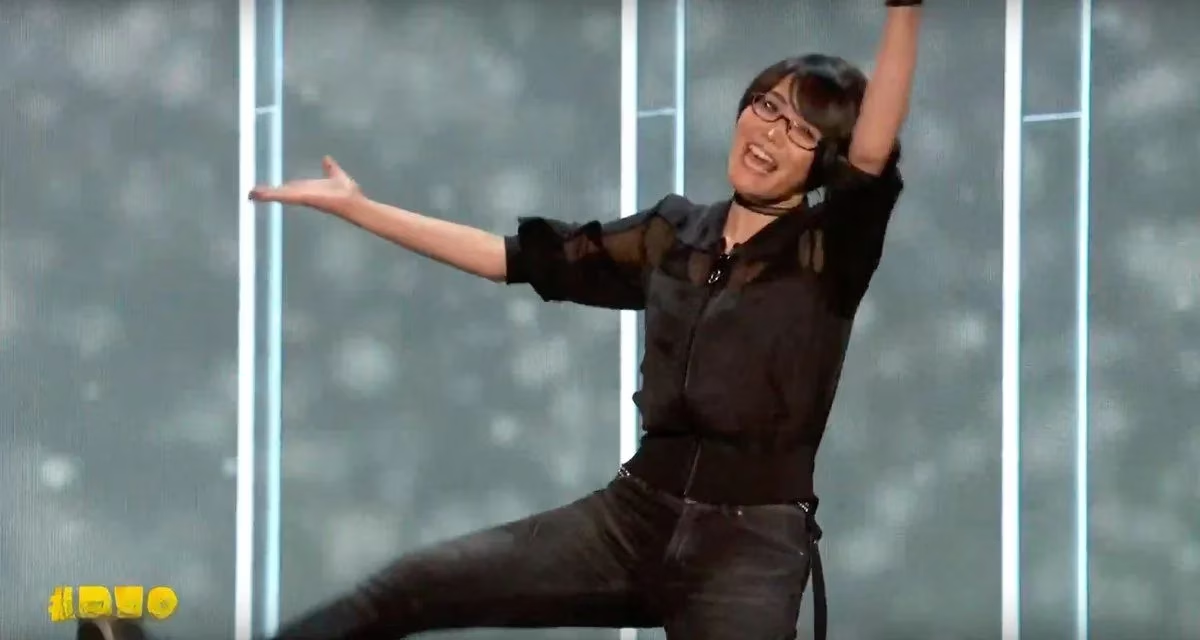
I still vividly remember Bethesda’s E3 2019 press conference. It was, honestly, a bit dry—until a spirited developer named Ikumi Nakamura stepped onto the stage. She had this genuine, infectious energy that cut right through the corporate stiffness. As she introduced GhostWire: Tokyo, her eyes lit up, and she punctuated her sentences with those now-iconic poses. In that moment, she didn’t just sell a game; she made thousands of us feel her passion. Fast-forward to 2026, and that fleeting presentation continues to echo in my mind every time I boot up GhostWire: Tokyo on my system. I’ve played through its neon-soaked streets more times than I can count, and I always wonder: would I have even picked up the controller if not for her? Probably, but would I have cared so deeply? Honestly, no.
I remember the aftermath of that conference like it was yesterday. Within hours, the internet flooded with fan art. Not just a few doodles—hundreds of tributes to Ikumi herself, capturing her playful stance and warm smile. She could have just moved on, but instead, she posted a now-legendary photo holding up her phone, its screen displaying a gallery of fan creations under the title “My treasure.” That image itself became a treasure for us. She tweeted, “These fan arts are my treasures and make me smile.” How often does a developer wear their heart on their sleeve like that? It felt like a conversation, not a monologue.
That human connection made the wait for GhostWire: Tokyo feel almost personal. At the time, details were sparse: an action-adventure game set in a mysteriously deserted Tokyo, threaded with occult elements and “spectral abilities.” No gameplay, no release date. But we trusted her vision. When 2022 arrived and the game finally launched, I nervously slotted the disc into my console, half-expecting a letdown. To my relief, Tango Gameworks delivered something special. The city pulsed with eerie beauty—rain-slicked alleys crawling with menacing Visitors, rooftops lit by digital billboards, and a haunting silence broken only by the whispers of yōkai. The combat, weaving hand gestures with spiritual powers, felt as unique as that first trailer promised.
Of course, things changed behind the scenes. Ikumi Nakamura left Tango Gameworks not long after that E3, setting off to found her own studio. I’ll admit, my heart sank when the news broke. Would the game lose its soul? Yet playing it, I sensed her fingerprints everywhere—the quirky enemy designs, the blend of horror and whimsy, the very pulse of the Shibuya district. It was as if her initial spark had ignited a creative fire that outlasted her tenure. By 2024, GhostWire: Tokyo had gathered a passionate modding community, who added everything from new spectral abilities to visual overhauls that made the cityscape even more breathtaking. I’ve lost entire evenings just grappling across rooftops, absorbing lost souls.
But what’s really kept me coming back these past three years? Is it the slick combat? Yes. The atmosphere? Absolutely. But underneath it all, I think I’m still chasing that feeling Ikumi gave us back in 2019—the promise of a game made by someone who genuinely loves stories, monsters, and the strange beauty of Tokyo. Every time I encounter a new kappa by a river or watch a visitor dissolve into mist under my katashiro, I think of her smile. It’s rare for a director to become as much a part of a game’s identity as the game itself, but she managed it in less than five minutes.
In the years since, I’ve watched studios try to replicate that “E3 moment,” but few have succeeded. Keanu Reeves’ appearance at Microsoft’s 2019 show was explosive, sure, but it was a celebrity flex. Ikumi felt like one of us—a creator who couldn’t contain her excitement. Her legacy, for me, isn’t just the art on my phone or the framed print of fan tributes I keep on my shelf (yes, I bought one). It’s the lesson that games are made by people, and people connect best to other people, not rehearsed scripts.
Now, in 2026, with rumors of a GhostWire sequel swirling and Ikumi’s new project finally teased, I find myself wondering: will lightning strike twice? Maybe not. But I’ll be there, controller in hand, because that one director at a forgettable press conference reminded me why I love this medium. And if she ever needs a reminder of how much she touched our lives, I hope she still has that phone, forever scrolling through her treasures. We sure do.