Star Wars Eclipse: Forging a New Path in the High Republic Era
Star Wars Eclipse, the highly anticipated High Republic era game by Quantic Dream, pioneers an uncharted narrative frontier. This groundbreaking title offers a unique opportunity to define the era's lore and identity through its signature branching storylines, promising to be a foundational cornerstone for the beloved franchise.
In the ever-expanding galaxy of Star Wars media, a new beacon is set to emerge from the creative nebula of Quantic Dream. Star Wars Eclipse represents not just another entry into the beloved franchise, but a calculated leap into relatively uncharted narrative space. As of 2026, with the franchise's cinematic and television landscapes well-mapped, the gaming frontier offers the most fertile ground for genuine exploration. Quantic Dream, renowned for its intricate, branching narrative tapestries in games like Detroit: Become Human, is preparing to weave a multi-protagonist story within a period of Star Wars history that remains, for many fans, a tantalizing mystery: the High Republic era.
While titles like Star Wars Outlaws promise to deepen our understanding of the familiar Galactic Empire's seedy underbelly, Star Wars Eclipse has the unique privilege and burden of pioneering. The High Republic era, though featured in comics, books, and briefly in Star Wars Jedi: Survivor, has yet to be fully realized in a major interactive experience. Star Wars: The Acolyte will blaze the trail on television, but Eclipse will be the first video game to plant its flag in this golden age of the Jedi. This positioning makes it less a sequel or spinoff and more of a foundational cornerstone, like the first hyperlane charted through an unknown sector—its success could determine the traffic of stories to follow.
The Canvas of the High Republic
Why does this setting matter so much? The Galactic Empire, for all its iconic menace, is a well-trodden narrative path. Its aesthetics, power structures, and conflicts are deeply ingrained in the collective consciousness. Games set there, no matter how excellent, are often adding detail to a masterpiece that's been decades in the painting. Star Wars Eclipse, by contrast, is handed a nearly blank canvas. The High Republic is an era of light, expansion, and Jedi at their zenith, a concept as fragile and full of potential as a freshly spun kyber crystal. This allows Quantic Dream to:
-
Introduce wholly new lore without being constrained by decades of established events.
-
Define the visual and tonal identity of the era for a massive audience.
-
Create characters and conflicts whose fates aren't pre-determined by a saga set centuries later.
The game has the opportunity to operate not just as a story, but as a world-building engine, generating the foundational myths and histories that future games, shows, and books can reference. Its success could make the High Republic as viable a setting for games as the Clone Wars or the Imperial era.
The Quantic Dream Signature in a Galaxy Far, Far Away
Quantic Dream's signature is the narrative fork in the road, where player choice doesn't just change a line of dialogue but can alter the fate of entire characters and civilizations. Applying this to the Star Wars universe, especially in an era where the Light Side of the Force is dominant, presents fascinating questions. Will choices revolve around political diplomacy, philosophical disagreements within the Jedi Order, or the moral compromises of expansion? The multi-protagonist structure suggests we might see this era from vastly different perspectives—perhaps a Jedi, a senator, and an explorer—each with their own branching path that collectively paints a complex picture of this \u201cgolden age.\u201d
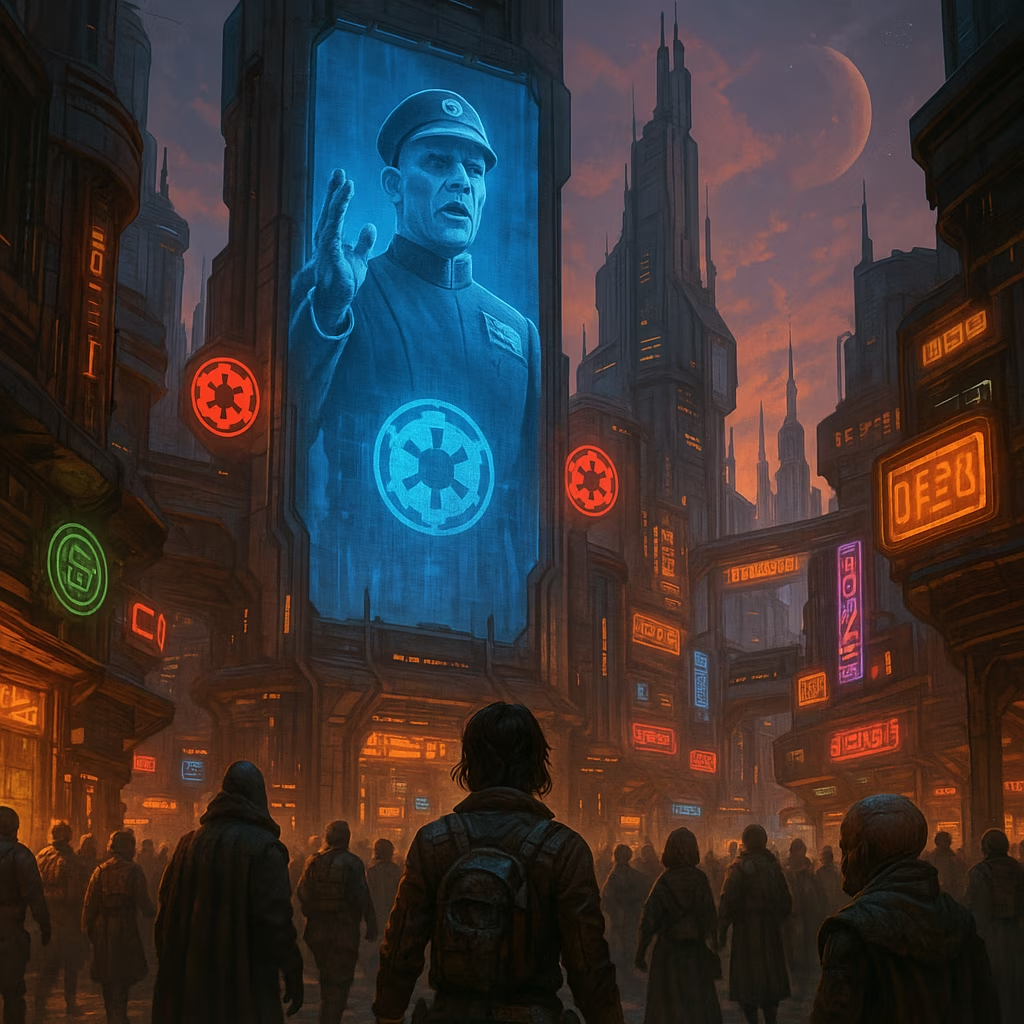
A Ripple in the Force: Eclipse's Potential Legacy
The impact of Star Wars Eclipse could extend far beyond its own credits. A hit game could catalyze a new wave of High Republic projects. Imagine:
-
A prequel to the Star Wars Jedi series exploring the full stories of characters like Dagan Gera and Santari Khri, whose High Republic-era flashbacks in Survivor were mere fragments.
-
An open-world exploration game set on the gleaming worlds of the Republic's core.
-
A strategy or management game about founding new outposts on the galactic frontier.
In this way, Eclipse is less like a single player entering a game and more like a master archivist unlocking a vast, new wing of the Jedi Archives. Its role is to make the High Republic feel not like a footnote in a history text, but a living, breathing, and playable period brimming with its own epic tales. While Star Wars Outlaws will refine and enrich a known quantity—the Galactic Empire's criminal underworld—with the addition of new planets like Toshara, Star Wars Eclipse is tasked with the alchemical process of spinning narrative gold from raw, unexplored myth.
The Weight of Expectation
With great opportunity comes great responsibility. The game must satisfy both Quantic Dream fans expecting deep, consequential choice and Star Wars fans hungry for a respectful, exciting expansion of canon. It must make the High Republic feel both authentically \u201cStar Wars\u201d and thrillingly new. It must tell a story that is compelling on its own while also feeling like a vital chapter in a larger, unfolding history.
As of 2026, the anticipation is palpable. Star Wars Eclipse represents a bold bet on the franchise's future, a willingness to let a video game lead the charge into a new era of storytelling. Its success could prove that the most exciting stories aren't always about fighting a familiar empire, but about exploring the fragile dawn that came before the fall. It stands poised, not as a reflection of the Star Wars we know, but as a beacon illuminating the Star Wars we have yet to discover.