Star Wars Outlaws: A Deep Dive into the Galaxy's Unspoken Languages and Lore
Star Wars Outlaws and Outer Rim languages offer immersive gameplay, unveiling the galaxy's rich, diverse linguistic tapestry for gamers.
As a dedicated gamer immersed in the ever-expanding Star Wars universe, I believe the upcoming Star Wars Outlaws represents a thrilling opportunity to explore the niche, often-overlooked aspects of galactic lore that the films merely hinted at. Based on the compelling trailers released so far, the game is poised to plunge us into the gritty criminal underworld, a domain previously only scratched by Solo and a handful of extended universe materials. But as an open-world adventure set in the Outer Rim, its potential extends far beyond syndicates and spice runs. The game's five confirmed planets—some original, some familiar—are canvases for rich cultural exposition, from delving into species-specific histories to showcasing reactions to Imperial tyranny. However, one particularly fascinating and underexplored lore element that the movies glossed over, and which Outlaws is perfectly positioned to emphasize, is the galaxy's intricate tapestry of languages.
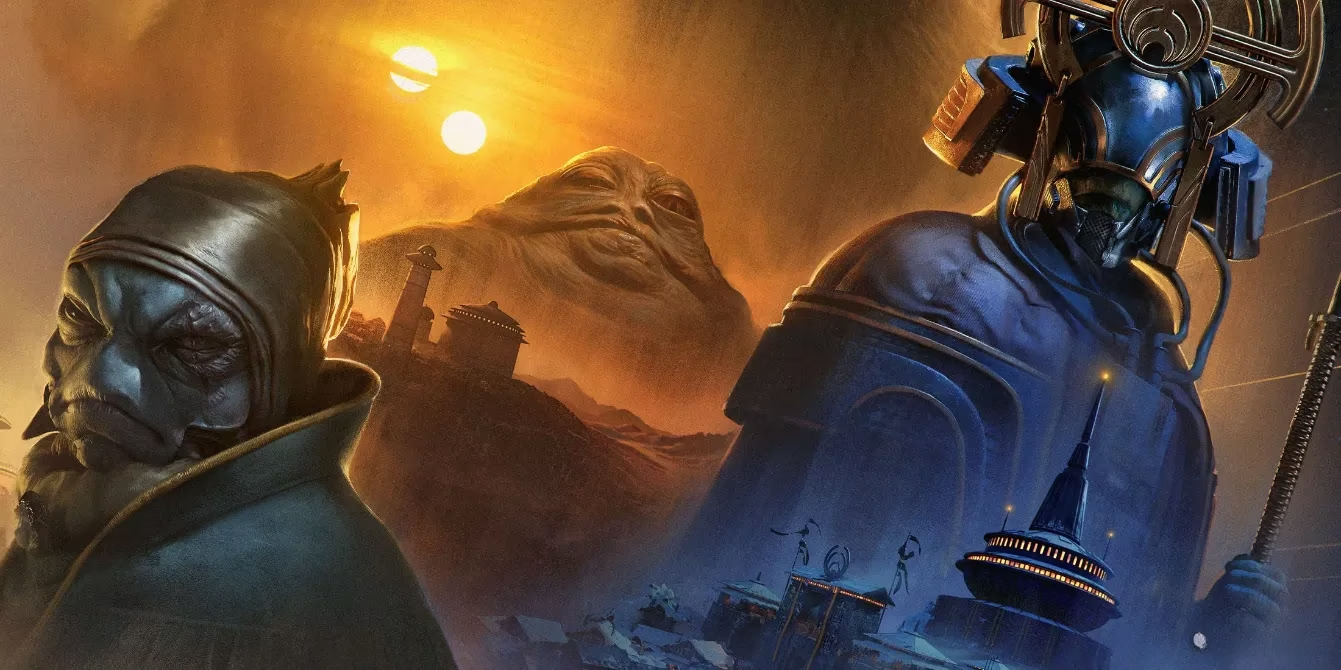
It made perfect sense for the original 1977 film, primarily targeting a Western audience, to use English (or "Galactic Basic") as the primary mode of communication. To justify this within the narrative, the films introduced protocol droids as translators or simply stated that Basic was the galaxy's lingua franca. Yet, for us long-time aficionados, the expanded lore reveals a universe buzzing with linguistic diversity. This isn't just background noise; it's a core aspect of world-building. The films only offered glimpses, but the broader canon is replete with unique dialects and tongues that define cultures and factions.
The Linguistic Landscape of the Outer Rim
Star Wars Outlaws will have us navigating the perilous sectors of the Outer Rim, a region synonymous with lawlessness and opportunity, deliberately distant from the Empire's core on Coruscant. This setting is a linguistic goldmine. Here, Galactic Basic shares airspace with a cacophony of alien dialects. The most prominent among them is undoubtedly Huttese. Originating on Nal Hutta, the Hutt homeworld, this guttural language became the de facto tongue of the criminal underworld. Its popularity in the Outer Rim was partly strategic; the Empire's limited knowledge of Huttese made it a perfect code for illicit dealings. Beyond Huttese, we have:
-
Binary: The beeps and whistles of droid communication.
-
Mandalorian (Mando'a): The tongue of the warrior culture.
-
Shyriiwook: The complex roars and growls of Wookiees.
-
Various species-specific languages: From Twi'leki to Dosh, practically every major species has fragments of its language documented in canon.
This linguistic variety shouldn't just be ambient sound in Outlaws. It should be a integral gameplay mechanic and a tool for immersion.
Language as a Gameplay Pillar
Imagine this: Our protagonist, the scoundrel Kay Vess, needs to secure a deal with a Rodian crime lord or barter for parts with a secretive Mon Calamari engineer. They don't speak Basic. This is where the game can innovate. Instead of universal translators magically solving everything, Star Wars Outlaws could brilliantly weave language barriers into its RPG-like dialogue and quest systems.
🔧 Potential Mechanic: The Protocol Droid Companion
Kay might need to seek out, befriend, or even hire a protocol droid fluent in specific dialects. This droid would become a vital companion, not just in combat, but in social interactions. Need to negotiate with a Hutt? You'd better have your droid's Huttese translation module updated. This creates dynamic gameplay:
| Scenario | Without Translator | With Translator Droid |
|---|---|---|
| Huttese Cartel Deal | Misunderstandings lead to hostility or worse deals. | Unlock special dialogue options, better prices, or hidden quest info. |
| Droid Uprising Side-Quest | Unable to parse Binary signals, missing the quest entirely. | Decode distress calls, uncovering a unique narrative thread. |
| Ancient Alien Ruins | Can't decipher warnings or clues, leading to environmental hazards. | Translate inscriptions, revealing shortcuts, secrets, or lore entries. |
This system would make exploration and preparation meaningful. Hearing a conversation in untranslated Huttese in a smoky cantina wouldn't just be set-dressing; it would be a puzzle piece. You'd need to decide if finding a translator is worth the potential reward, adding a layer of strategy to Kay's outlaw journey.
Enriching Lore Through Dialogue
Focusing on language allows Outlaws to showcase cultural depth in a way few Star Wars games have. When a character chooses to speak their native tongue, it says something about their trust, heritage, or defiance. An Ithorian insisting on speaking in their melodic, two-mouthed language could be a sign of pride in their culture amidst Imperial attempts to homogenize the galaxy. A smuggler using a pidgin mix of Basic and Huttese slang would immediately feel authentic to the Outer Rim's melting pot.
Furthermore, in 2026, as gaming narratives strive for greater sophistication, this attention to linguistic detail would set Star Wars Outlaws apart. It moves beyond visual world-building to auditory and interactive world-building. Learning key phrases could become part of character progression, similar to learning spells or skills in other RPGs. "Fluent in Huttese" could be a perk that opens up entire new faction questlines or unique vendors.
The Bigger Picture: A Living, Breathing Galaxy
Ultimately, by taking its alien languages seriously, Star Wars Outlaws has the chance to present the most culturally textured and lived-in version of the galaxy since the heyday of the Knights of the Old Republic series. It’s not just about what we see on these five planets—the bustling markets of Tatooine or the neon-lit alleys of a new world—but about what we hear. The grunts of Gamorrean guards, the melodic tones of a Twi'lek's song, the frantic Binary of a malfunctioning astromech.
This approach honors decades of fan-beloved lore crafted in books, comics, and games, while using modern interactive storytelling to make players feel the galaxy's vast diversity firsthand. As we await its release, my hope is that Massive Entertainment seizes this unique opportunity. Let Kay Vess's adventure be one where understanding the words of the galaxy is just as important as wielding a blaster. Let Star Wars Outlaws give voice to the unsung cultures of the Outer Rim and prove that in a galaxy of trillions, there's no single way to speak. The foundation is all there in the lore; now it's time to hit the streets, find that protocol droid, and truly listen.