Star Wars Outlaws and the Beauty Debate: Kay Vess, Realism, and Gaming's 'Woke' Culture
The Star Wars Outlaws protagonist Kay Vess controversy highlights the fierce debate over 'woke' culture and character representation in modern gaming. This clash reflects a profound industry-wide shift in how players perceive realism and relatability in video game heroes.
The gaming world is no stranger to controversy, but the recent buzz surrounding Star Wars Outlaws has taken a particularly personal turn. At the center of the storm is its protagonist, the sharp-witted thief Kay Vess, whose digital visage has become an unlikely battleground for broader cultural debates. While some players applaud her design as a breath of fresh, realistic air in a galaxy far, far away, others have launched a volley of criticism, with the word "ugly" being thrown around with surprising frequency. This isn't just about polygons and texture maps; it's a reflection of the ongoing, often heated, conversation about representation, "woke" culture, and what it means to see oneself—or a version of reality—in the games we play. As we look ahead from 2026, this debate around Kay Vess feels less like an isolated incident and more like a defining moment in modern gaming discourse.
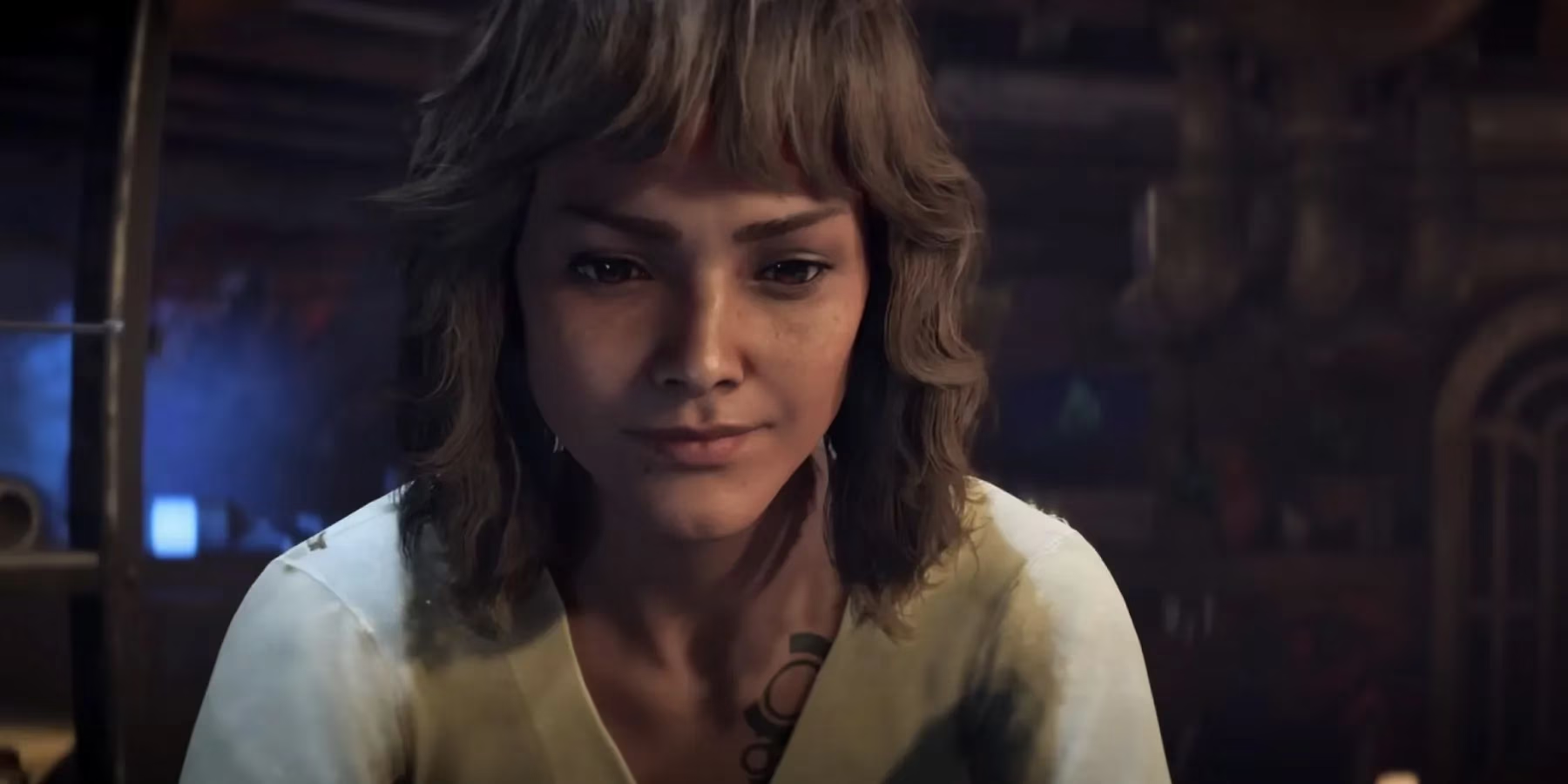
The core of the controversy lies in a simple, yet profoundly subjective, question: What makes a video game character appealing? For a vocal segment of the player base, Kay Vess missed the mark. Scrolling through social media in the wake of the game's promotional material, one could find comments accusing the developers of doing a disservice to the actress portraying her, Humberly González, and suggesting the design was a deliberate move away from conventional beauty standards. The subtext, often made explicit, pointed fingers at so-called "woke" agendas—a catch-all term that has become a lightning rod in entertainment. Critics argued that the pursuit of forced inclusivity or political correctness had resulted in a character they found unappealing. It was, for them, a case of style over substance, or rather, a specific social style overriding their expectations for a Star Wars hero.
However, to label this as a unanimous verdict would be a major misstep. A powerful counter-narrative emerged just as strongly. Many players and commentators rushed to defend Kay Vess, framing her not as a failure of design, but as its triumph. Their argument was compelling: Kay Vess looks like someone who has a story. She isn't a polished princess or a flawless warrior; she's a scrapper from Canto Bight, a survivor whose face might show the grit and determination of life on the fringe. This faction celebrated her as a relatable and grounded addition to the Star Wars pantheon. "Beauty is in the eye of the beholder, and my beholder is tired of the same old face," one supporter quipped online, capturing the sentiment that variety itself is a form of beauty. They saw depth, personality, and realism—qualities that often get sacrificed at the altar of generic attractiveness.
This divide is about much more than one character's cheekbones. It mirrors a massive, industry-wide shift. The debate around "woke" culture in gaming—which fundamentally advocates for social awareness and inclusive representation—has been simmering for years. Kay Vess became a new flashpoint in this ongoing war of aesthetics and ideology. Consider the parallel universe of the Fallout TV series, which faced nearly identical accusations. Its star, Ella Purnell, had to directly address claims that the narrative was overly politicized. It seems that any time a female lead doesn't fit a narrow, historically dominant mold, the "woke" alarm bells start ringing for a certain segment of the audience. The table below outlines the common arguments from both sides of this cultural chasm:
| Critics' Perspective | Defenders' Perspective |
|---|---|
| Sees design as unattractive or "ugly" | Sees design as realistic and refreshing |
| Interprets it as forced "woke" inclusivity | Views it as meaningful representation |
| Feels it disrespects the actor's real looks | Believes it serves the character's story |
| Wants traditional, idealized beauty standards | Advocates for diverse, relatable character designs |
Fast forward to 2026, and the landscape has only become more complex. Games featuring strong, nuanced female protagonists are no longer a novelty but an expectation for many. The discussion has evolved from "should they exist?" to "how are they portrayed?" Kay Vess, in retrospect, stands as an early benchmark in this new era. The backlash she faced, while intense, also galvanized a community that demanded more from its heroes than just a pretty face. It sparked conversations about the very purpose of character design: Is it solely to be aesthetically pleasing, or is it to build a believable persona that enhances the narrative?
The performance capture and portrayal by Humberly González added another layer to this. González brought Kay Vess to life with a physicality and expression that aimed for authenticity. Defenders of the design argued that translating a real human's performance—with all its subtle imperfections and strengths—into a digital character is an art form in itself, one that should prioritize emotional truth over airbrushed fantasy. To dismiss this as "ugly" was, in their view, to dismiss the craft of storytelling itself.
So, where does this leave us? The heated debate over Kay Vess's appearance in Star Wars Outlaws was a microcosm of a much larger cultural moment. It highlighted the growing pains of an industry and a fanbase navigating the shift toward more diverse and realistic storytelling. The criticism revealed lingering attachments to outdated tropes, while the defense signaled a growing appetite for characters with whom players can connect on a human level, not just a visual one. As games continue to push the boundaries of narrative and representation, these conversations will persist. The legacy of Kay Vess won't be whether she was deemed pretty or not by a vocal minority on social media; it will be that she was real enough, compelling enough, and human enough to make the debate worth having in the first place. In the grand scheme of the galaxy, that's a win for storytelling.