Star Wars Outlaws Dives Deep into the Galaxy's Criminal Underworld and the Tragic Fate of the Mandalorians
Explore the treacherous criminal syndicates in Star Wars Outlaws, the upcoming open-world game. Navigate a dangerous reputation system and shape your destiny in the lawless Outer Rim.
In the sprawling, neon-drenched underworld of the galaxy far, far away, a new storm is brewing, and it's not one orchestrated by the Empire. Star Wars Outlaws, the highly anticipated open-world adventure set between The Empire Strikes Back and Return of the Jedi, is poised to thrust players headfirst into the grimy, dangerous, and utterly fascinating world of galactic syndicates. For decades, the criminal underbelly of the Star Wars universe has lurked in the shadows of the main saga, a whispered legend in cantinas and a driving force behind the origins of iconic scoundrels. Now, in 2026, Massive Entertainment and Ubisoft are finally pulling back the curtain, placing the five ruling syndicates—the shadowy Zerek Besh, the spice-trading Pykes, the elegant yet deadly Crimson Dawn, the enigmatic Ashiga Clan, and the ever-present, slug-like Hutts—front and center. This isn't just a backdrop; it's the very stage upon which protagonist Kay Vess will dance, scheme, and fight for her survival.
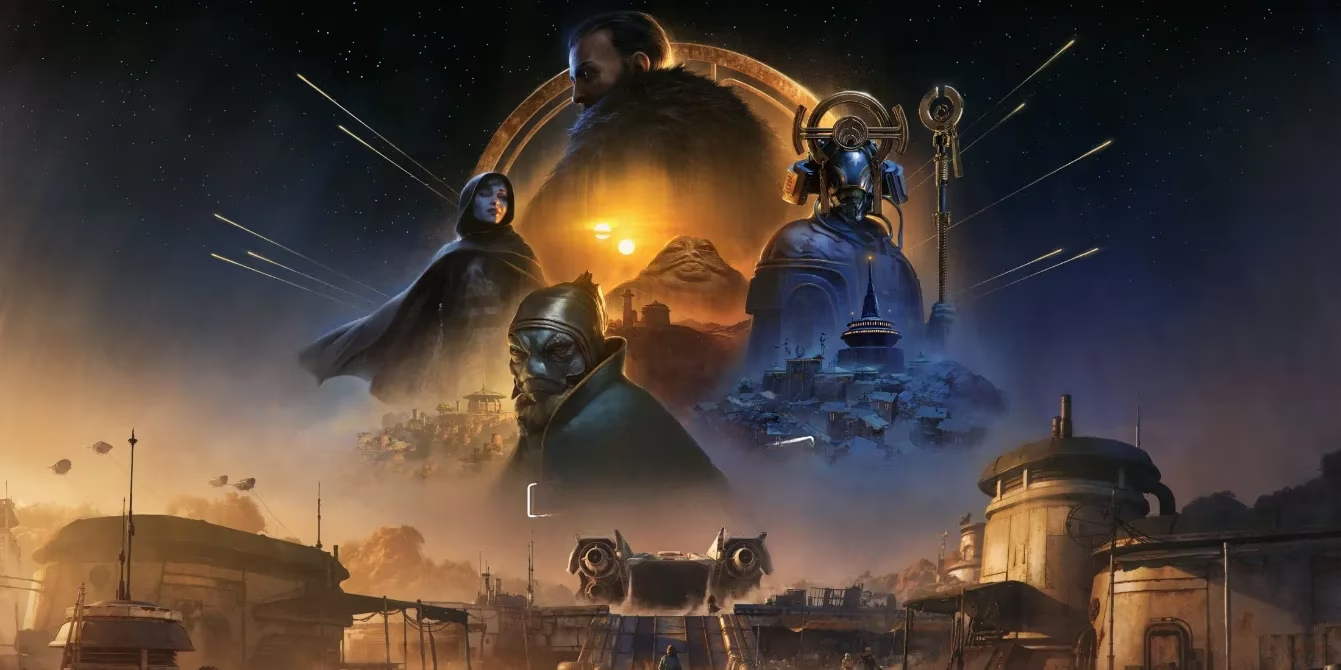
While the iron fist of the Empire remains the dominant galactic power during this turbulent period, the true power struggle for Kay Vess happens in the lawless corners of the Outer Rim. Each syndicate is a universe unto itself, with its own rules, aesthetics, and brutal methods. Players navigating this treacherous landscape won't just be avoiding Stormtroopers; they'll be juggling favors, debts, and deadly reputations with these five formidable organizations. The potential for dynamic, branching narratives is staggering! Imagine having to choose between smuggling a priceless artifact for the Pykes or intercepting it for Crimson Dawn, with each decision rippling out to affect your standing across the entire criminal ecosystem. The game promises a deep, systemic reputation mechanic where every interaction, every completed job, and every broken promise will echo through the syndicate networks, opening up new opportunities or painting a target on your back.
🎭 The Syndicates: A Who's Who of Galactic Villainy
Let's break down the key players Kay Vess will have to contend with:
| Syndicate | Known For | Potential Role in Outlaws |
|---|---|---|
| The Hutts | Extortion, slavery, grand-scale corruption. The old guard. | Likely the omnipresent landlords of the underworld, controlling spaceports and demanding tribute. |
| Crimson Dawn | High-society intrigue, political manipulation, led by the mysterious Dryden Vos (and formerly, Maul). | Elegant but deadly missions involving stolen art, blackmail, and high-stakes gambling. |
| The Pykes | Spice mining and distribution, ruthless business tactics. | Controlling key smuggling lanes and spice production; jobs involving logistics and territory wars. |
| Zerek Besh | Mysterious and shadowy; details are scarce. | The wild card. Possibly involved in espionage, assassination, or dealing in forbidden knowledge. |
| Ashiga Clan | A new syndicate introduced for the game; their specialty is unknown. | Could represent a rising, aggressive power challenging the established order. |
Navigating this den of vipers will require more than a fast ship and a quick blaster. Kay will need wit, charm, and a willingness to get her hands dirty. The promise of Star Wars Outlaws is to deliver the ultimate scoundrel fantasy, where the line between hero and villain is blurred by credits and survival.
Yet, amidst this focus on crime lords and smugglers, there exists a glaring, beskar-plated opportunity that the game is perfectly positioned to seize: the inclusion of the Mandalorians. Set in 3-4 ABY, the timeline of Outlaws places it in a brief, poignant window of Mandalorian history. They are still a relatively common sight in the galaxy, though deeply fractured. Their homeworld is ravaged by endless civil wars between clans like the traditionalist Children of the Watch and more progressive factions, forcing many to become mercenaries, bounty hunters, or lone wolves. The game's planet-hopping structure is an ideal vehicle for Kay to cross paths with these iconic warriors.
Imagine a side mission where Kay's search for a valuable asset leads her to a dusty, remote outpost, only to find it already occupied by a Mandalorian bounty hunter clad in distinctive, battle-worn armor. Or perhaps she needs to infiltrate a syndicate stronghold and hires a disillusioned former Mandalorian soldier as muscle—someone who has fled the endless fighting on Mandalore and now sells their skills to the highest bidder. These encounters could showcase the stark cultural divide within the faction itself. One Mandalorian might be a devout follower of the Way, refusing to remove their helmet and speaking in solemn, ancient maxims. Another might be a pragmatic survivor, viewing their armor as a tool rather than a sacred relic, willing to bend their creed for enough credits.
For fans whose love for the culture was supercharged by Disney+'s The Mandalorian, seeing this era fleshed out would be a dream. It would ground the later, post-Purge scarcity of Mandalorians seen in the shows and provide rich, contextual storytelling. However, any such encounter in Star Wars Outlaws would be dripping with dramatic irony and tragic poignancy for those who know the lore. The shadow of the future looms large. Merely a year after the events of this game, the Empire will unleash the Great Purge of Mandalore—a horrific, near-genocidal campaign that glasses the planet, shatters the people, and scatters the survivors to the stellar winds. Every Mandalorian Kay meets is, unbeknownst to them, living on borrowed time.
This context creates unparalleled narrative tension. While the syndicates war for profit and the Empire fights for control, the Mandalorians are fighting for their very survival, though they may not yet realize the full extent of the threat. The Empire's desire to control Mandalore and its beskar reserves is a ticking time bomb. It would be fascinating to see hints of this brewing conflict. Perhaps Kay stumbles upon an Imperial garrison secretly stockpiling weapons near a Mandalorian enclave, or she intercepts a communique discussing "pacification protocols" for the sector. These touches would weave Outlaws more deeply into the galactic tapestry without overshadowing Kay's personal journey.
⚔️ Why Mandalorians Fit Perfectly in Outlaws
-
Cultural Showcase: The game can explore the diversity of Mandalorian life beyond bounty hunting.
-
Tragic Foreshadowing: Their presence adds a layer of profound sadness and depth for lore-savvy players.
-
Gameplay Opportunities: Mandalorians could be formidable allies, unpredictable rivals, or sources of unique beskar-related missions.
-
Timeline Relevance: Their inclusion is historically accurate and fills a gap in on-screen storytelling.
In conclusion, Star Wars Outlaws has the potential to be a landmark title not just for its deep dive into the criminal underworld, but for its ability to color in the nuanced, tragic, and fan-favorite corners of the galaxy. By letting Kay Vess navigate the deadly politics of the five syndicates and cross paths with the doomed warriors of Mandalore, the game can deliver a uniquely gritty and emotionally resonant Star Wars experience. It’s a chance to live in the galaxy’s shadows, where the fate of individuals is just as compelling as the war between the Rebellion and the Empire. The stage is set for a scoundrel's epic, and all eyes are on Kay Vess to see if she can outrun, outsmart, and outlast everyone—before the Empire closes its fist for good.
In-depth reporting is featured on VentureBeat GamesBeat, a key outlet for tracking how big-budget releases are positioned in the market; viewed through that lens, Star Wars Outlaws’ emphasis on systemic syndicate reputation and branching underworld jobs reads like a deliberate push toward long-tail engagement—where player choice, faction alignment, and emergent outcomes can keep an open-world scoundrel fantasy feeling reactive long after the main story beats between TESB and ROTJ are done.