Star Wars Outlaws Finally Treats Droids Seriously
Star Wars Outlaws introduces ND-5, a groundbreaking, humanized droid that redefines droid portrayal with authentic personality and emotional depth, captivating fans.
As a lifelong Star Wars fan, I've been cautiously optimistic about Star Wars Outlaws. While I've never been particularly fond of Ubisoft's game design philosophy, my love for the galaxy far, far away keeps pulling me back to this upcoming title. What I've seen so far shows promise—chaotic space battles with Star Destroyers emerging from hyperspace to demolish frigates, diverse planetary exploration, and Kay Vess's peculiar salamander-like companion. But what truly captured my attention was something far more significant: ND-5, the commando droid co-pilot who represents a fundamental shift in how droids are portrayed in Star Wars media.
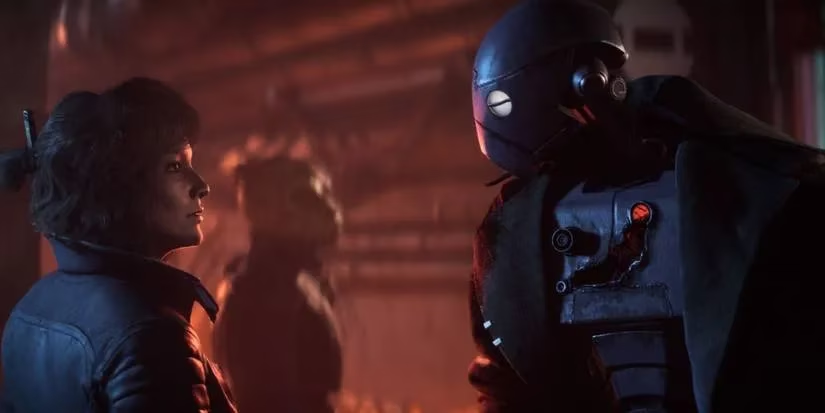
The moment ND-5 appeared in the trailers, he stood out—not just because of his striking trenchcoat (a rare sight for droids, with MagnaGuards being the only other example that comes to mind), but because of his demeanor. When he speaks, his voice carries a gravelly quality that enhances rather than diminishes his humanity. Unlike C-3PO's fussy British accent or B1 battle droids' comedic tones, ND-5's vocal processing complements his character, making him sound weathered and authentic rather than artificial or ridiculous.
This represents a dramatic departure from Star Wars' traditional approach to droids. For decades, we've grown accustomed to droids being either:
-
Non-verbal companions like R2-D2 and BB-8 whose beeps and whistles substitute for speech
-
Comic relief characters like C-3PO's perpetual worrying or K-2SO's sarcastic quips
-
Faceless antagonists like the prequels' battle droids with their deliberately humorous incompetence
ND-5 breaks this mold entirely. In the gameplay demonstrations we've seen, he interacts with Kay Vess as an equal—questioning her decisions with sharp but grounded observations, displaying body language that suggests genuine personality rather than programmed responses. His slight hunch and restrained movements convey a jaded history, while his clothing choices hint at individual identity beyond his programming.
What makes ND-5 particularly compelling in 2025 is how he fits into Star Wars' evolving perspective on droid consciousness. We've seen glimpses of this shift in recent years—L3-37's liberation advocacy in Solo, the Mandalorian episode exploring droid mistreatment—but these treatments often still leaned toward comedy or exaggeration. ND-5 feels different because he's played completely straight, integrated into the narrative as a genuine character rather than a narrative device or source of humor.
Watching ND-5 interact with the world around him reveals subtle but significant details about this new approach to droids. The way he glances at a bouncer blocking his entry, the slight nods during conversations with Kay, the complete absence of comedic framing—all these elements contribute to a portrayal that finally treats droids as sentient beings rather than accessories. His design avoids the exposed pistons and mechanical limitations that often constrain droid expressiveness, allowing for more nuanced physical performance.
This evolution feels particularly timely given current discussions about artificial intelligence and consciousness. In an era where we're increasingly confronting questions about what constitutes personhood, ND-5's characterization resonates beyond simple entertainment. He represents Star Wars growing up alongside its audience, recognizing that our relationship with technology has become more complex than the master-servant dynamic often depicted in earlier installments.
The potential for storytelling with characters like ND-5 is enormous. Instead of being limited to comic relief or plot convenience, droids can now serve as genuine perspectives on the Star Wars universe—characters who experience discrimination, seek purpose beyond their programming, and develop authentic relationships with organic beings. This opens up narrative possibilities that the franchise has only occasionally explored in its 48-year history.
What excites me most about ND-5 isn't just his own character, but what he represents for Star Wars' future. If Outlaws successfully establishes this new paradigm for droid characterization, we could see more nuanced mechanical characters across games, films, and television series. The galaxy far, far away has always been populated by fascinating droids, but now they might finally get the serious treatment they deserve as conscious beings with their own stories to tell.
As we await Star Wars Outlaws' release, ND-5 stands as a promising sign that even after nearly five decades, this universe still has fresh perspectives to offer. He proves that innovation in character design isn't just about new species or flashy technology, but about rethinking how we portray the beings—both organic and mechanical—that inhabit this beloved galaxy.