Star Wars Outlaws: How to Instantly Refresh Any Shop Inventory
Master the orbit reset trick to restock merchants in Star Wars Outlaws and keep your blaster charged and Bacta Vials flowing.
In the sprawling underworld of Star Wars Outlaws, Kay Vess’s journey is a delicate balance of improvisation and firepower. As players navigate the seedy cantinas and dusty outposts of the Outer Rim in 2026, the need for a well-oiled arsenal becomes not just a preference but a survival mechanism. Upgrading the Trailblazer ship, modifying the speeder, and enhancing the iconic blaster all demand a steady stream of crafting materials. However, savvy scoundrels know that victory often hinges less on marksmanship and more on logistics—specifically, the art of ensuring a merchant’s shelves are never bare. The most critical consumables, from Bacta Vials to ion grenades, can vanish from inventories when you need them most, creating a bottleneck that feels like trying to siphon hyperfuel through a cracked hose: slow, frustrating, and ultimately detrimental to your criminal enterprise.
The Mechanics of Galactic Supply and Demand
The commercial ecosystem in Star Wars Outlaws operates on a fixed principle. Each vendor is a static fountain rather than a raging river; their inventory type never changes, only the quantity of their predefined stock depletes. If a merchant in Mirogana sells Durasteel and Bacta Vials, they will never suddenly stock Coarser Weave or Thermal Detonators. Instead, their current supply of those specific items can vanish after a purchase, leaving an empty hook on the wall. The economic heartbeat of the game is a refresh trigger that restores these quantities to their maximum. Crucially, specific gear and unique quest items exist outside this cycle—once purchased, they are gone forever, serving as permanent milestones rather than renewable assets. This system requires players to think of shop inventories like a tide pool; the water (stock) may drain, but the geological structure (the item list) remains constant, waiting for the gravitational pull to fill it again.
The Orbital Reset: A Scoundrel’s Shortcut
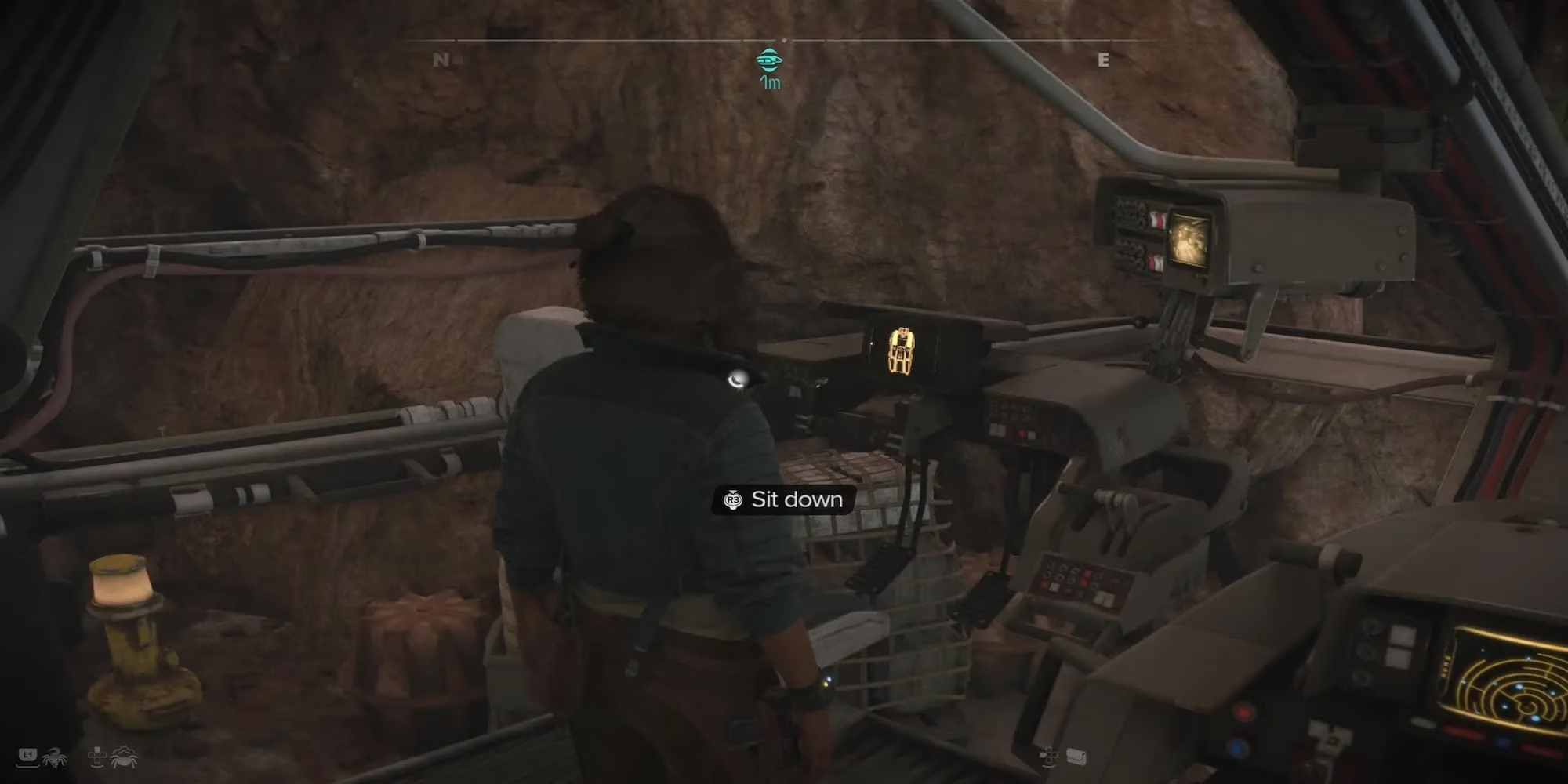
To trigger a restock without burning credits on a hyperspace jump, players must leverage the planet's orbit as a reset mechanism. The process is akin to a cosmic Etch A Sketch—simply shaking the screen by leaving the atmosphere clears the board. The definitive method requires taking the Trailblazer from the landing zone, pulling up into the planet’s orbit, and immediately fast-traveling back to the surface. There is no need to chart a course to Tatooine or Akiva; simply skimming the stratosphere counts as 'traveling out into space'. This loop functions as a spatial reload, a digital sleight of hand where the game’s memory allocates fresh stock numbers the moment you break atmo. For players hoarding a large medpac capacity, this might feel less like shopping and more like conducting a high-frequency trading algorithm, where rapid resets yield a bounty of healing supplies without the drudgery of waiting for an invisible timer.
Navigating the Early-Game Blockade
For the completionist who intends to scour Toshara cell by cell before pushing the main narrative thread, a roadblock exists. The refreshing tactic is gated behind mission progression, a deliberate lock that keeps the player grounded early on. Star Wars Outlaws withholds the full sandbox until the sixth main mission, titled False Flag. This is the narrative hinge where the Trailblazer’s hyperdrive is finally patched up, transitioning the ship from a static set piece to a fully operational base. This mission serves as the tutorial for flight mechanics, but more importantly, it hands over the keys to the inventory refresh exploit. Prior to this, players are stuck with static shop inventories, forced to ration their grenades as if they were hard candy in a vacuum.
Once False Flag is complete, the ship becomes a permanent fixture at the landing zone of any major city hub. The best part of this reset strategy is the economy of it. Unlike fueling up for a long haul or using crafting components to build items, flying into orbit and diving back down costs absolutely zero resources. The only tax is a few seconds of loading screens and the swirling hyperspace tunnel animation. It is a weightless bullet fired towards a restocking target—no recoil, no resource drain, just pure, efficient resupply.
Strategic Implications for High-Stakes Heists
Understanding this mechanic transforms how players prepare for late-game Imperial compounds or syndicate vault runs. The limitation of a shop’s maximum inventory cap means that a single refresh might not fill a fully upgraded carrying capacity. A character with a heavily expanded consumable belt might find a vendor’s 'full' restock only provides half of what they can carry. The solution isn't to search for a mythical superstore with higher caps—they don't exist. Instead, the workflow becomes machine-like:
-
Fast-travel to a trusted vendor.
-
Purchase the maximum available stock of Bacta Vials and heavy munitions.
-
Jump into the Trailblazer, ascend to orbit, and U-turn back to the surface.
-
Repeat the purchase until satiated.
This turns the preparation phase into a meditative rhythm, a chance to hoard equipment like a mynock hoarding power cables. For the ultimate outlaw experience in 2026, this knowledge separates the amateur pickpockets from the professional heist-planners. It confirms that in the lawless frontier, the greatest hack isn’t a faster blaster or a quieter engine; it’s understanding that a captain’s best friend is the empty vacuum of space right above their head, ready to reset the board on a whim.
| Game Phase | Shop Refresh Status | Key Requirement |
|---|---|---|
| Pre-'False Flag' | Locked / Static | Complete main missions to repair the Trailblazer |
| Post-'False Flag' | Active / Unlimited | Fly into planet orbit and return; No resource cost |
| Gear/Cosmetics | Never Refreshes | Purchase once per file; Permanent unlock |
In essence, mastering the inventory refresh is the silent partner to every successful blaster fight. It’s the unseen thumb on the scale, turning scarcity into abundance with a simple echo of skyward flight.