Star Wars Outlaws, Kay Vess, and Ubisoft's Bad-Faith Debate
Star Wars Outlaws' Kay Vess and Julian Gerighty show Ubisoft how to reject bad-faith criticism with clarity, not vague apologies.
In 2026, the video game industry still loves a good culture-war dust-up, but the Star Wars Outlaws case remains a useful reality check. Back in 2024, with the game less than a month from launch, Ubisoft creative director Julian Gerighty was asked about online criticism of Kay Vess, the game's lead. Specifically, some corners of YouTube and social media were pushing the tired narrative that video game women were no longer 'attractive enough.' Gerighty did not take the bait. He told The Washington Post that Kay is meant to be approachable, a petty thief who barrels through the story making bad decisions, and who is centered on humour, humility and toughness. Then he added the line that made fans sit up: 'And she's beautiful, come on.'
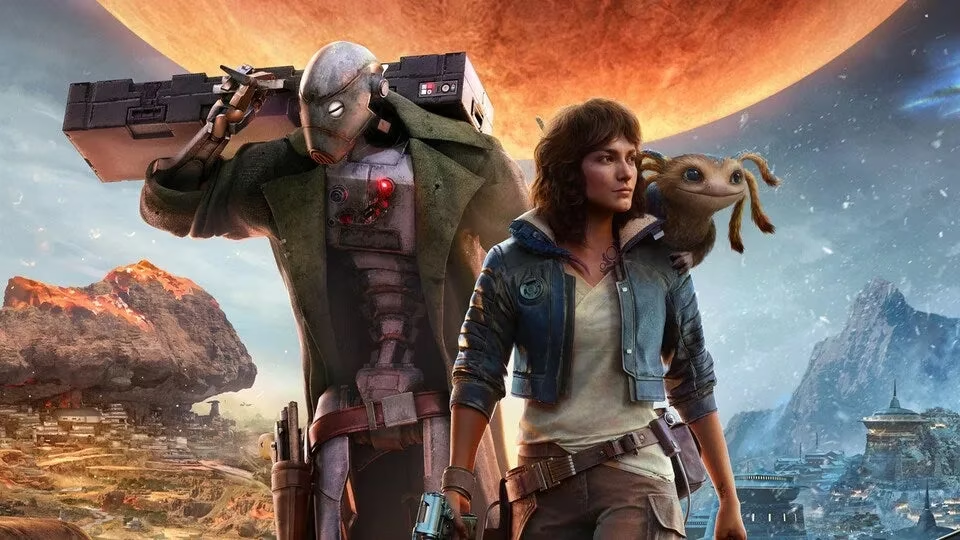
Gerighty's response was a straight-shooter move. He did not pretend the criticism was all in good faith, and he did not write a vague corporate paragraph that tried to please everyone. 'It makes no sense to me,' he said, 'and it's not worth engaging with. If you engage with bad-faith people, there's no nuance and no possibility of real dialogue. So all we can do is make the best game possible.' That is a clean boundary, not a dodge. It also fits the character he and Massive Entertainment were building: a scoundrel with a smart mouth, a messy plan, and a knack for barreling through trouble.
The contrast with Ubisoft's Assassin's Creed Shadows messaging was hard to miss. Ubisoft raised eyebrows when it issued a vaguely worded apology for 'some elements' in Assassin's Creed Shadows' promotional materials that had 'caused concern' among some fans. Fans widely attributed the statement to the ongoing backlash over the game's inclusion of historical figure Yasuke as a Black samurai and its dual protagonist. Moderators of the main Assassin's Creed Reddit described the topic as a 'tedious discussion' that Ubisoft's statement had only 'exacerbated.' In plain English: the apology poured fuel on a fire that was already smoking.
| Flashpoint | Ubisoft's move | Fan read |
|---|---|---|
| Star Wars Outlaws / Kay Vess | Gerighty called out bad-faith criticism and refused to debate it | Seen as direct, defensive of the character, and clear about creative intent |
| Assassin's Creed Shadows | Vague apology for 'some elements' that 'caused concern' | Seen as muddying the water and giving bad-faith actors more oxygen |
This is not about silencing criticism. Players can dislike a character design, a story choice, or a trailer. That is normal. The issue is bad-faith framing: a moving goalpost where no answer is good enough. Gerighty's point is simple: once a debate has no nuance and no possibility of real dialogue, engaging is not worth the candle. Haters gonna hate, but studios still have to ship. The elephant in the room is that vague apologies often land as a kick in the teeth to developers who have spent years on a game, and they rarely satisfy the people demanding them.
Star Wars Outlaws is developed by Massive Entertainment, the studio behind The Division. It is set between The Empire Strikes Back and Return of the Jedi, and it is an open-world action game focused on the scrapes of Kay Vess, a Han Solo-esque scoundrel. Gerighty is heading the project as creative director, after previously directing The Division 2 and The Crew, and working as an associate producer on the Splinter Cell series. At the time, Eurogamer's Ian Higton wrote after an extended hands-on that 'Despite being a blatant mix of all things Ubisoft, Outlaws feels like a proper Star Wars adventure.' That is the kind of line a studio wants floating around: not a culture-war headline, but a game that actually lands.
Around the same period, Ubisoft boss Yves Guillemot spoke out to condemn 'malicious and personal online attacks' directed at Assassin's Creed Shadows' development team after the game's reveal. Assassin's Creed boss Marc-Alexis Coté also addressed the matter and discussed how he reacted to a tweet from billionaire X and Tesla owner Elon Musk criticising diversity in game design. So the wider Ubisoft picture was messy: one team was trying to put out a fire with a vague statement, while another creative lead was calling a spade a spade and refusing to feed the trolls.
As of 2026, Star Wars Outlaws is no longer the new kid on the block, but the episode still says a lot about how Ubisoft handles heat. The takeaway is not that every studio should clap back at every critic. It is that a clear creative defense can keep the conversation on the game itself, while a vague corporate apology can leave developers, fans, and moderators stuck in the same tedious loop. The internet never forgets, and bad-faith arguments are a moving goalpost. But a straight shooter with a clear boundary can at least stop the circus from taking over the tent. 🎮