Star Wars Outlaws: Navigating the Galactic Frontier with Poetic Grace
Star Wars Outlaws and seamless space travel redefine open-world gaming, as Ubisoft crafts a visually stunning, immersive galactic adventure.
In the vast, silent theater of the cosmos, a new chapter unfolds. A decade of waiting for a truly open-world Star Wars experience has led to this moment, where the galaxy's promise feels tangible once more. With the franchise's development expanding beyond its exclusive confines, Ubisoft has stepped into the light, offering Star Wars Outlaws as an answer to a long-held dream. The recent unveiling of gameplay has painted a picture not just of a game, but of a potential new standard—a universe where the journey between stars and soil is as much a part of the story as the blaster fire and shadowy dealings. The dream of seamless traversal, of being a speck of dust surfing the solar winds, is now within reach, shaped by a developer known for crafting worlds meant to be swallowed whole.
The Symphony of Ascent and Descent
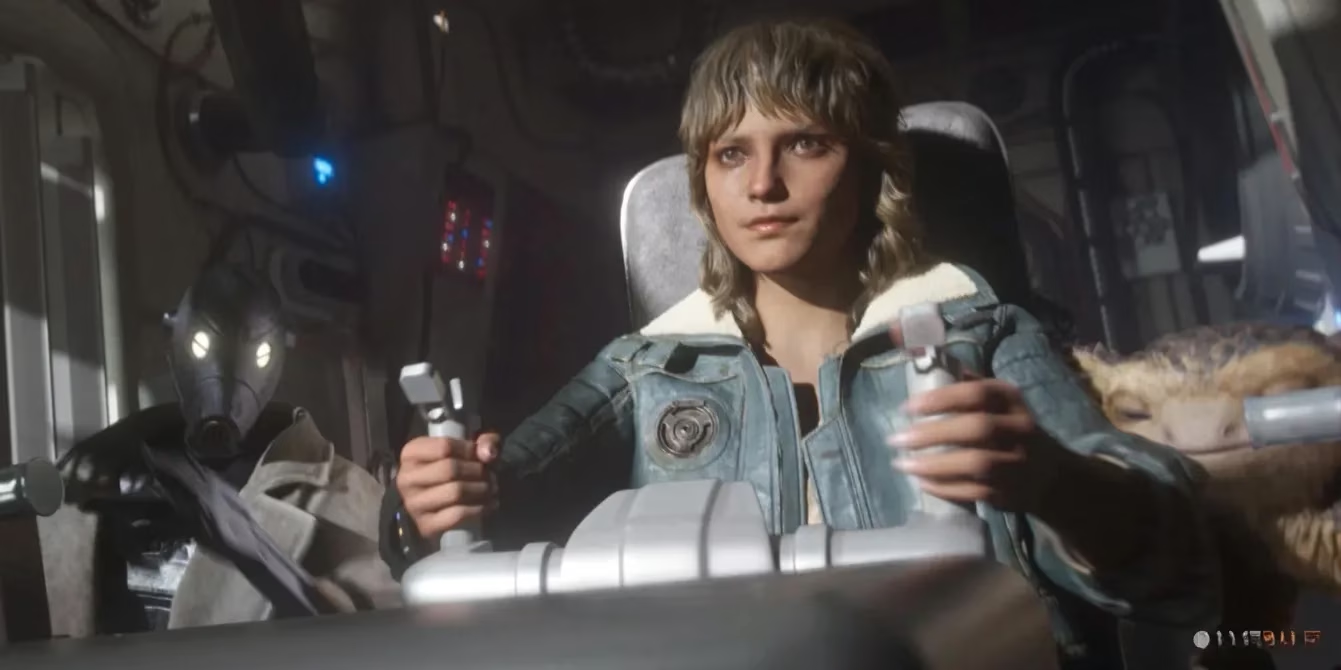
At the heart of this galactic promise lies the dance of space travel. Ubisoft has, from the first whispers of promotion, heralded the ability to move from the vacuum of space directly to a planet's surface—a transition that has become a modern gaming holy grail. The newest footage reveals this process not as a mere technical function, but as a cinematic sequence. Upon initiating a landing, control gently slips from the player's hands, not to a stark loading screen, but to a curated visual spectacle. This approach avoids the jarring interruption of a traditional load, instead weaving the transition into the fabric of the adventure itself. For a title of this ambition, it represents a carefully considered compromise, a poetic interlude between acts of exploration and conflict. It is the deep breath before the plunge, a moment where the game itself seems to pause and admire the scale of its own creation.
The Galactic Pendulum: Between Two Titans
Any discussion of virtual space exploration in the late 2020s inevitably swings between two colossal reference points: No Man's Sky and Starfield. These are the twin suns around which all other titles must navigate.
-
No Man's Sky offers a seamless, almost liquid transition from space to planet. Its universe feels continuous, a single, breathable entity. The immersion it creates is like diving into a silent, endless ocean—the surface breaks with barely a ripple.
-
Starfield, in stark contrast, fragments its cosmos. Its travel is infamously segmented by loading screens, creating a universe that feels more like a series of beautifully rendered dioramas behind glass than a cohesive, traversable whole. The attempt to fly manually from planet to planet often feels like running into an invisible, unyielding wall.
Star Wars Outlaws positions itself as the golden mean on this cosmic pendulum. It does not grant the utter, unfettered control of No Man's Sky, recognizing the immense technical burden of rendering its detailed, story-rich planets. Yet, by transforming the necessary loading into a cinematic event, it elevates the process far above Starfield's disruptive pauses. The transition is not hidden, but celebrated—it is the opening of a storybook page, a deliberate turn in the narrative rather than an interruption of it.
A Tapestry of Systems in a Living Galaxy
The space travel mechanic does not exist in a vacuum; it is but one thread in a richly woven tapestry. Star Wars Outlaws promises a galaxy that feels alive with consequence and opportunity:
| Feature | Description | Inspiration/Comparable Feel |
|---|---|---|
| Crime Syndicate Reputation | Your actions build or burn bridges with major galactic factions. | A dynamic, living world of shifting alliances. |
| Wanted System | Attract unwanted attention from law enforcement, requiring evasion or confrontation. | Evokes the escalating chaos of classic open-world crime dramas. |
| Lush Environmental Exploration | Diverse, hand-crafted planets for protagonist Kay Vess to discover. | The environmental storytelling and scale of Ubisoft's own finest open worlds. |
This ecosystem suggests a universe where every jump to hyperspace or descent through an atmosphere is a link in a chain of cause and effect. The space travel becomes the silent courier between these moments of drama, the umbilical cord tethering the player's story to the larger galactic narrative.
The Developer's Proven Hand
Ubisoft does not approach this frontier unprepared. Its legacy with Assassin's Creed and Far Cry is a chronicle of crafting worlds that beg to be traversed from every conceivable angle—across rooftops, through jungles, and over mountain ranges. The studio understands the topography of player freedom. Applying this philosophy to the ultimate frontier, space, was the next logical leap. In Star Wars Outlaws, they have not attempted to reinvent the hyperdrive but have instead focused on perfecting the journey's rhythm. They have found a strong middle ground, a cadence that respects both technical limitations and the player's desire for immersion. The cinematic landing sequence is not a surrender to loading times, but a masterful sleight of hand, a magician's flourish that directs your gaze to the wonder, not the mechanism.
The Uncharted Horizon
As the year 2026 approaches, the final shape of Star Wars Outlaws as a complete experience remains veiled like a nebula. Yet, the clarity with which it presents its vision of space exploration is a beacon of confidence. It promises a galaxy that feels traveled, not merely teleported through. It understands that in the Star Wars mythos, the ship is not just a vehicle; it is a home, a character, and a vessel for dreams. By treating the act of travel with this poetic reverence, Star Wars Outlaws aims to capture a feeling often lost in the pursuit of pure simulation: the awe of the journey itself. It seeks to make the player not just a pilot, but a poet of the parsecs, charting a course through a living legend where every transition from star-dusted void to alien soil is a verse in an epic yet to be fully told.