Star Wars Outlaws: The Cosmic Tapestry That Saved Open Worlds
Star Wars Outlaws revolutionizes open-world exploration with hand-crafted, curiosity-driven design, offering a galaxy of unique wonders.
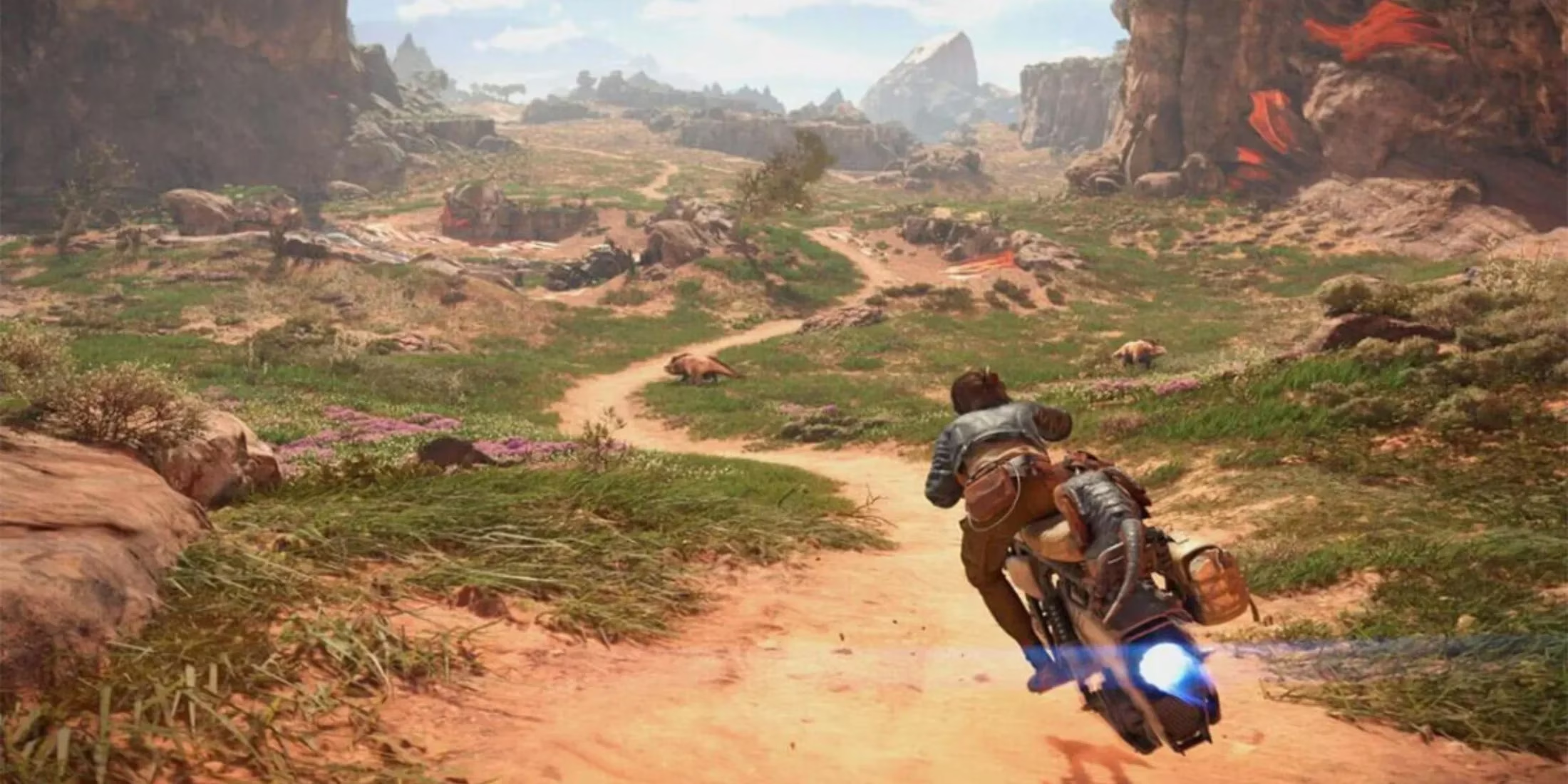
As I sit here in 2026, my controller still humming with the echoes of a galaxy far, far away, I can barely contain the volcanic eruption of joy that is my gamer soul. Let me paint you a picture of the grand cosmic banquet that is Star Wars Outlaws—a game that didn’t just break the mold of open-world design; it vaporized it with a disruptor rifle and rebuilt it from stardust. For years, we’ve wandered through bloated digital wastelands where developers treated creativity like a lazy protocol droid treats a rusty motivator, but Massive Entertainment has delivered a masterpiece that feels like a symphony composed by a choir of Force ghosts. The open-world genre, that lumbering Hutt of a design philosophy, has finally been slashed down to size with a lightsaber of intentionality, and I’m here to shout from the spires of Coruscant about how this game reshaped my very understanding of virtual exploration.
The standard open-world formula, as we’ve known it, is a crumbling architectural relic—a Sarlacc pit of monotony that swallows players whole with its endless, identikit content. Too often, developers wield a "copy-and-paste" design doctrine like a stormtrooper blasting blindly, flooding maps with repetitive activities and collectibles that cluster together like a swarm of mynocks on a power cable. I’ve trudged through the catacombs of Elden Ring, where every dungeon felt like a déjà vu nightmare of the last, and galloped across Ghost of Tsushima’s beautiful but suspiciously familiar fields, my enthusiasm draining like a leaky hyperdrive. Even Final Fantasy 7: Rebirth, with its soul-stirring narrative, couldn’t escape the gravitational pull of this lazy vortex. But Star Wars Outlaws? It’s a shimmering nebula of innovation, a celestial rebel that strapped a jetpack to Ubisoft’s tired model and rocketed it into orbit. The game’s designers clearly understood that a vast open world isn’t just a blank canvas to be spammed with filler—it’s a living tapestry that must be threaded with the golden filaments of curiosity-driven discovery.
Let me drag you into the deliciously hand-crafted chaos of this universe, where every location feels like a bespoke jewel plucked from the treasure hoard of a Mon Calamari admiral. Imagine descending into the hollowed-out wreckage of an old starship on Toshara’s windswept plains—the metal ribs groaning overhead like a dying bantha, while a hidden datapad whispers secrets of a forgotten smuggler. Or picture the moment I stumbled into a sinkhole on Akiva, its depths glittering with treasure as if the planet itself had coughed up a lungful of diamonds. There’s no algorithmic mediocrity here; the game world is a kaleidoscopic fever dream of visual nuance, where I never once felt the bitter tang of repetition. Each planet is its own distinct organism, from the dusty mechanic’s paradise of Mirogana to the cluttered neon underbelly of Kijimi City, and I tasted the rare sweetness of a developer that cared enough to sculpt every alleyway and vendor stall with the precision of a Geonosian architect. This approach is a meteor strike to the copy-paste epidemic, a defiant roar against the burnout that’s sickened so many adventurers like a galactic plague.
Now, let’s talk about the cantinas, those glorious dens of scum and villainy that could have so easily been a parade of clones. In a lesser game, each bar would be a cardboard cutout—same sticky floors, same wobbly Bith band, same grumpy bartender polishing the same glass until the heat death of the universe. But Star Wars Outlaws? No! I sauntered into the smoky lounge of Mos Eisley, where a Twi’lek dancer’s lekku swayed like hypnotic pendulums, and then later crashed a high-stakes sabacc den on Cantonica, its chandeliers dripping with crystal tears. Each cantina is a distinct heartbeat, a miniature theater of galactic culture that keeps the experience as unpredictable as a wild bantha chase. The cities themselves are labyrinthine puzzles—Mirogana’s vertical slums stacked like a Jenga tower of despair, while Kijimi’s frozen streets twist into dead ends that hide black-market secrets. As I navigated these organic mazes in 2026, I couldn’t forecast vendor locations with the lazy certainty I’d wielded in other titles; the layouts defied patterns like a smuggler dodging Imperial patrols.
What truly sends me into a supernova of enthusiasm is how this game reengineers player psychology. The open world isn’t a checklist—it’s a gravitational pull toward the unknown, a siren song that lures you with whispers of hidden caches and environmental storytelling. I felt like a genuine scoundrel-explorer, my senses humming with the thrill of unscheduled detours. One minute, I was chasing a rumor about a downed TIE fighter; the next, I was knee-deep in a jungle cave, fighting off gundarks to snatch a relic that glowed with ancient malice. This design philosophy is a cleansing fire, burning away the choked clutter of a hundred useless map markers and leaving only the pure, unadulterated joy of wandering. The industry has been gasping for such dedication, heaving with the exhaustion of cookie-cutter gigantism, but this game is a prototype starfighter pointing toward a brighter future for the genre. I’m not just playing a game here; I’m dancing with a restored faith in what virtual worlds can achieve, and every session feels like unearthing a relic from a lost civilization of masterful design.
In 2026, as we stand on the precipice of new hardware and wilder ambitions, Star Wars Outlaws remains a beacon—a pulsing hyperspace prism that refracts the cluttered, weary chaos of modern open-world games into a coherent beam of brilliance. It’s a reminder that hand-crafted artistry, not procedural glut, is the true Force behind unforgettable adventures. My fingers are still twitching with the muscle memory of navigating its unique cities and cantinas, and I’m confident this isn’t the last time we’ll see such soul poured into a digital expanse. Until then, I’ll keep my engines primed and my eyes on the horizon, ready for the next curious signal in the void.