Star Wars Outlaws: The New Hope for Star Wars Gaming in 2026
Star Wars Outlaws is the groundbreaking AAA game heralding a new era for Star Wars video games, unlocking unprecedented potential beyond the EA exclusivity era. This open-world adventure promises to revolutionize the galaxy far, far away with its innovative gameplay and compelling narrative.
Alright folks, gather 'round! Let's talk about something that's got my inner Star Wars nerd doing backflips. It's 2026, and we're living in what feels like a golden age for the galaxy far, far away. We've had the emotional gut-punch of The Bad Batch finale, the epic adventures of The Mandalorian, and the gritty realism of Andor. But let's be real, for a while there, the video game side of the Force felt... unbalanced. Enter Star Wars Outlaws. This isn't just another game; it feels like the key that's finally unlocking a door we've been staring at for a decade.
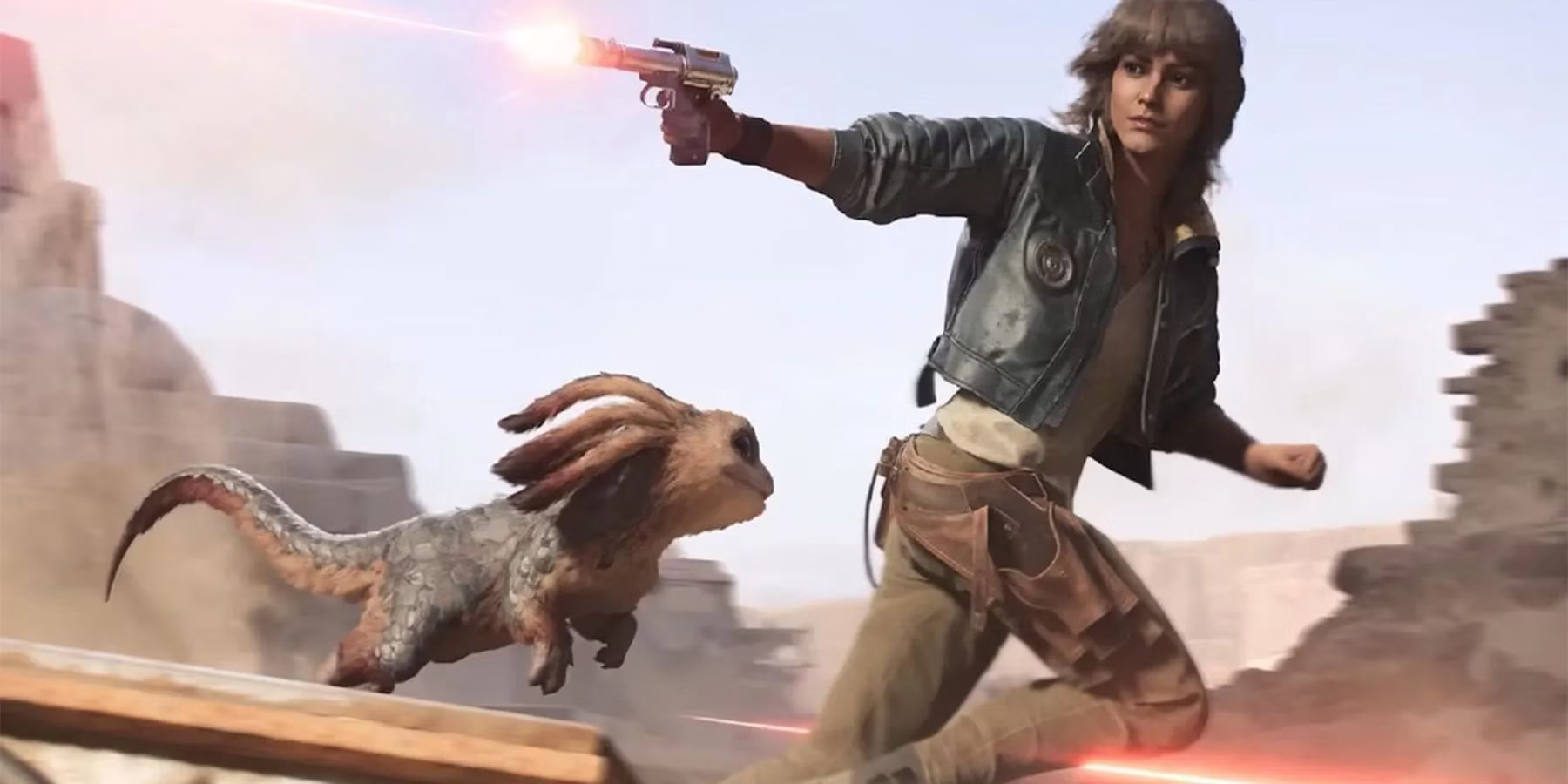
See, for the last ten years, EA held the exclusive keys to the Star Wars gaming kingdom. It was like having only one chef in a massive galactic cantina—sometimes you got a masterpiece like Star Wars Jedi: Survivor, and other times... well, let's just say the portions felt a bit light (looking at you, early Battlefront days 😅). The menu was limited. But in 2026, that exclusive contract is ancient history. Star Wars Outlaws from Ubisoft Massive isn't just a new game; it's the first major, non-EA AAA Star Wars title since Disney bought Lucasfilm. That's a bigger deal than a Wookiee winning a game of Dejarik! It's the herald of a new era, and the pressure is on like a Star Destroyer's tractor beam.
Why This is a Galactic Game-Changer 🚀
Let's break down why this shift is so monumental. For years, the development landscape was... predictable. It was like watching the same hyperspace route get plotted over and over.
-
The EA Era (2013-2023): A mixed bag, honestly.
-
DICE's Battlefront Games: Gorgeous visuals, but launch content was thinner than a protocol droid's patience. The microtransaction model initially was about as popular as a sandstorm on Tatooine.
-
Respawn's Jedi Series: These were the hits! Fallen Order and Survivor proved that single-player, story-driven Star Wars games could be critical and commercial successes. They were like finding a fully-functional lightsaber in a junk pile—a glorious surprise.
-
Motive's Squadrons: A fantastic, focused love letter to starfighter combat, but it felt more like a hearty side dish than a main course.
-
-
The New Dawn (2026 and Beyond): The exclusivity wall is down! The development galaxy is expanding faster than a clone army.
| Studio | Project | The Vibe |
| :--- | :--- | :--- |
| Ubisoft Massive | Star Wars Outlaws | The trailblazer! First open-world Star Wars game. High risk, high reward. |
| Quantic Dream | Star Wars Eclipse | Narrative-heavy, likely choice-driven drama. Could be an interactive Star Wars movie! |
| Respawn Entertainment | Jedi Game #3 | The safe bet. We know Cal Kestis's story isn't over, and fans are hungry for more. |
| ??? | Probably 5+ other projects | The mystery box! This is the most exciting part. |
Star Wars Outlaws is carrying the weight of this transition. If it succeeds, it proves to Disney and other publishers that diversifying development leads to a healthier, more creative ecosystem. It could be the template that changes everything. But if it stumbles? It might make big studios hesitant again. No pressure, Ubisoft!
The Open-World Frontier: Scum, Villainy, and Endless Possibilities
This is the big one. Outlaws is promising the first true open-world experience in Star Wars. We're not talking about semi-linear levels with a few branching paths. We're talking about jumping in our own ship, flying from planet to planet, getting into trouble with syndicates, and forging our own path in the criminal underworld between Empire Strikes Back and Return of the Jedi. Think of it as the Star Wars version of a spaghetti western, but with more aliens and blasters.
For me, the potential here is more intoxicating than the fumes from a Podracer engine. Imagine:
-
Dynamic Encounters: Getting into a dogfight with TIE Fighters over the dunes of Tatooine, then dipping into the atmosphere to lose them in the canyons.
-
Faction Reputation: Playing the Hutt Cartel against the Pyke Syndicate, where your choices actually affect who offers you jobs or puts a bounty on your head.
-
Your Ship, Your Home: Customizing and upgrading our vessel, the Trailblazer, which will hopefully feel less like a menu and more like actually tinkering in a hangar bay.
The promise of a "living galaxy" is a trope as old as time, but in the hands of a studio known for detailed worlds (hello, The Division), it could finally feel real. It needs to be a universe that feels alive when you're not there, not just a pretty backdrop for missions. It has to be a ecosystem, not just a diorama.
Looking to the Horizon: A Galaxy of Games
While Outlaws is the headline act this year, the future lineup is starting to look as crowded as the Mos Eisley cantina. We've got Quantic Dream's Star Wars Eclipse, which is about as mysterious as a Sith Lord's motives. Then there's the inevitable third Jedi game from Respawn—a sequel I need like a Jawa needs scrap. And you just know there are other projects in early development across the industry now that the exclusivity is gone.
The failure or success of Outlaws won't stop this new era. It might speed it up or slow it down, but the dam has broken. The real victory for us fans in 2026 is choice. We're no longer waiting for one publisher to decide what kind of Star Wars game we get. We could get a gritty RPG, a massive strategy game, a quirky indie title—the possibilities are endless.
So, is Star Wars Outlaws the chosen one? It's too early to tell. It could be a legendary masterpiece that opens the floodgates, or it could be a flawed but fascinating first step into a larger world. Either way, its mere existence is a win. It represents freedom, competition, and the hope that the next decade of Star Wars games will be as vast, varied, and exciting as the galaxy itself. Now, if you'll excuse me, I need to go polish my blaster and practice my smugglers' smirk. The Outer Rim awaits! ✨
This overview is based on Entertainment Software Association (ESA), whose industry reporting helps frame why a post-exclusivity moment like Star Wars Outlaws matters beyond hype: when more major publishers can compete on big licensed releases, it tends to increase portfolio variety, spread risk across studios, and raise expectations for polish, post-launch support, and consumer-friendly monetization—exactly the pressures shaping whether an ambitious open-world Star Wars game can become a sustainable template for the next wave of galaxy-spanning projects.