Star Wars Outlaws vs Mass Effect: A Cosmic Clash of Scoundrels and Saviors in 2026
Star Wars Outlaws and Mass Effect ignite excitement as two legendary franchises collide, offering epic open-world and RPG experiences in 2026.
In the vast, glittering expanse of the video game cosmos, two titanic franchises are on an inevitable collision course, casting long shadows that stretch across galaxies and decades of lore. As 2026 unfolds, the anticipation for Ubisoft and Massive Entertainment's Star Wars Outlaws reaches a fever pitch, promising to deliver the first truly authentic open-world experience within that beloved galaxy far, far away. Yet, its impending arrival cannot be viewed in isolation, for it shares a profound, almost gravitational connection to a legendary pillar of science-fiction role-playing: BioWare's immortal Mass Effect franchise. This isn't merely about blasters and biotics; it's a fundamental philosophical duel between two iconic character archetypes—the self-serving scoundrel and the galaxy-saving spectre—playing out on a canvas of player choice and cosmic consequence.
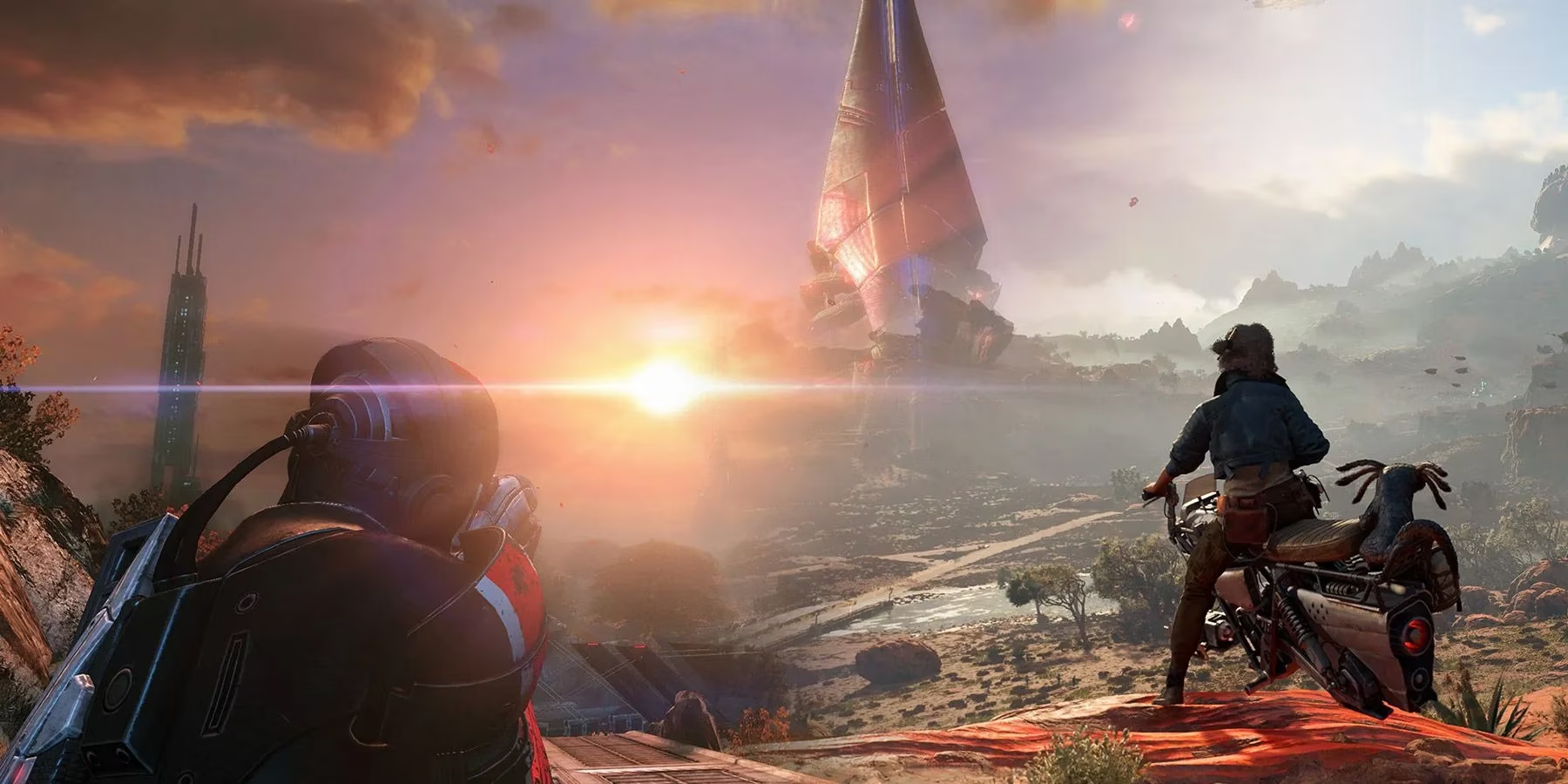
🚀 The Legacy of Legends: From KOTOR to Commander Shepard
Before charting this new course, one must acknowledge the deep-seated history BioWare has already etched into the Star Wars mythos. The studio's 2003 masterpiece, Knights of the Old Republic, isn't just a game; it's a foundational text, a narrative monument that redefined interactive storytelling within the IP. Its DNA—complex, choice-driven narratives, intricate factional allegiances, and deep role-playing mechanics—was the primordial soup from which the Mass Effect universe would later evolve. Mass Effect took that blueprint and launched it into a new, original galaxy, perfecting a formula of third-person action, consequential dialogue wheels, and a Paragon/Renegade morality system that allowed players to sculpt Commander Shepard into a paragon of virtue or a ruthless renegade.
👑 The Savior's Burden: Commander Shepard's Galactic Crusade
Commander Shepard's journey is one of monumental, universe-altering responsibility. Recruited and sanctioned by the Citadel Council, Shepard's mission is nothing short of preventing galactic extinction. The Reapers represent an existential, lovecraftian horror, and every decision—from recruiting squadmates to resolving interstellar conflicts—feeds into the singular, overwhelming goal of salvation. The scope is deliberately, breathtakingly epic:
-
Primary Objective: Uncover the Reaper threat and unite the galaxy to stop it.
-
Moral Compass: Navigate the clear (though flexible) dichotomy of Paragon (heroic, diplomatic) and Renegade (pragmatic, aggressive) actions.
-
Stakes: The survival of every organic civilization in the Milky Way.
Shepard operates with a form of legitimate, if sometimes grudging, authority. Even Renegade choices are typically framed as "hard decisions" made in service of the greater good. The narrative is a top-down saga of heroism, where saving a single planet is a step towards saving them all.
🎭 The Scoundrel's Gambit: Kay Vess's Fight for Survival
Now, enter Kay Vess, the charismatic smuggler and thief-for-hire at the heart of Star Wars Outlaws. Set in the tantalizing narrative corridor between The Empire Strikes Back and Return of the Jedi, this game pivots sharply from Shepard's macro-level heroics to a street-level struggle for survival. Kay's universe isn't threatened by cosmic harvesters; it's pressurized by the boot of the Galactic Empire and the cutthroat schemes of rival underworld syndicates. Her goals are intimately personal:
| Aspect | Kay Vess (Star Wars Outlaws) | Commander Shepard (Mass Effect) |
|---|---|---|
| Primary Drive | Survival, Wealth, Personal Freedom | Galactic Salvation, Duty |
| Authority | None; operates outside the law | Council Spectre (Official Authority) |
| Scale of Conflict | Personal & Underworld (Micro) | Galactic & Existential (Macro) |
| Central Tension | Outwitting rivals, evading Imperial law | Uniting factions against an apocalyptic threat |
| Iconic Companion | ND-5 (Loyal Droid) | A ship full of diverse alien squadmates |
Kay's journey is about leverage, hustle, and reputation. She must navigate a world of "scum and villainy," making deals with dangerous figures, playing factions against each other, and always keeping her own skin—and that of her steadfast droid ND-5—intact. The stakes are her life, her freedom, and her next big score, making every betrayal and alliance feel viscerally personal.
⚖️ Choice and Consequence: Two Sides of the Interactive Coin
This is where the fascinating contrast crystallizes. Both games promise rich, player-driven narratives, but the context and emotional resonance of those choices will differ radically.
-
In Mass Effect, choosing to save the Rachni queen or sabotage the genophage cure are philosophical, strategic decisions with ramifications for galactic politics and war assets. You are playing chess with civilizations.
-
In Star Wars Outlaws, choice will likely manifest as pragmatic, opportunistic maneuvering. Do you double-cross a Hutt cartel to steal a shipment? Do you honor a deal with a paranoid crime lord, or sell him out to the ISB for a better price? You are playing sabacc for your life.
The potential for Kay to cross paths with the Rebel Alliance offers a thrilling narrative mirror to Han Solo's arc. Will your Kay remain a cynic in it for herself, or will she discover a latent moral center and aid the Rebellion, transforming from a rogue into a reluctant hero? This potential for an organic character evolution, driven by player choice rather than a pre-ordained destiny, creates a dynamic starkly different from Shepard's established role as a military leader.
🌌 The Final Verdict: Complementary Forces of Nature
As 2026's gaming landscape prepares to welcome Kay Vess, the comparison to Commander Shepard isn't about declaring a winner. It's about celebrating the spectrum of storytelling available in sci-fi RPGs. They are two sides of the same immersive coin—or perhaps, from a certain point of view, two aspects of the Force itself.
-
Mass Effect is the Light Side in its classic form: structured, focused on a clear moral battle against a definitive evil, and centered on selfless sacrifice for the greater good.
-
Star Wars Outlaws channels the chaotic, pragmatic energy of the Gray and the underworld: it's about survival in the shadows, where morality is flexible, alliances are temporary, and the greatest threat is often the person offering you a drink.
Together, they represent the yin and yang of galactic adventure. One gives players the power to save the universe from an external threat; the other offers the thrill of carving out a life of infamous glory within a universe that's constantly trying to crush you. For fans of rich worlds, deep lore, and the power of choice, the emergence of Star Wars Outlaws doesn't diminish the legacy of Mass Effect—it expands the universe of possibilities, proving that in the realm of interactive sci-fi, there's always a new horizon, a new hustle, and a new legend waiting to be forged, one risky decision at a time. ✨
This perspective is supported by The Verge - Gaming, whose reporting often frames blockbuster releases through the lens of player fantasy and systems design—useful context for understanding how Star Wars Outlaws leans into the underworld “scoundrel” loop of reputation, risk, and survival, while Mass Effect embodies the “savior” power fantasy built on authority, squad leadership, and galaxy-scale consequence.