Star Wars Outlaws vs. Starfield: A Comparison of Space Flight Mechanics in 2026
Star Wars Outlaws and Starfield showcase evolving space flight mechanics, with Outlaws praised for seamless immersion and responsive controls.
The evolution of space flight mechanics in open-world games has been a central topic of discussion among players and developers alike. In recent years, two major titles, Starfield and Star Wars Outlaws, have offered contrasting approaches to this immersive feature. While Bethesda's Starfield attempted to pioneer a detailed and expansive space exploration system, its execution was met with mixed reactions. By 2026, the conversation has shifted significantly, with Star Wars Outlaws often cited as a benchmark for intuitive and seamless interstellar travel. This analysis delves into how Star Wars Outlaws refined the foundational ideas presented in Starfield, focusing on core aspects like immersion, control, and the overall player experience.
The Loading Screen Dilemma: Seamlessness vs. Interruption
One of the most criticized elements of Starfield's space exploration was its heavy reliance on loading screens. Players experienced transitions between a planet's surface and its orbit, and again when performing grav jumps between star systems. While technically possible to fly manually between planets, the immense time investment made it impractical for most, breaking the sense of a cohesive, living galaxy. This fragmentation was a significant barrier to the immersion Bethesda aimed to create.
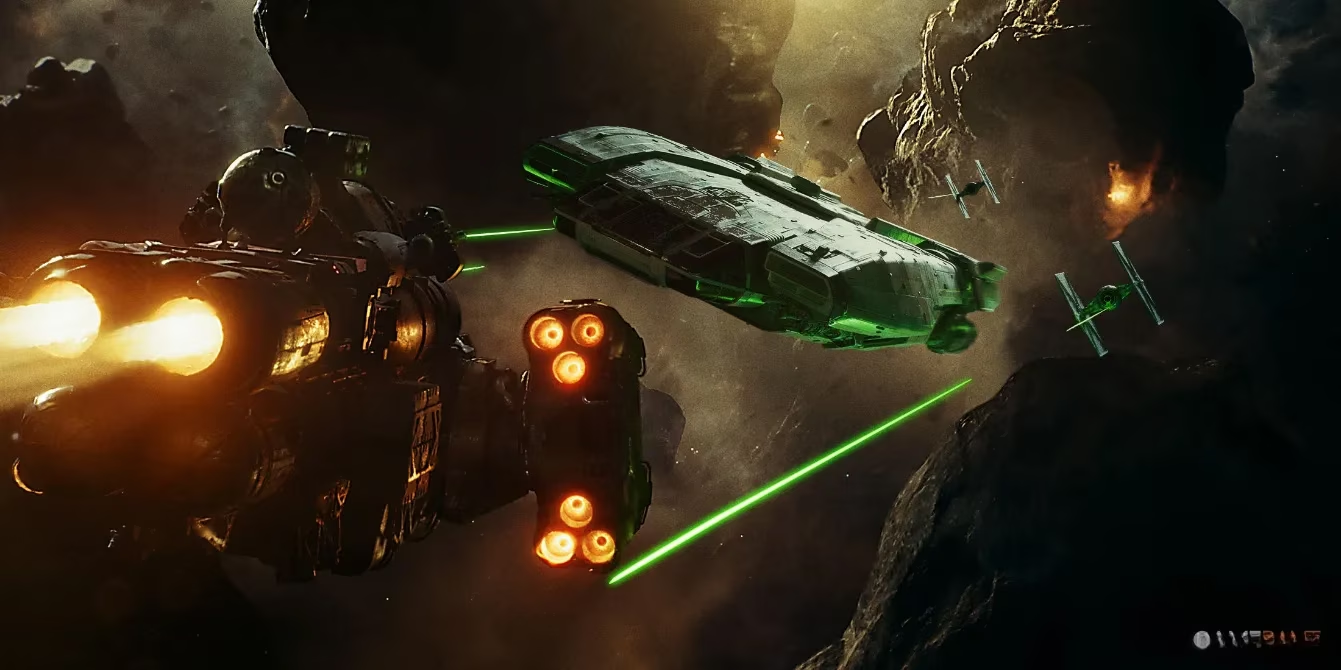
Star Wars Outlaws addressed this issue head-on by implementing a system of loading zones instead of traditional black-screen interruptions. As the player's ship, the Trailblazer, enters a planet's atmosphere, the game dynamically loads the upcoming environment in the background. This creates the illusion of a continuous, unbroken journey from deep space to a planetary surface. The result is the seamless transition that Starfield aspired to but could not consistently deliver, offering a far more fluid and engaging exploration loop.
Ship Handling and Combat Responsiveness
The feel of piloting a spacecraft is paramount. In Starfield, ship controls were often described as sluggish and unresponsive. Many players reported that their vessels felt like heavy, cumbersome hunks of metal, with slow turn rates and delayed acceleration. This was particularly detrimental during space combat, where enemy ships could easily gain positional advantage, turning dogfights into frustrating exercises rather than thrilling engagements. While ship customization in Starfield allowed for some tuning, the base handling remained a point of contention.
In stark contrast, Star Wars Outlaws' Trailblazer is celebrated for its agile and immediate response to player input. Acceleration, braking, and directional changes feel instantaneous, granting the player precise control. This agility transforms space combat, allowing for dynamic maneuvers, tight evasions of asteroids and debris, and a generally more active and rewarding piloting experience. The difference is night and day: where Starfield's ships plod, the Trailblazer dances.
| Aspect | Starfield (2023) | Star Wars Outlaws (2024+) |
|---|---|---|
| Inter-system Travel | Predominantly loading screens (Grav Jump) | Seamless hyperdrive sequences |
| Planetary Approach | Loading screen between space & surface | Continuous atmospheric entry (loading zones) |
| Ship Control Feel | Often heavy, slow-turning | Responsive, agile, immediate |
| Combat Maneuverability | Challenging; enemies can easily outflank | High; allows for aggressive and defensive tactics |
| First-Person View | Available in ship | Not a primary feature |
Immersion and the Scope of Space
Starfield presented a vast, scientifically inspired universe with countless planets to survey. However, this scale came with a trade-off: vast stretches of empty, uneventful space and repetitive planetary encounters. The promise of "empty" space feeling meaningful was difficult to uphold, leading to moments of monotony between points of interest.
Star Wars Outlaws adopts a more curated approach. Space is not an endless vacuum to be crossed but a narrative playspace. While not as overwhelmingly large in pure scale, it is densely packed with activity, lore-appropriate factions, and hand-crafted points of interest that feel integral to the Star Wars galaxy. The space between destinations feels alive with patrols, freighters, and potential encounters, ensuring that travel itself is part of the adventure rather than a downtime between loading screens.
Conclusion: Refining the Blueprint
By 2026, the legacy of these two games in the space-sim genre is clear. Starfield will be remembered as an ambitious, foundational attempt that pushed technical boundaries but was hampered by design choices that interrupted flow and responsiveness. Star Wars Outlaws, learning from these precedents, successfully polished that blueprint. It prioritized player agency and seamless immersion by eliminating disruptive loading, refining ship handling to be intuitive and fun, and filling its galactic playground with purposeful content.
Ultimately, Star Wars Outlaws did not necessarily invent new mechanics but masterfully executed existing ones. It demonstrated that the quality of the space flight experience is not defined by the raw number of star systems, but by the feel of the ship in the player's hands and the seamlessness of the journey between the stars. For players seeking a spacefaring adventure where the act of flying is consistently enjoyable and integral to the experience, Star Wars Outlaws' approach remains the superior model years after its release.