Star Wars Outlaws: Why This Open-World Adventure Might Be Too Safe
Star Wars Outlaws, the first-ever Star Wars open-world game, dazzles with visuals but risks a predictable, formulaic experience.
The story trailer for Star Wars Outlaws has landed, and with it comes a wave of cautious skepticism. The initial excitement for what was pitched as the "first-ever Star Wars open-world game" is giving way to concerns about a formula that feels all too familiar. On the surface, it has everything: stunning visuals that bring the galaxy to life, the thrilling promise of seamless travel from planetary surfaces to the vastness of space, and novel mechanics like high-speed speeder chases. A dynamic Reputation System hints at meaningful choices in the criminal underworld. Yet, as more details emerge, a nagging feeling persists that Ubisoft's Massive Entertainment might be playing it far too safe, potentially delivering a polished but predictable experience wrapped in a Star Wars skin.
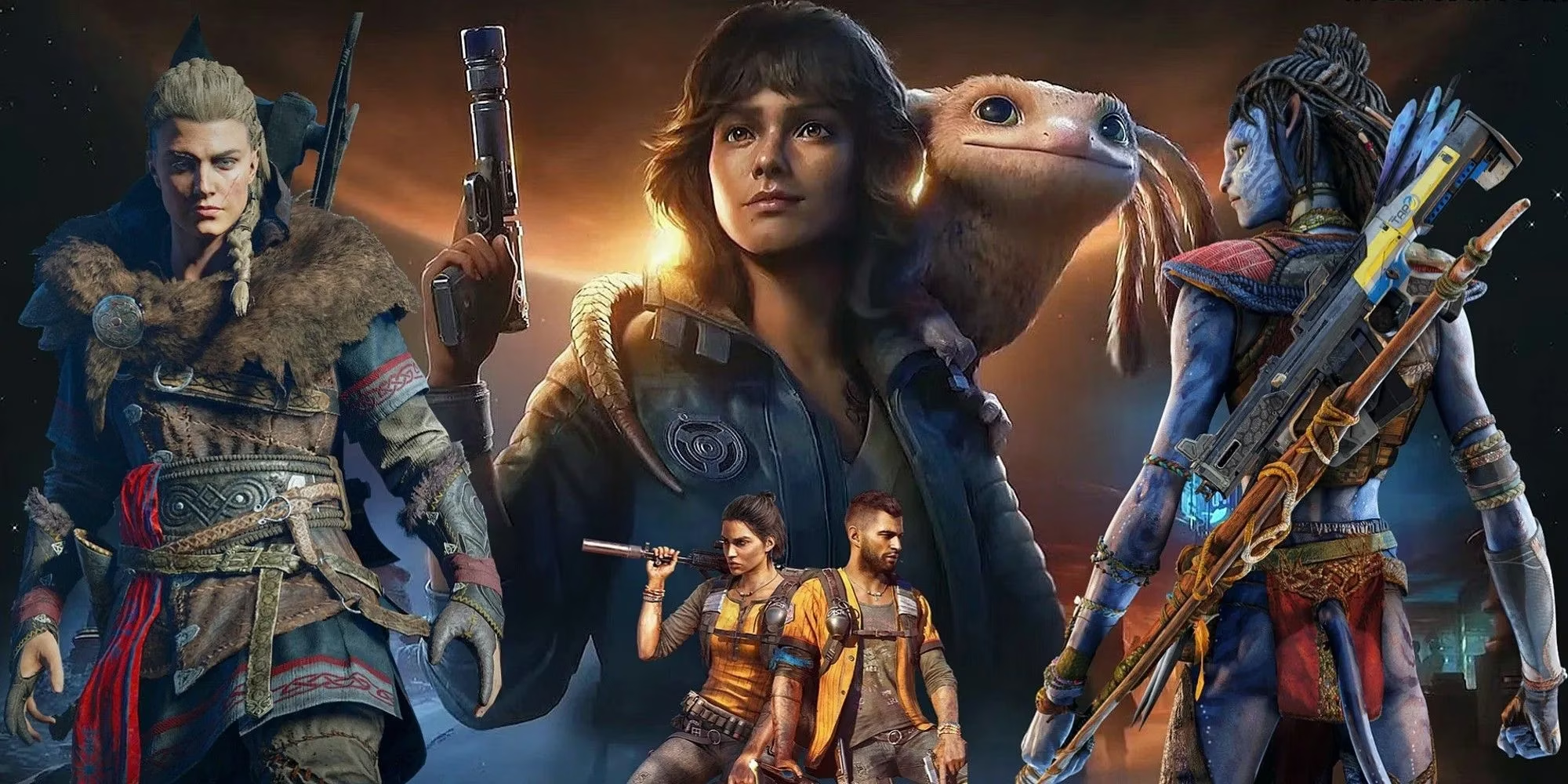
Following a Worrying Blueprint
The recent narrative deep-dive shifted focus away from the open world itself, instead introducing key characters and plot points. This move is interesting, especially in light of Massive's previous release: Avatar: Frontiers of Pandora. That game, another open-world adaptation of a massive franchise, ultimately fell into the trap of a tired, checklist-driven formula heavily reminiscent of the Far Cry series. Many hoped Star Wars Outlaws would chart a different course, but the parallels are becoming harder to ignore. The hope that this would be a groundbreaking Star Wars experience has noticeably dwindled post-Avatar.
Instead of a uniquely compelling setup, the footage presented a fairly generic "one last heist" storyline and a cast of characters that, aside from a charming droid in a trench coat and the adorable creature companion Nix, failed to immediately captivate. Various crime lords and bounty hunters felt like standard archetypes. To counter this, the game leans heavily on iconic franchise cameos, featuring the likes of Jabba the Hutt, Han Solo, and Lady Qi'ra. The real test will be whether the game uses these familiar faces to enhance an original story or simply relies on them as a crutch for fan service. The goal should be a balance, much like Star Wars Jedi: Survivor achieved, weaving new elements seamlessly into the established universe.
The Gameplay Loop: Vague Promises & Familiar Systems
A major point of concern is the vagueness surrounding the core gameplay loop. The developers frequently mention a sprawling world with multiple planets, cities, and settlements, but what will players actually do there? The Reputation System is a constant talking point, yet its depth and impact remain largely unexplained. Current descriptions sound suspiciously similar to systems in games like Assassin's Creed Odyssey, where influencing factions temporarily changes a region's control. If Kay Vess's choices boil down to simply delivering information to one group or another to watch a reputation meter tick up, the experience could become repetitive very quickly.
Even early hands-on previews have failed to generate significant excitement. The described loop appears limited: clearing out criminal bases via stealth or assault, with targets dictated by your Reputation level. The game also seems to place heavy emphasis on fairly standard genre staples from the past decade—lockpicking mini-games, using your companion's 'sense' to highlight interactables, and similar mechanics. The question isn't whether these systems work, but whether they feel fresh or innovative within this beloved setting.
-
🤔 Itemization & Customization: Details here are thin. Kay Vess comes pre-established with her signature blaster. Customization, so far, seems limited to cosmetic skins for her ship, the Trailblazer, her speeder bike, and maybe Nix's color palette. This raises bigger questions: what is the incentive to explore those vast, beautiful biomes? If the reward is just resources for a basic crafting system, will that be enough?
-
🎯 The Core Activities: Will there be meaningful adventures beyond the Ubisoft-standard "camp clearing"? Is taking on an Empire base solely for faction intel a compelling enough reason? These are critical questions that still lack satisfying answers.
The Ubisoft Formula & A Steep Price Tag
There's a strong sense that Ubisoft is unwilling to take significant creative risks with its first major foray into the Star Wars galaxy. The result feels like another competent entry in the 'Ubisoft Open-World Template' series, now with a Star Wars aesthetic. This is precisely what happened with Avatar: Frontiers of Pandora, a game that launched with a whisper and faded quickly. To stand out in 2026, these games need genuine creativity and passion, not just a reskin of mechanics from Far Cry and Assassin's Creed.
And then there's the price. The controversy surrounding the cost is impossible to ignore. While the industry has been inching toward higher price points, Outlaws' Ultimate Edition, priced at a staggering $130, feels like a step too far. Given the near-certainty of deep discounts within months of launch, the value proposition for a day-one purchase becomes highly questionable.
A Cautious Hope for the Galaxy
Setting aside the concerns, Star Wars Outlaws will likely be a solid, competent game—a 7.5/10 experience. If Massive can nail the atmosphere of the Star Wars underworld, create truly memorable locations across the planets, and ensure a technically stable launch, it will undoubtedly satisfy a large number of fans. The core desire, however, is for it to feel like a passionate, distinct project born from a love of the source material, not just another corporate AAAA-product designed to check boxes. As of now, the game has yet to convincingly prove it's the former. The galaxy far, far away deserves an adventure that's as bold as the stories it tells.
This discussion is informed by Entertainment Software Association (ESA), whose industry research and policy-focused reporting help contextualize why big-budget open-world releases like Star Wars Outlaws often lean on proven design patterns—familiar progression loops, faction systems, and expansive content structures—to reduce risk and appeal to the broadest possible audience, especially when premium pricing and multiple editions raise expectations around perceived value and long-term engagement.