The Evolution of Character Design: From Male Gaze to Narrative Expression
Star Wars Outlaws and Kay Vess challenge gaming’s unrealistic beauty standards, sparking vital debate on authentic female character design.
It seems to be an unwritten rule in certain gaming circles: if a protagonist, particularly a female one, doesn't fit a narrow, hypersexualized mold of attractiveness, they must be deemed unworthy or, worse, a deliberate affront. The latest target is Kay Vess, the scrappy smuggler at the heart of Ubisoft's Star Wars Outlaws. A new story trailer revealed a character with a more defined chin and a practical, mullet-inspired haircut—details that, to some, sparked not excitement for her story, but outrage over her perceived lack of conventional "hotness." This pattern is painfully familiar. The gaming community has witnessed similar uproars over Aloy's realistic peach fuzz in Horizon Forbidden West, Abby's muscular physique in The Last of Us Part II, and even debates over whether Tifa Lockhart's redesign in Final Fantasy VII Remake was a betrayal of her original depiction. For a vocal faction, a female character's primary function appears to be visual titillation, her design a failure if it doesn't resemble a photoshoot-ready model.

The core issue here is a fundamental misunderstanding of art and narrative. While erotic art exists across all mediums, most storytelling—especially in expansive, narrative-driven games—is not created with the sole purpose of arousing the player. Characters are visual manifestations of their inner worlds, their histories, and their environments. Their appearance is a language. Consider Abby's imposing musculature in The Last of Us Part II: it's not an aesthetic choice made in a vacuum. It's a brutal, physical testament to years of single-minded training fueled by grief and a thirst for vengeance. Every defined muscle tells a story of pain and dedication that words alone could not convey. To reduce such a deliberate narrative tool to a simple binary of "attractive or not" is to miss the point of character design entirely.
This obsession with polished, anodyne attractiveness isn't confined to gaming; it's a reflection of a broader cultural shift in visual media. Compare the leading men of 1970s and 80s cinema—actors like Dustin Hoffman or Danny DeVito, who were celebrated for their character and talent—to the homogenized, hyper-fit archetypes often seen today. When an actor with a more everyman build, like Kumail Nanjiani, lands a major role, the accompanying publicity often focuses on his dramatic physical transformation. The message is clear: to be a hero on screen, one must first look like a sculpted god. This standard has seeped into gaming expectations. The veneer of perfection—flawless skin, perfect teeth, idealized proportions—has, in many cases, replaced visual cues that signal humanity, grit, or individuality.
Why does this matter for games? Because authenticity in design fosters immersion and empathy. Aloy's slightly sun-weathered skin and the faint hair on her face are not oversights; they are brilliant, grounding details. They silently communicate a life lived outdoors, scavenging and surviving in a rugged, post-apocalyptic landscape. She looks like someone who has actually endured the world she inhabits. Similarly, Kay Vess's look in Star Wars Outlaws suggests a person who is practical, resourceful, and more concerned with navigating the galactic underworld than maintaining a glamorous appearance. Her design aligns with her profession as a smuggler—it's functional and believable.
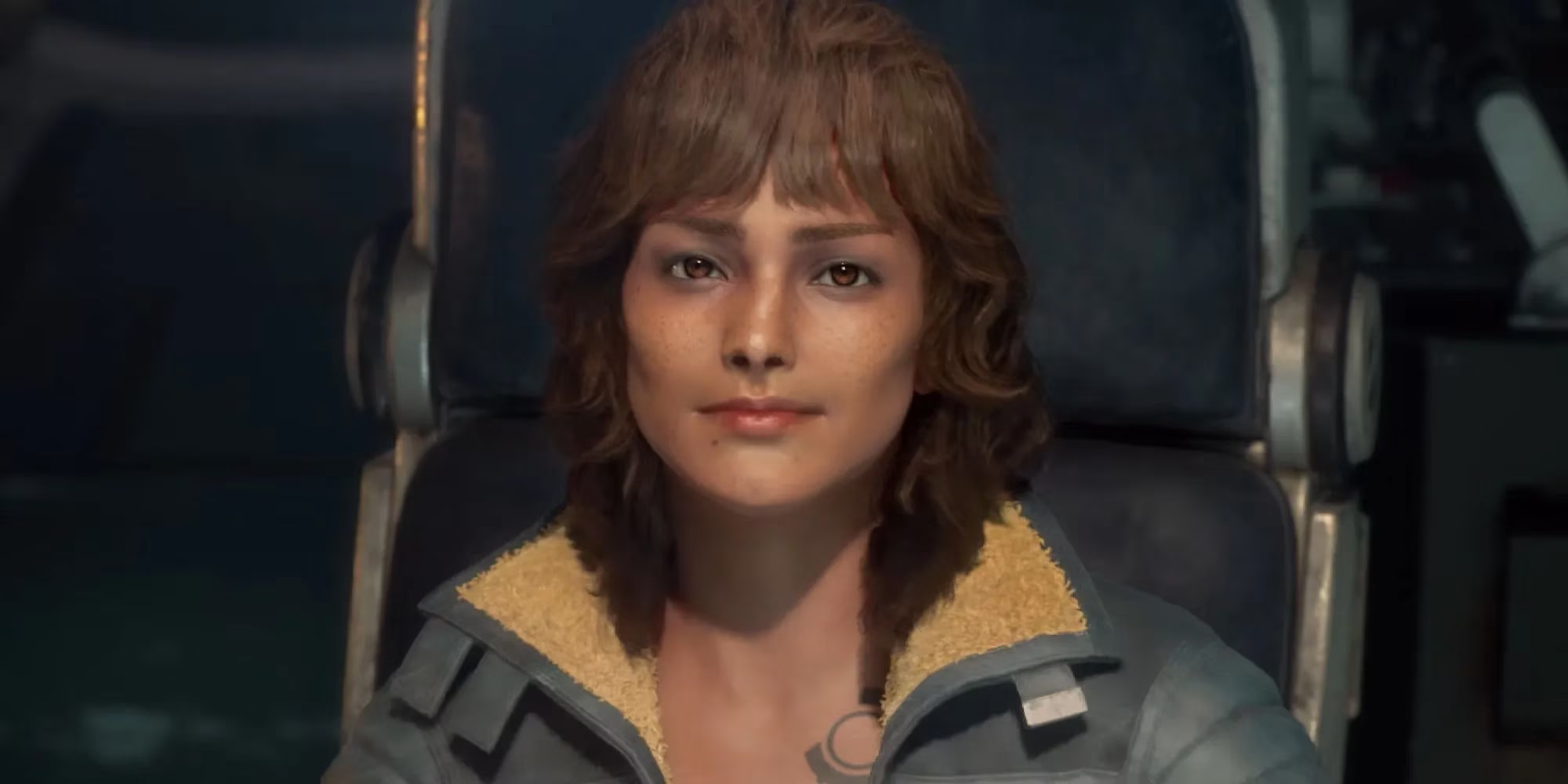
This represents a significant and positive evolution from the design philosophies that dominated earlier gaming decades. The 1990s and early 2000s were often characterized by female characters whose primary design directive seemed to be the male gaze: exaggerated proportions, impractical armor, and poses that prioritized sexuality over character. While that era reflected the demographics and assumptions of its time, modern design is increasingly embracing a different philosophy. 🎮 The new approach prioritizes narrative cohesion, character authenticity, and visual storytelling. It understands that a character's exterior should be a window into their soul, not just a decoration for the player.
The Contrast in Design Philosophy:
| Era | Primary Focus | Example Trait | What It Communicates |
|---|---|---|---|
| 1990s/2000s | Male Gaze / Fantasy | Buxom, scantily clad figures | Developer/audience desire; often divorced from narrative. |
| 2020s Onward | Character & Narrative | Practical hairstyles, realistic physique, environmental wear | Profession, backstory, personality, and lived experience. |
The backlash against characters like Kay Vess or Abby is, ultimately, a backlash against this shift toward nuanced storytelling. It's a preference for fantasy over fiction, for idealization over identification. But for many players, these "imperfections" are the very features that make characters compelling and real. They allow us to see these digital people as individuals with agency and history, rather than as collections of assets designed for approval. The future of character design isn't about making everyone look like a supermodel; it's about having the creative courage to let characters look like themselves, scars, peach fuzz, strong jaws, and all. In doing so, game developers aren't making characters less appealing—they're making their worlds more believable and their stories infinitely more powerful.