The Galactic Loading Screen War: Star Wars Outlaws vs Starfield's Immersion Revolution
Star Wars Outlaws and Starfield ignite a compelling debate over immersive loading screens, blending cinematic flair with efficient gameplay.
In the vast, competitive cosmos of gaming, a new battle has erupted—one not fought with blasters or lightsabers, but with the subtle, often-maligned art of the loading screen. Ubisoft's recent deep dive into Star Wars Outlaws has ignited a firestorm of debate that has spread across the galaxy faster than a hyperspace jump. The catalyst? A seemingly simple transition from the cold void of space to the dusty plains of Tatooine. During the Ubisoft Forward event, developers showcased over ten minutes of gameplay, revealing a landing sequence so seamless it left veteran spacers blinking in disbelief. As the scoundrel Kay Vess pilots her ship toward the planet, a prompt appears: 'Press A to initiate landing.' What follows is not the jarring, static screen of old, but a cinematic descent that masks its technical workings behind a veil of immersion. This single feature has become the focal point of an interstellar debate, pitting the communities of Star Wars Outlaws and Bethesda's Starfield against each other in a philosophical war over the very soul of the spacefaring adventure.
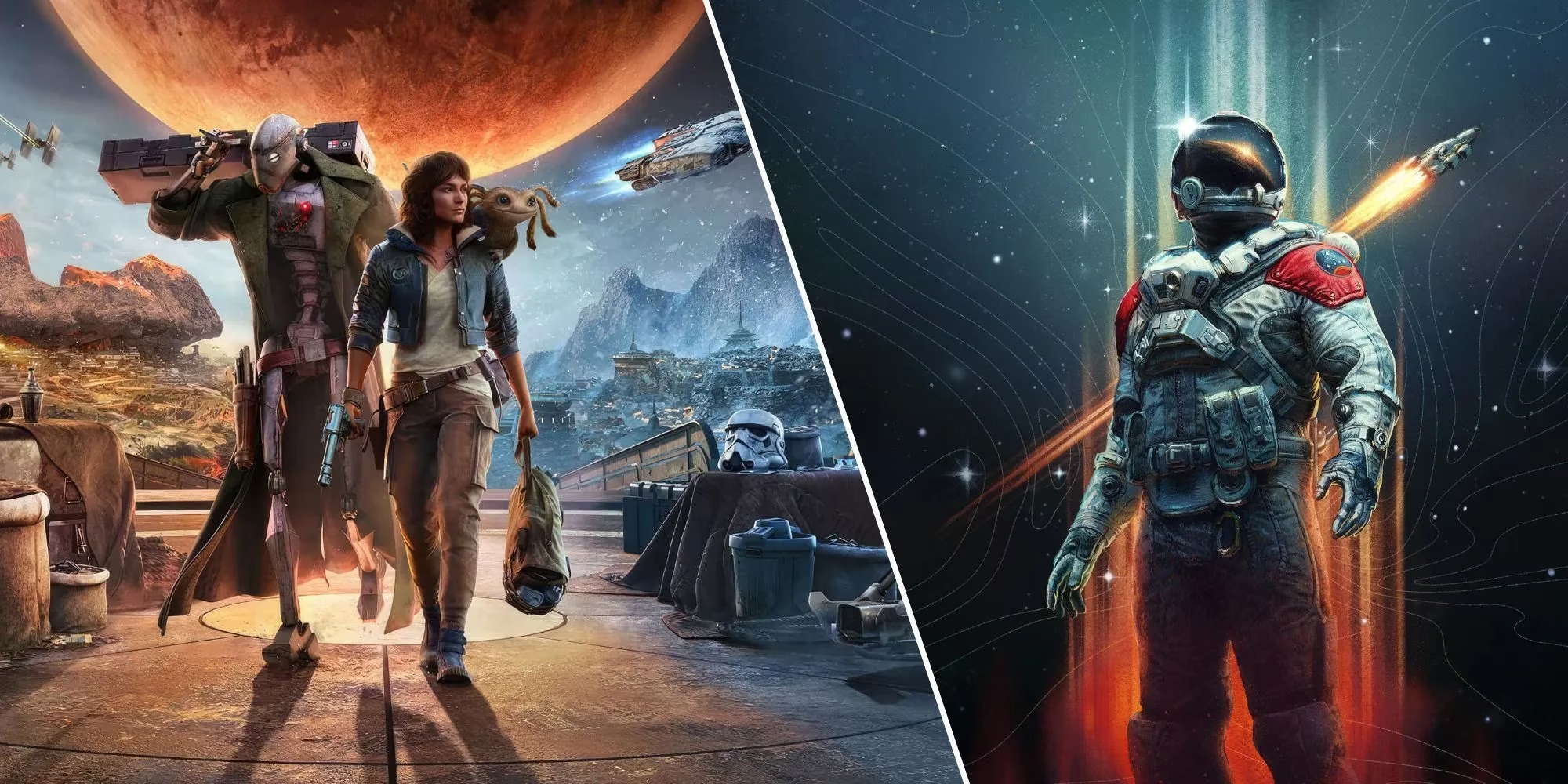
The Illusion of Seamlessness: Outlaws' Cinematic Sleight of Hand
Ubisoft's approach in Star Wars Outlaws is a masterclass in subterfuge. The game doesn't eliminate loading; it disguises it. The player selects a landing spot from a menu, much like in Starfield, but instead of a progress bar, the ship enters a controlled, cinematic descent through the atmosphere. This hidden loading screen is like a magician's distraction, directing the audience's gaze away from the trick being performed backstage. For many players, this is revolutionary. It maintains the fragile bubble of the game world, preventing that immersion-shattering moment where you're reminded you're just sitting in a chair holding a controller. The process is undeniably prettier, making the player feel like a true pilot navigating re-entry. However, critics have been quick to point out the cost: time. This immersive sequence appears to take significantly longer than Starfield's brief, traditional loading screens. For some, this trade-off is akin to choosing a scenic, winding mountain road over a direct highway—beautiful, but not efficient.
Starfield's Pragmatic Warp Drive: Speed Over Spectacle
On the other side of the nebula sits Starfield, a game built on a foundation of staggering scale. With over a thousand planets to explore, its design philosophy prioritizes function. Transitioning from orbit to surface triggers a quick, unmistakable loading screen. It's a brief interruption, a digital hiccup, before the action resumes. The Starfield community's argument is one of pure utility. When you're managing resources, surveying planets, and engaging in combat across a galaxy, frequent, short interruptions are preferable to fewer, longer cinematic sequences. Their loading screens are like the efficient, unceremonious airlock of a military frigate—it gets the job done without fanfare. The debate has grown so heated that it has exposed a fundamental divide in player psychology. Is the journey part of the experience, or is it merely an obstacle between destinations?
The Core of the Conflict: A Matter of Cosmic Scale
A crucial, often overlooked factor in this debate is the sheer difference in scope between the two games. Comparing them directly is, as some astute fans have noted, like comparing a meticulously curated artisanal bakery to an industrial bread factory. Both make bread, but their methods and outputs are worlds apart.
| Aspect | Star Wars Outlaws | Starfield |
|---|---|---|
| Number of Planets | A focused handful (roughly 5) | Over 1,000 procedurally generated worlds |
| Landing Philosophy | Cinematic, hand-crafted sequences | Quick, menu-driven transitions with loading screens |
| Primary Goal | Deep immersion in a curated Star Wars story | Unparalleled freedom and scale of exploration |
| Loading Experience | Hidden, longer, narrative-driven | Visible, faster, utilitarian |
The focused nature of Outlaws allows Ubisoft to pour resources into making each planet landing a unique, story-beat moment. Starfield's gargantuan scale makes such an approach technologically impossible—imagine a 20-minute cinematic every time you wanted to scan a barren ice ball for iron. This distinction is the gravitational center around which the entire argument orbits.
The Player's Dilemma: Time vs. Presence
Ultimately, this galactic loading screen war boils down to a simple, personal choice: What do you value more in your virtual escapism?
-
The Time-Conscious Scoundrel (Team Starfield): This player sees loading as dead time. They want to get back to the action—looting, shooting, or building—as fast as possible. A two-second loading screen is a minor nuisance; a thirty-second atmospheric entry is a patience-testing eternity. For them, immersion is built through gameplay agency and world density, not through unskippable animations.
-
The Immersion Purist (Team Outlaws): This player lives for the fantasy. The roar of the engines, the glow of atmospheric friction on the cockpit glass, the feeling of actually flying the ship—these moments are as important as the quests themselves. A loading screen is a fourth-wall-breaking cardinal sin. The longer, cinematic approach is not a delay; it's the gameplay equivalent of a sommelier letting a wine breathe, an essential step to fully appreciate the experience.
There is no universal right answer. The gaming galaxy in 2026 is vast enough to accommodate both philosophies. Star Wars Outlaws offers a guided tour through iconic locations with premium presentation, while Starfield provides a universe-sized sandbox where efficiency is king.
The Future of Virtual Travel
This debate signifies a pivotal moment for open-world and space-sim games. The era of the spinning wheel or progress bar as a standard is ending. Developers are now forced to innovate, to treat transitions not as technical necessities but as narrative opportunities. Outlaws' solution may be just the beginning. We might soon see:
-
Dynamic Ship Interior Activities: Use the 'loading' time to repair systems, check the galactic map, or converse with companions.
-
Procedural In-Flight Events: Random asteroid fields, distress signals, or pirate scans that occur during descent, making every landing unique.
-
Context-Sensitive Sequences: A damaged ship might have a rougher, more involved landing sequence than a pristine one.
The Star Wars Outlaws vs. Starfield loading screen war is more than a petty fan dispute. It is a fascinating snapshot of evolving player expectations and developer ingenuity. Whether you prefer the brisk efficiency of a teleporter or the slow-burn majesty of a starship's descent, one thing is clear: the humble loading screen will never be viewed the same way again. The final frontier is no longer just space—it's the seamless journey to get there.