Ubisoft Forced Star Wars Outlaws PS5 Early Access Players to Restart Progress in 2024
Ubisoft's Star Wars Outlaws early access players were forced to wipe their saves after a patch. The incident sparked outrage among premium buyers.
In the summer of 2024, the buzz around Ubisoft's ambitious open-world adventure Star Wars Outlaws reached a fever pitch. The game promised players a chance to live out their scoundrel fantasies among the stars, and early adopters were eager to get an early taste through the Gold and Ultimate Editions, which granted three days of exclusive pre-launch access. Just hours after these privileged players began their journeys across the Outer Rim, however, a sudden and jarring contradiction emerged: to save their progress, they first had to destroy it.
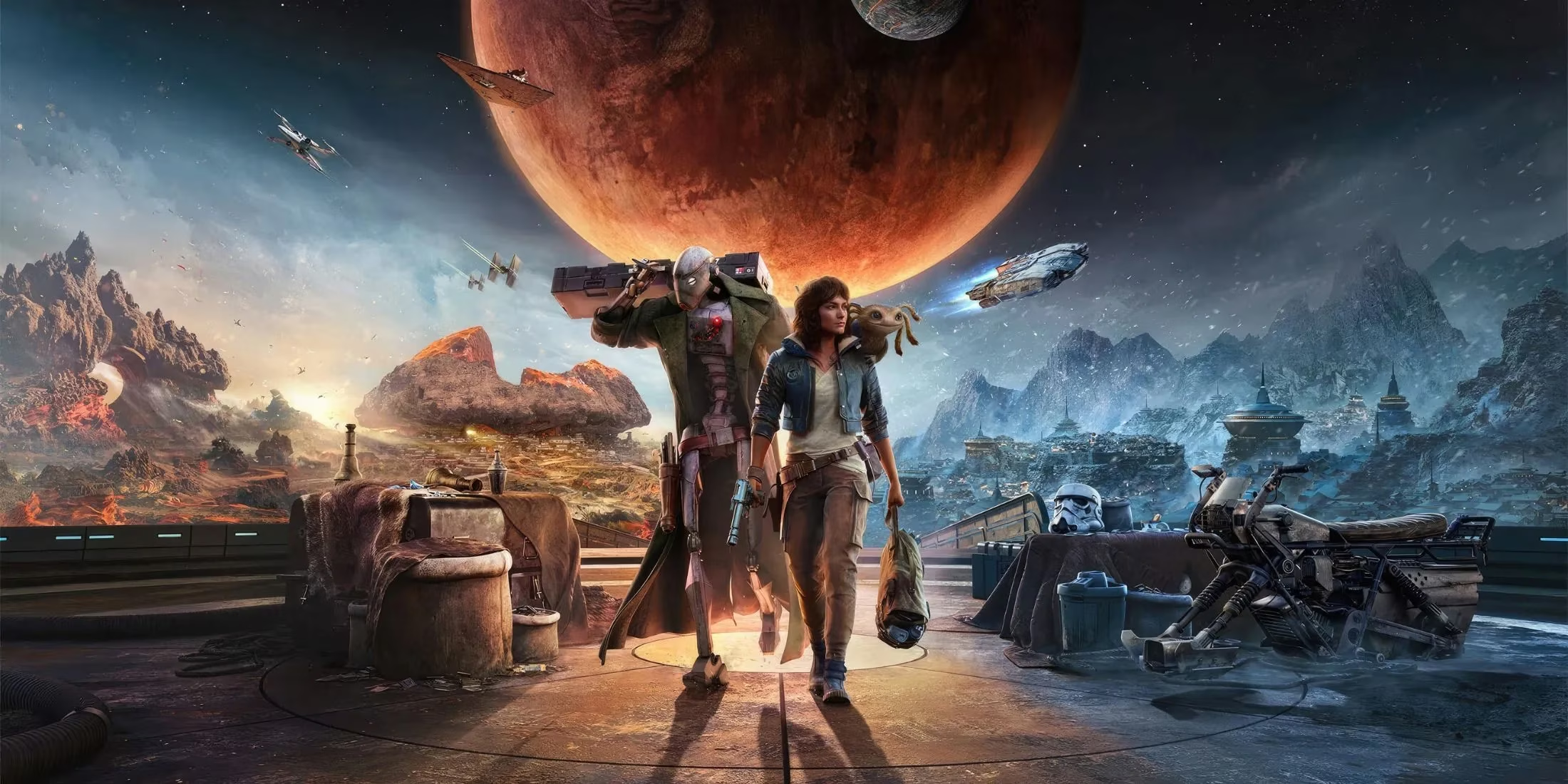
On August 27, 2024, Ubisoft began sending emails to a targeted group of PlayStation 5 players, instructing them to update the game to version 1.000.002 immediately. The message carried an unnerving ultimatum. Players who failed to apply the patch would face "progression blockers," and more importantly, they were told to completely wipe their saved data and start a new game. Only through a fresh beginning, the email argued, could they "fully enjoy Star Wars Outlaws as the team intended." The wording left little room for negotiation, but for many deeply immersed explorers, the cost was already steep.
⏳ The Early Access Dilemma
To understand the scale of frustration, one must recall the premium structure Ubisoft had established. The Standard Edition of Star Wars Outlaws was set to release on August 30, 2024. Those who purchased the Gold Edition not only gained the three-day head start but also secured the game's season pass. The Ultimate Edition piled on extra cosmetic items and a digital art book. These were the most dedicated fans—the ones willing to pay a premium to be first. For Ubisoft to tell them, less than a day into their adventure, that their evening’s exploits were effectively null was a bitter pill.
The incident highlighted a sharp disconnect between a developer’s technical necessity and the player’s lived experience. While the patch was engineered to eliminate a game-breaking bug in the previous build, the communication strategy fell flat. Many affected users discovered the mandate not through a system-level notification, but via an email that arrived while they were already deep into the scoundrel storyline. By the time they checked their inbox, they had accumulated several irreplaceable hours of progression.
😡 Player Outcry and the Fabio Vincent Case
One of the most vocal critiques came from Twitter user Fabio Vincent. He reported that when the update initially triggered, he had only played for about 30 minutes. No restart directive appeared at that point. He continued playing, unaware of the lurking requirement, and eventually racked up an additional four hours in-game. Only then did he discover that all his progress—scraped together through tense stealth sections, speeder chases, and emergent encounters with syndicates—would have to be sacrificed. His social media post became a rallying point, encapsulating the confusion and anger of a player base that felt left in the dark.
This wasn't a universal problem. Reports indicated that only a subset of PS5 users were affected, and no similar messages were circulated among PC or Xbox Series X|S players. For those spared, the launch was a smooth journey into a living galaxy. For the unfortunate few, the early access became a tutorial in disappointment. The hashtag #OutlawsRestart briefly trended within gaming circles, accompanied by screenshots of the email and snarky memes comparing the request to Alderaan being destroyed.
⏱️ A Silver Lining: The Game’s Length
Amid the backlash, one detail offered a glimmer of consolation. Star Wars Outlaws was not an Odyssey-sized epic that demanded hundreds of hours. Developers had indicated that the main story could be completed in approximately 25 hours, a relatively compact runtime by modern open-world standards. For players forced to restart, redoing five or six hours meant losing at most a quarter of the critical path. While still painful, it was a far cry from the despair of losing double-digit progress in a game like Assassin's Creed Valhalla.
Of course, completionists felt the sting more acutely. Side quests, optional syndicate missions, and the pursuit of every hidden treasure meant that many early access pioneers had already strayed far from the golden path. For them, the lost progress represented not just time, but also the organic storytelling moments that make first playthroughs magical—the chance meeting with a quirky NPC, the unplanned space skirmish that turned into a narrow escape. Those memories couldn't be reloaded.
🔧 Ubisoft’s Response and Long-Term Impact
In the days following the incident, Ubisoft issued a broader statement acknowledging the frustration. They emphasized that version 1.000.002 was critical to maintaining game stability and that the restart request was the only way to guarantee that the corrupted save states from the older build wouldn't propagate deeper issues later. The studio also pointed out that the fix was deployed rapidly—within hours of detecting the progression blocker—but conceded that the in-game messaging should have been more intrusive. A system-level prompt that forced a restart immediately, rather than relying on an email, would have spared many the double agony of playing unknowingly.
Looking back from 2026, the Star Wars Outlaws restart saga serves as a cautionary tale in live service communication. The industry has since evolved. Most major studios now implement mandatory in-game warnings that lock players out of further progression until a patch is applied and new game is started, avoiding the email disconnect entirely. The episode also fueled the ongoing debate about the value of early access programs. Are they a genuine reward for the most loyal customers, or simply a paid beta test where players absorb the most severe bugs?
For Star Wars Outlaws, the controversy faded relatively quickly. The game went on to receive positive reviews for its world-building, Kay Vess's character arc, and the seamless transitions between planetary exploration and space combat. By September 2024, the restart requirement was a distant memory for most, buried under an avalanche of new content and post-launch updates. Yet in forums and retrospectives, the incident remains a vivid reminder of how fragile the bond between a game and its earliest supporters can be.
🎮 Lessons for the Future
From a design perspective, the bug that prompted version 1.000.002 was never publicly detailed, but it was likely a quest-state corruption that could have blocked players from advancing past a crucial narrative gate. Such bugs are the nightmare of any development team, especially under the pressure of a fixed launch date. The decision to demand a full restart, while extreme, was a calculated one: a clean slate was safer than attempting to surgically repair individual saves.
Player patience, however, has its limits. The Star Wars brand carries enormous emotional weight, and fans expected a polished experience in return for their premium spend. When that trust was tested in the first hours, it sparked a wave of cynicism that echoed earlier Cyberpunk 2077 and Fallout 76 controversies, albeit on a smaller scale. The golden rule that emerged is simple: never let a player accumulate progress that you know you’ll have to erase. Real-time validation of save integrity upon login and transparent, unmissable instructions would have changed the narrative.
As the gaming landscape moves deeper into 2026, the Star Wars Outlaws restart episode is frequently cited in developer postmortems. It underscores the critical difference between a technical fix and a player-friendly fix. Technology solved the bug; only empathy could have solved the angst. And while the 25-hour main story meant that lost hours were never truly catastrophic, the sting of being told to let go of your first journey through the stars—after paying for the privilege—still resonates as a lesson in how not to launch a game.