Why I'm Tired of Gamers Complaining About 'Ugly' Female Characters
The tiresome discourse around Star Wars Outlaws protagonist Kay Vess's appearance exemplifies a persistent and predictable cycle of superficial criticism targeting female video game characters, overshadowing genuine discussions about gameplay and narrative.
As I sit here in 2026, scrolling through the usual gaming discourse, I can't help but feel like I'm watching a rerun of a particularly bad reality TV show—the plot never changes, but the cast of characters does. The latest episode? Star Wars Outlaws and the relentless, exhausting dissection of protagonist Kay Vess's appearance. Ubisoft Massive's upcoming open-world romp through the galaxy far, far away looks like a blast, a smuggler's sandbox I'm genuinely excited to dive into. Yet, a vocal corner of the internet seems more preoccupied with whether Kay's cheekbones are sharp enough to be deemed 'attractive' than with the game's actual mechanics or story. It's a debate that's as stale as month-old blue milk, and frankly, I'm over it.
This whole saga feels less like genuine criticism and more like a ritualistic tantrum thrown by a subset of gamers who view any female character not explicitly designed for their visual pleasure as a personal affront. It's a phenomenon that has become as predictable as a loot box in a mobile game. The pattern is painfully familiar:
-
A major game featuring a female lead is announced or shown.
-
A segment of the online 'anti-woke' brigade descends.
-
They hyper-analyze the character's face and body, comparing it to unrealistic ideals.
-
They declare the character 'ugly' and the game 'ruined by wokeness.'
-
Rinse and repeat.
We saw it with Aloy in Horizon Forbidden West. Gamers combed through screenshots of her face like forensic accountants auditing a tax return, criticizing her 'masculine' features and even the tiny, realistic hairs on her face—details that would be praised as graphical fidelity in a male character.
Then came the Fable reboot reveal, where the customizable female hero sparked another unjustified outrage cyclone. Apparently, her fantasy adventurer wasn't glamorous enough for the keyboard critics, who bombarded the trailer with complaints as if her cheekbone structure was a critical gameplay bug.
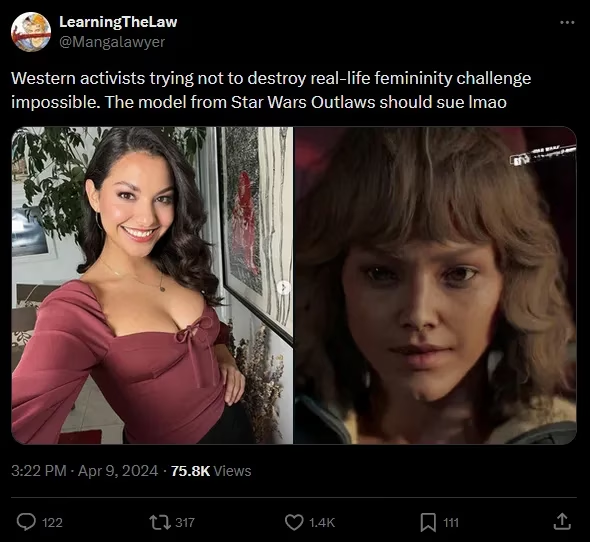
And now, here we are with Kay Vess. The criticism this time has a particularly flimsy veneer of 'logic': people are upset because Kay's in-game model doesn't look exactly like the actress she's modeled after, Humberly González. To me, this argument holds as much water as a colander. Video game characters based on actors are almost never 1:1 replicas. They're interpretations! Martin Sheen's Illusive Man in Mass Effect 2 is recognizably him, but also clearly a stylized, otherworldly figure. Sam Witwer's Deacon St. John in Days Gone shares his likeness but is altered to fit the grimy, post-apocalyptic world. This is standard practice! It's like complaining that a portrait painting isn't a perfect photograph.
What's truly baffling, and honestly a bit pathetic, is the complete lack of context these critics apply. Let's break down the job descriptions of these so-called 'unattractive' heroes:
| Character | Game | Primary Occupation | Likely Beauty Routine |
|---|---|---|---|
| Kay Vess | Star Wars Outlaws | Smuggler & Outlaw | Avoiding Imperial patrols, fixing hyperdrives, maybe wiping engine grease off her face. |
| Aloy | Horizon series | Tribal Hunter & Savior of the World | Tracking massive robot dinosaurs, climbing ancient ruins, surviving in the wilderness. |
| Fable Hero | Fable | Magical Adventurer | Fighting balverines, buying property, getting haircuts (maybe). |
In what universe are any of these professions ones where looking like a supermodel is a job requirement? Kay is a scruffy outlaw living on the fringe of society; her concerns are credits and survival, not contouring. Aloy spends her days in a post-apocalyptic wilderness. The idea that she should have perfectly smooth skin and full makeup is as absurd as expecting a Space Marine to worry about his skincare regimen.
The most ironic part? Most of these characters are still conventionally attractive by mainstream standards! The edits some gamers make to 'fix' them, slapping on layers of makeup and softening features, don't make them look more 'real' or 'better'—they make them look like porcelain dolls who've never seen a day of hardship in their lives. It reveals the criticism for what it is: not a demand for realism, but a demand for conformity to a very specific, male-centric fantasy.
This whole circus is as embarrassing as it is sexist. It reinforces the tired, damaging stereotype that women in games exist primarily as decoration, their worth tied to their appeal to a presumed male audience. It tells female gamers that their heroes need to be approved by a committee of strangers online before they're deemed 'acceptable.' It's a mindset that's as outdated as a dial-up modem.
I love video games. I believe they can be profound, moving, and inclusive art. But this constant background noise of toxicity over female character designs is like a grating, unskippable cutscene that plays on loop. It's a desperate, immature display that, frankly, makes our community look bad. In 2026, we should be celebrating diverse and interesting characters, not picking them apart based on the most superficial criteria imaginable. Kay Vess is a smuggler with a blaster and a speeder bike—let's talk about her adventures, not her cheekbones. The galaxy's underbelly awaits, and it doesn't care how 'pretty' you think its inhabitants are.